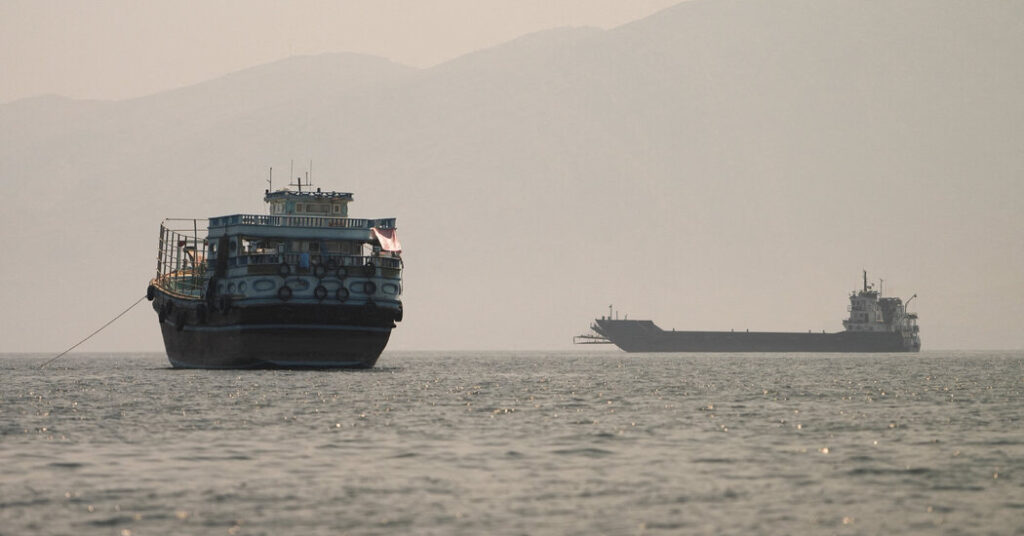
A United Nations agency said on Tuesday that it had started a plan to evacuate the hundreds of ships and thousands of mariners that became stranded in the Persian Gulf during the U.S.-Israeli war against Iran.
The International Maritime Organization said the operation to move vessels through the Strait of Hormuz would be carried out in cooperation with the United States, Oman and Iran, among other Gulf states.
“We have secured the necessary safety guarantees and have thoroughly verified the conditions for safe navigation to support these operations,” Arsenio Dominguez, secretary-general of the I.M.O., said in a statement.
The number of ships leaving the strait has picked up as Iran and the United States began negotiations to try to forge a long-term peace deal, but the traffic is still below prewar levels. The I.M.O. said as many 600 ships were still stuck in the Gulf.
Iran attacked commercial vessels during the war, deterring shipping companies from passing through the strait. They have idled in the Gulf with their crews aboard for more than three months. Even as the war wound down in recent weeks, many ship operators stayed in the Persian Gulf, waiting for a clear signal that it was safe to go through the strait.
Michelle Wiese Bockmann, an analyst with Windward, a maritime intelligence firm, said the evacuation plan would be “most welcome for those stranded vessels yet to exit because of safety and security risks.”
A spokeswoman for the I.M.O. said that it had started contacting ships to start the evacuation.
Oman’s defense ministry said on Tuesday that the evacuating ships should follow a route that runs close to the country’s coastline. For weeks, the U.S. military has been coordinating the passage of ships along those routes.
Mr. Dominguez said 11,000 crew members had been stranded in the Gulf where, he said, they had suffered “months of hardship and distress.” According to the I.M.O., 46 ships were attacked during the war and 14 sailors killed.
The shipping industry wants a return to prewar arrangements in the strait, through which a fifth of the world’s oil and a significant share of its natural gas were transported before the conflict. Before the war, ships paid no feels or tolls to go through.
In the memorandum of understanding that Iran and the United States signed last week, Iran said vessels could go through the strait with no charge for 60 days. But Iran has taken steps that suggest it will try to charge vessels using the waterway.
Commenting Tuesday on the talks with Iran, U.S. secretary of state, Marco Rubio, said, “No country is allowed to charge tolls or fees on an international waterway.”
Jenny Gross contributed reporting.
The post U.N. Sets Plan to Evacuate Stranded Ships Out of Persian Gulf appeared first on New York Times.