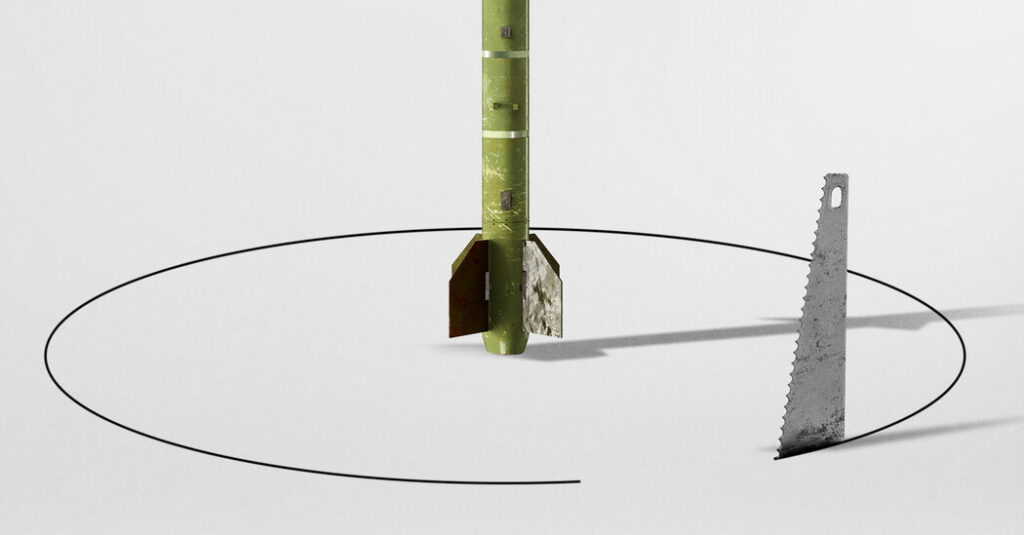
With Iran, Donald Trump has done the impossible once more. In attacking that country in February, he went where his predecessors never dared, joining with Israel in a bid to overthrow or incapacitate the regime in Tehran. Having achieved neither, he appears to have accepted worse terms than he could have obtained through diplomacy. His war was a political albatross as well, garnering, at the start, less support from the public than any other major conflict in modern U.S. history.
Now the hawks who were exhilarated by Operation Epic Fury are apoplectic at Mr. Trump for ending the conflict. The doves won’t forgive him for starting it. Everyone is worse off and no one is happy: a fitting, extraordinary finish to a Trumpian war.
In its broad contours, however, the result is familiar, verging on routine. True to form, the United States launched a regime-change war in the Middle East. It targeted an adversary that members of both parties have long treated as a near-existential threat. And again, only faster this time, the effort came to grief. The question now is whether the cycle of ineffectual American intervention has been broken, or simply taken another turn. If the serial disasters of previous wars didn’t keep this one from happening, why would even the conspicuous failure of this one prevent the next?
It very well may not; the risk of renewed conflict looms. But in important respects this war is unlike any other, starting with the person who launched it. Mr. Trump was the hard-liners’ best hope. He took his best shot at Tehran and came up short.
The unnecessary, unjustified and unlawful war that followed convulsed the region, battered the global economy and exasperated the American public. And yet it may bequeath an accidental gift: a lasting aversion to military conflict with Iran and a chance to replace decades of failed policy with serious diplomacy.
The first factor is Mr. Trump himself. Barack Obama, who sought to engage Iran from the outset of his presidency, faced constant opposition from Republicans and many Democrats, wounding his nuclear deal. Mr. Trump tore it up three years later, and he has now become the instigator and loudest champion of a brutal war, the father of its failure and, one hopes, the bringer of peace. Think Nixon going to China — if Nixon had bombed China first.
No president has ever had more latitude to come to terms with the Islamic Republic, should he so choose. The administration’s deal has been mocked but not truly contested by the left, which wants the fighting to end. Washington’s Iran hawks scream, but having alienated Democrats long ago, they risk winding up politically homeless if they fully break with Mr. Trump. Nor can they easily separate themselves from the president. They applauded him for wrecking the Obama nuclear agreement and thrilled at his turn toward war just months ago. At this point, they can only hope that Mr. Trump fails to reach a broader nuclear accord so they can pressure him to return to war with even grander objectives.
They may succeed, of course. Mr. Trump could not be more erratic; translating his ambiguous “memorandum of understanding” with Iran into a detailed agreement poses a daunting challenge; and, in violation of his own deal, he almost immediately, and has since persistently, threatened to resume bombing should Iran’s behavior displease him. Still, for Mr. Trump, the use of enormous force against Iran is no longer a tantalizing option about which he can fantasize, but a bruising experience from which he had to retreat. The war he imagined delivered swift glory. The war he got was born unpopular and is dying an orphan.
If even a tenuous and hostile truce holds through the remainder of Mr. Trump’s term, then his successors, too, will know the price of war. They will have seen that the United States rapidly depleted enormous quantities of high-end munitions, needed in Europe and Asia, while failing to eliminate Iran’s missiles and drones. That Iran swiftly took control of the Strait of Hormuz, inflicting unmistakable costs on ordinary Americans, while the United States lacked the military options to force the strait open. That after all the bombs fell, the future of Tehran’s nuclear program still could be addressed only through negotiations, with a regime that emerged emboldened, vindicated and victorious. Future presidents will remember, in short, that the war was counterproductive on its own terms and came at the expense of every other foreign and domestic priority.
They are also less likely to be taken in by those who cheered this misadventure. For years, critics of the Obama nuclear accord claimed that all they wanted was a “better deal,” accomplished through pressure but not violence. Today they stand exposed, after lining up behind a major attack that was launched by a proudly improvisational president in the absence of any looming threat and that yielded a deal they cannot defend. Going forward, their promises of cost-free coercion will sound like what they are: a drumbeat for war.
This conflict also has strained the regional order that brought the United States and Iran to the brink many times before. For decades, Washington has purposely enmeshed itself in security arrangements that divide the Middle East sharply into friends and foes. The first pillar is America’s special relationship with Israel. Washington’s grievances with Tehran run deep, but the vehemence of its hostility toward Iran — and its willingness to resort to force — owes much to its unique commitment to Israel, which sees the Islamic Republic’s missile and drone arsenal, regional proxies and nuclear ambitions as direct and existential threats.
Now, however, America’s partnership with Israel is under unparalleled strain. The war’s arc is telling. What began as the closest, most integrated U.S.-Israeli military campaign in history ended with an American leader publicly rebuking his Israeli counterpart in the harshest terms, criticizing his “vicious” bellicosity in Lebanon and accusing him of jeopardizing a deal with Iran.
This comes on top of a sharp shift in U.S. opinion: 60 percent of American adults hold a negative view of Israel, up from 42 percent in 2022, not least because they see a widening gap between Israeli behavior and U.S. interests. Many believe Prime Minister Benjamin Netanyahu bamboozled Mr. Trump into war with talk of swift and easy victory, and then engaged in repeated escalations to block any offramp. Mr. Netanyahu, too, has shot his shot, and his entreaties to resume hostilities are likely to encounter greater resistance in America.
The U.S. backlash against Israel could abate. If Mr. Netanyahu loses the parliamentary election that is to be held in several months, many in Washington will sigh in relief and hope the bilateral relationship reverts to its norm. A future Israeli government, more pragmatic than its predecessor, yet no less alarmed by Iran’s behavior and equally determined to counter it, might devise its own plans for military action and hope to rehabilitate its influence in America. But after the war in Gaza, after Iran, after criticism of U.S. support for Israel has morphed into a grass-roots issue that resonates from left to right, the task will be tall.
The second pillar of America’s regional order is its military footprint in the Persian Gulf: a network of bases meant to project U.S. power and protect Arab states but that Tehran regarded as both genuine threat and plum target. The result has been a self-reinforcing system in which partnerships meant to deter conflict aggravated it and in which America, purporting to be guardian of the peace, became a central belligerent in war.
The Iran war has physically degraded that system. Tehran reportedly damaged at least 20 U.S. military sites across the region, knocking out missile defense systems, aircraft and other infrastructure. Washington must confront the fact that its network of bases created vulnerability, not security, for itself and its partners. Gulf states learned a harsher lesson: that, in their hour of need, the United States prioritized its own and Israel’s interests, leaving them exposed to Iranian retaliation for a war they did not want and had little part in shaping.
Potentially more consequential than the material damage, then, is the blow to the rationale for America’s regional role. Gulf monarchies won’t sever security ties with Washington, but both sides have reason to ask whether the vast American military footprint in the Middle East is part of the problem it was supposed to solve, and whether they wouldn’t be better off building a regional equilibrium that does not so heavily rely on promises of American protection.
America’s turn away from war is incipient and fragile. The tendency still exists to view Iran as the root cause of all that bedevils the Middle East and exaggerate the threat it represents, enable and underwrite Israel’s aggressive solutions and equate America’s interests with its military presence in the Gulf. So long as these conditions persist, Mr. Trump or his successors may again resort to military force.
Those opposed to yesterday’s Iran war have a stake in preventing tomorrow’s, to break the entanglement of the United States in conflicts it regrets more quickly and more intensely the more they keep happening. This mission is hardly impossible. Military defeat — which is what the United States just suffered — has repeatedly compelled Americans to re-evaluate the severity of a threat they could not eliminate.
Five decades ago, the United States left Vietnam to the Communists and discovered that dominoes did not fall. Five years ago, it departed Afghanistan and learned to distinguish the victorious Taliban from Al Qaeda and ISIS. Confronting the true toll of war prompted Americans to ask whether the threat had been inflated all along.
Iran, by all rights, should not be one of America’s top problems. One day, one way or another, it will cease to be. The question is when, and at how terrible a price.
Robert Malley, the special envoy for Iran from 2021 to 2023, is president emeritus and Middle East program director at the International Crisis Group and a lecturer at Yale University’s Jackson School. Stephen Wertheim is a senior fellow in the American statecraft program at the Carnegie Endowment for International Peace and a visiting lecturer at Yale Law School. He is the author of “Tomorrow, the World: The Birth of U.S. Global Supremacy.”
Source images by Wirestock and tiero/Getty Images
The Times is committed to publishing a diversity of letters to the editor. We’d like to hear what you think about this or any of our articles. Here are some tips. And here’s our email: [email protected].
Follow the New York Times Opinion section on Facebook, Instagram, TikTok, Bluesky, WhatsApp and Threads.
The post Trump’s Iran Debacle Could Be a Gift for America appeared first on New York Times.