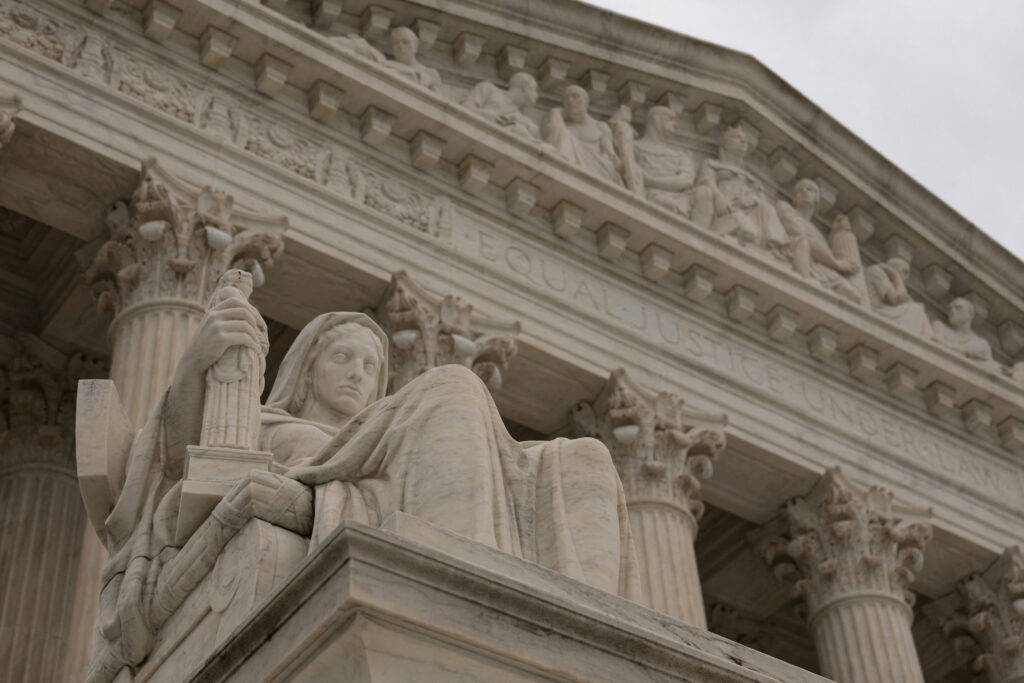
The Supreme Court on Tuesday ruled a Rastafarian can’t pursue a lawsuit against prison officials who forcibly sheared his dreadlocks in violation of a court order while he was incarcerated at a facility in Louisiana.
In a 6-3 ruling along ideological lines, the justices found Damon Landor could not sue prison officials as individuals under a 2000 federal law that requires states to protect the religious rights of prisoners in state institutions.
Landor chose to sue the prison officials individually because the high court had previously found sovereign immunity barred inmates from bringing such suits against states or prisons.
Justice Neil M. Gorsuch, who wrote the majority opinion, found prison officials could not be held personally liable in most instances for violations of religious rights under the Religious Land Use and Institutionalized Persons Act (RLUIPA). The ruling centered on the technicalities of the law.
“Under the Spending Clause, Congress lacks regulatory authority to impose liability on them directly and must depend instead on consent,” Gorsuch wrote of the prison officials. “And because they never agreed to answer suits like this one, Mr. Landor’s case cannot proceed against them any more than a breach of contract action might proceed against a defendant who never formed a contract.”
The ruling came over the objections of the court’s liberals, who said the court had barred any remedy for a violation of RLUIPA, rendering it toothless.
“Prisoners like Landor who suffer violations of their religious freedom in state prisons — no matter how blatant — will often be left remediless,” Justice Ketanji Brown Jackson wrote for the liberals. “And encroachments on prisoners’ statutory rights are likely to happen with fair frequency, as state-empowered prison officials will have little incentive to abide by federal law, even if it is handed to them on a piece of paper.”
She added: “We took this case to address whether Landor can seek money damages from the officials who ignored the law, held him down, and ‘uncrowned him before God.’”
The ruling dealt with the question of who can be held liable under the RLUIPA but departed from a series of decisions by the Supreme Court expanding religious freedoms in recent terms, including allowing religious parents to opt their children out of lessons featuring LGBTQ+ books, permitting a football coach to pray on a field at a public high school and protecting a Christian web designer who did not want to serve same-sex couples.
That trend has pushed up against another set of court decisions limiting the ability of prisoners to obtain compensation for ill treatment in custody.
Landor’s case began in 2020, when he arrived at the Raymond Laborde Correctional Center to serve out a term for drug possession. The two previous facilities in which Landor was incarcerated allowed him to keep his dreadlocks, a symbol of his religious devotion that he had grown for roughly 20 years and that reached nearly to his knees.
At Laborde, Landor told a prison guard about his faith and presented him a copy of a court decision that found RLUIPA prevented Louisiana prisons from forcing Rastafarians to cut their hair.
The guard threw the ruling in the trash.
Despite pleading with the warden, Landor was handcuffed to a chair and held down by two correctional officers, who trimmed his dreadlocks. Landor was devastated because lengthy dreadlocks are seen as a physical embodiment of Rastafarians’ religious commitment to God.
After Landor finished his term, he sued under RLUIPA. He also filed claims in state court for negligence, infliction of emotional distress and violation of the Louisiana Constitution.
Congress enacted RLUIPA under the Constitution’s spending clause, requiring state corrections departments to comply with the law’s provisions in order to receive federal money. The law includes a provision that allows individuals to sue to enforce the law’s requirements.
Landor’s case raised the issue of whether the law also allows people to sue prison officials for damages in their personal capacity. In 2011, the Supreme Court ruled it did not authorize claims against state prison officials in their official capacities, so the one remaining avenue for Landor to collect damages in federal court for his treatment was to sue officials personally.
Zack Tripp, an attorney for Landor, said in a statement that allowing suits such as Landor’s would have been an effective deterrent to prevent the abuse of prisoners’ rights.
“It means that inmates whose religious rights are violated by state prison officials will have no damages remedy no matter how egregious the wrong,” Tripp said.
In filings, Landor’s lawyers also pointed out that the Supreme Court held in 2020 that a “sister statute” of RLUIPA, employing the same language, does allow a plaintiff to sue a government official in his or her individual capacity for damages for religious discrimination.
The Louisiana attorney general and Department of Public Safety and Corrections wrote in briefs that the state “condemns” in “the strongest possible terms” what happened to Landor. They said they have changed grooming policy in response to the incident.
The state argued that allowing suits for damages, however, could open the door to lawsuits being filed against individual government officials in other areas of federal law, such as Title IX, the landmark statute that prohibits sex discrimination in education.
A federal judge and an appeals court ruled against Landor, finding the law did not allow him to sue officials for damages in their individual capacities. All other federal courts that have examined the issue have come to the same conclusion.
Landor is still able to pursue his claims in state court.
The post Supreme Court says Rastafarian can’t sue prison officials over shorn dreadlocks appeared first on Washington Post.