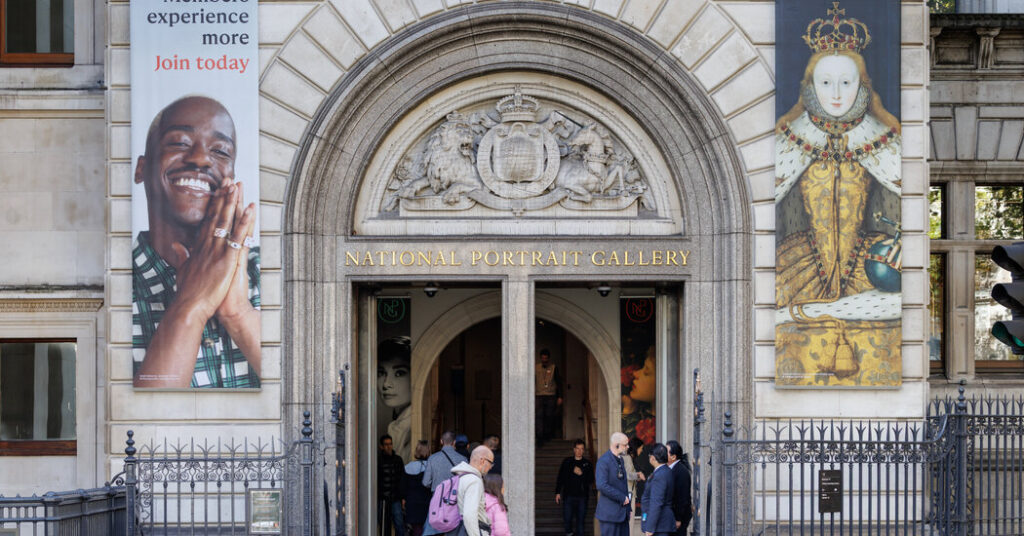
An artist has withdrawn a video installation from the National Portrait Gallery in London that blamed Winston Churchill for a famine in colonial-era India, after a historian and others complained that its characterization of Churchill’s role was inaccurate.
In the video, titled “Persistence,” the artist Helen Cammock, who narrates the work, compares Churchill to Oliver Cromwell, a commander during the British Civil Wars of the mid-1600s. She says in the video that her opinion of Cromwell changed after she learned that he had “starved people, en masse, a little like the willful starvation of the Indian population by Winston Churchill.”
Andrew Roberts, an English historian who wrote a biography of Churchill, sent the museum an open letter on June 16, signed by more than 50 current and former members of the House of Lords, including Nicholas Soames, a grandson of Churchill. The letter calls the video “an ideologically motivated rant” and “historically ludicrous.”
Mr. Roberts also accused Ms. Cammock, who in 2019 won the Turner Prize, Britain’s most prestigious visual arts award, of denigrating “someone who many believe to be our greatest Briton.”
In a statement, the museum described the artwork as “a reflection piece conceived as a first-person narrative” and that it was presented “as an artistic piece, not a documentary.” The film focused on representation of a wide range of groups and individuals in history and explored multiple historical narratives with a cast of real and imaginary characters. The museum said there was only one reference to Churchill in the 38-minute video.
The National Portrait Gallery said that Ms. Cammock had made the decision to withdraw the work on Monday, and that the views expressed in the film did not necessarily reflect those of the museum. It said that it respected both Ms. Cammock’s decision and the opinions of those who objected to her work.
A representative for Ms. Cammock directed questions about the matter to the National Portrait Gallery, which shared a separate statement by the artist. In it, Ms. Cammock said that the work, which had been on display at the museum for nearly a year, was developed with the portrait gallery and involved research in the museum’s archive.
“It asks us to think about who is honored and valorized and who is not,” she wrote.
The Bengal famine in 1943, in the final years of India’s rule by Britain, killed some three million people, and for decades academics have fiercely debated the role played by Churchill, who was Britain’s prime minister at the time.
The starvation in Bengal was not the result of an inadequate food supply, according to the Nobel Prize-winning economist Amartya Sen, who has studied famines and who experienced the Bengal famine as a child. Mr. Sen argued that a spike in food prices, brought on by Britain’s huge expenditures to fight Japan during World War II, led to many poor rural people going hungry.
Some scholars have argued that Churchill’s policies contributed significantly to the famine. Madhusree Mukerjee, a writer and physicist who is an outspoken critic of Churchill’s wartime administration, asserted in a 2010 book that the British government was repeatedly warned that its policies could lead to famine in India, but continued to export rice from there.
Other scholars, including Mr. Roberts, argue that the famine was caused mainly by a typhoon and the wartime destruction of supply lines. They say that once the Churchill administration became fully aware of the famine, it sent tens of thousands of tons of grain to India.
In her statement, Ms. Cammock said that there was “incredible pressure on artists and arts institutions” to bend to external pressures. She argued that challenging historical narratives was “vital to a healthy society.”
The post Artist Pulls Work From London Museum After Clash Over Churchill’s Legacy appeared first on New York Times.