FORT WORTH — Federal judges in Texas on Tuesday gave eight members of an alleged “antifa cell” prison sentences as long as 100 years for their roles last summer in a protest that turned violent outside an Immigration and Customs Enforcement facility.
Benjamin Song, a former Marine reservist who was convicted this year of attempted murder for shooting a police officer outside the Prairieland Detention Center in Alvarado, Texas, received 100 years. The other seven defendants were given prison terms between 30 and 70 years for a variety of charges such as rioting, providing support to terrorists, conspiracy to use and carry explosives, and conspiracy to corruptly conceal documents. Only Song was convicted of attempted murder.
The landmark case has been praised as a victory by Trump administration officials as they crack down on left-wing protesters. The sentences come a week after the Justice Department filed charges against 15 people in Minneapolis who prosecutors allege belonged to antifa groups that conspired to obstruct and attack immigration agents earlier this year.
The investigations stem from the National Security Presidential Memorandum-7, which President Donald Trump issued after the killing of conservative activist Charlie Kirk in September. The memo defined antifa as a “domestic terrorist organization” and directed the Justice Department to “investigate and disrupt networks, entities and organizations that foment political violence.”
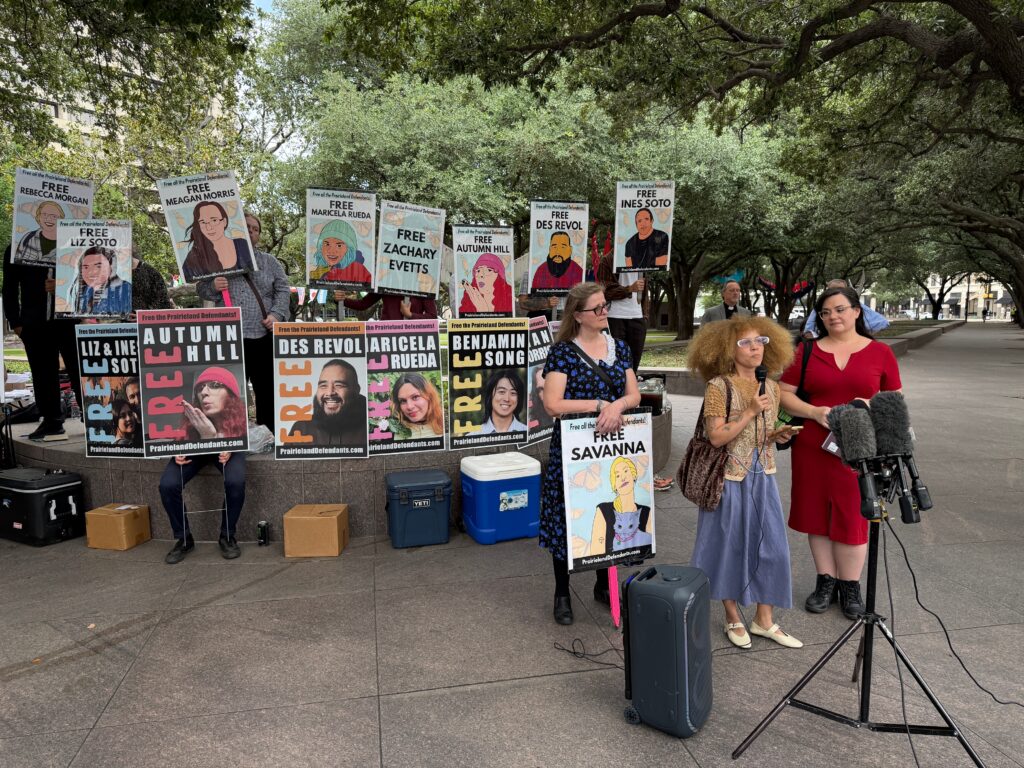
The other defendants in the Prairieland trial, which ended in mid-March, include Savanna Batten; Zachary Evetts; Autumn Hill; Meagan Morris; Maricela Rueda; Daniel Sanchez Estrada; and a couple, Elizabeth and Ines Soto. Ines Soto is scheduled for sentencing July 1. Batten, Morris, Hill, Elizabeth Soto and Evetts received 50 years each. Sanchez Estrada received a 30-year sentence, and Rueda, his wife, received 70 years.
Attorneys for the defendants — who include a middle school teacher, a college student, a mechanical engineer and a UPS worker — have said they are appealing the convictions.
Federal prosecutors declined to comment after the sentencings, which took place simultaneously in two courtrooms belonging to U.S. District Judge Mark Pittman and U.S. District Judge Reed O’Connor.
Assistant U.S. Attorney Shawn Smith argued at trial that the defendants, led by Song, plotted the attack by arming themselves, wearing all-black clothing known as “black bloc” to conceal their identities and hiding their phones in bags to prevent police from tracking them — all “antifa tactics,” he said.
Defense attorneys said during the trial that the case was politically motivated and the evidence slim. Defendants who were armed had obtained their guns legally, they noted. Pamphlets, zines and books seized from the accused were also legal, evidence of the group’s shared political beliefs, not membership in an organized group, attorneys said. They said the defendants’ chat messages displayed at trial showed they had planned a peaceful demonstration, not a violent attack.
Short for “anti-fascist,” antifa is a loosely knit movement of far-left activists — often anti-capitalist or anti-state — who oppose fascism and other right-wing ideologies.
Prairieland prosecutors defined antifa in court filings as “a militant enterprise made up of networks of individuals and small groups, primarily ascribing to a revolutionary anarchist or autonomous Marxist ideology, which explicitly calls for the overthrow of the United States government, law enforcement authorities and the system of law.”
During the trial, prosecutors walked jurors through the events at the ICE facility in Alvarado that led to the charges: A group arrived late on July 4 and began spray-painting anti-police graffiti, slashing tires, destroying a surveillance camera and setting off fireworks at the building. Officers inside called local police.
Alvarado Police Lt. Thomas Gross arrived just before 11 p.m. Song yelled, “Get to the rifles!” then allegedly started shooting his AR-15-style rifle with a modified trigger that increased the rate of fire, investigators said.
Gross, who did not testify or appear at the sentencing, testified at trial that he felt ambushed. A bullet passed through his shoulder and out of his neck, narrowly missing his spine, he said.
Several AR-style rifles were found at the scene, according to the criminal complaint, and some defendants were armed, wearing body armor and carrying two-way radios. No one else fired a weapon.
Patrick McLain, Evetts’s attorney, decried what he called the politicization of the prosecution. “MAGA made a statement today by these sentences,” he said after the sentencing.
Outside the courthouse, Song’s mother read a statement her son had attempted to share with the court before being interrupted by Pittman, who admonished him not to make “political statements” or deliver a “history lesson.”
In the statement, Song said he opposed fascism but insisted he was not a member of an antifa group, and that antifa is not a group.
“He has accepted full responsibility,” Hope Song said. “But he will never accept responsibility for a lie … which they are using to prosecute people all across the country for domestic terrorism.”
Razzan Nakhlawi contributed to this report.
The post Alleged antifa members in Texas are sentenced for ICE protest appeared first on Washington Post.