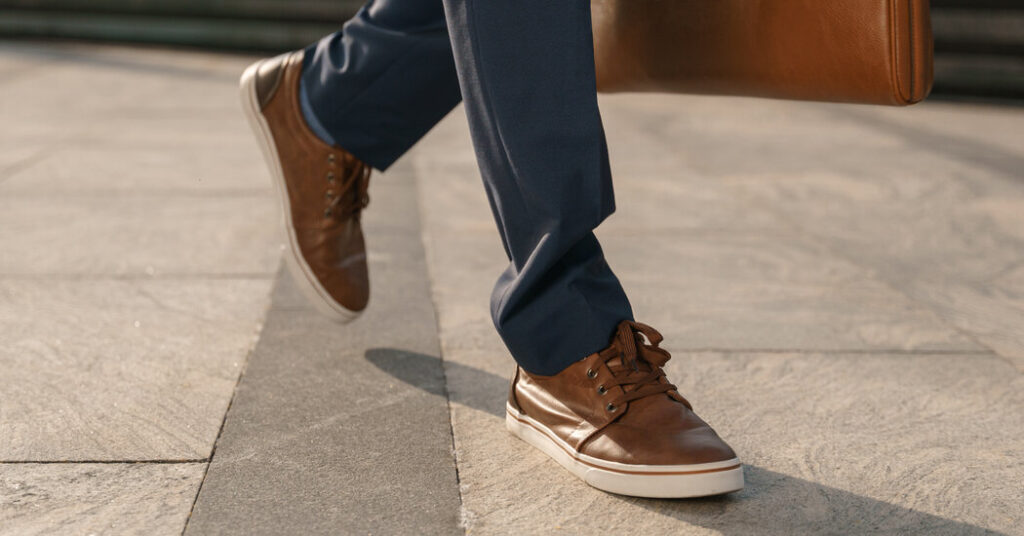
Would you please explain the history of how white-soled dress sneakers became standard men’s wear? l have seen them paired with the business casual dress of my sons and nephews in the Northwest and on well-tailored European 20- through 60-something businessmen. What’s going on? — Nathan, Seattle
The dress sneaker, that item of footwear (or Frankenstein monster of a shoe, depending on your point of view) that combines the rubber sole of a trainer with the leather upper of a lace-up, has become one of the defining styles of our times.
It is the evolutionary product of the rise of casual Friday, stealth wealth and comfort dressing. And unlike the snoafer or the sneakerina or the smule (or any other attempts at hybrid footwear, which generally end up making everything into a sneaker), it has successfully made the leap from novelty shoe to wardrobe staple.
Hakeem Jeffries wore his dress sneakers to an Oval Office meeting with President Joe Biden; Ben Stiller wore them to the New York Film Festival and courtside to cheer on the Knicks; and Kieran Culkin wore them as Roman Roy in “Succession.” Tim Cook posed in his favorites — the Zegna Triple Stitch — for the cover of the Time 100 in 2022, and Business Insider crowned those “Wall Street’s hottest footwear” last year.
Dress sneakers have become so ubiquitous among the executive set that many private clubs with old-fashioned dress codes have expanded their rules to accept members in white-soled shoes with leather uppers, even as they still expressly forbid traditional sneakers.
Which is, of course, the whole point of the style. It allows the wearers to have their footwear comfort and polish, too. It says, “I’m serious, but I’m also up for some pickup basketball on the side.” It says, “I’m respectful, but I’m not a boring old suit stuck in a passé dress code.” At least that is the theory.
It has taken a long time to develop.
“For most of the 20th century, men wore hard-bottom dress shoes to the office, most often in black calfskin,” said Derek Guy, a men’s wear historian who writes the men’s wear column Die, Workwear! Loafers crept in in the late 1960s, but, Guy said, “the casualization process generally stopped at sneakers.” At least until the turn of the millennium.
While it is hard to determine who actually invented the dress sneaker, Guy traces it to the Achilles Low made by Common Projects and released in 2004. They were, Guy said, “all white, minimally branded, Italian-made low-tops with an exorbitant price tag, which helped position them as status symbols.”
Gradually, brands at all levels of the markets got in on the game, including Allen Edmonds and Wolf & Shepherd, and luxury labels like Tom Ford, Loro Piana and Cole Haan. (The Cole Haan versions are the ones Roman Roy wore.) Wolf & Shepherd even had the N.B.A. Hall of Famer Steve Nash playing basketball in its “dress sneakers.”
“Eventually, dress sneakers started appearing on ESPN sports commentators,” Guy said. Then Silicon Valley embraced them as a way to signal that the “move fast and break things” founders had reached a (slightly) more professional stage of business. From there, it was but a short jump to the wardrobes of the bankers who loved them — or at least their valuations — and wanted to demonstrate like-mindedness.
Which may be a reason that, as social media and its covert addictive strategies are literally, and increasingly, put on trial, the association may be losing its appeal — along with its symbolic shoe. While it offers the appearance of executive dress, the reality is a little less buttoned-up, and that discrepancy between pretense and reality suddenly seems telling.
My colleague Andrew Ross Sorkin, the editor of the DealBook newsletter at The New York Times and the author of “1929,” who is known to wear dress sneakers, thinks “the loafer is making a comeback” among the Wall Street set when it comes to what they wear with their suits — at least according to his anecdotal observations.
“This may be a belated post-pandemic rebound,” Sorkin said. It could also be a reaction to current fears about unemployment and the need to look as if you take your job seriously.
Or perhaps it is simply an acknowledgment that, as Guy said, the dress sneaker is sort of the footwear equivalent of “T-shirts with a tuxedo printed on them.” In other words: a kind of kitschy middle ground. In shoes, as in life, it may be time to commit.
Your Style Questions, Answered
Every week Vanessa will answer a reader’s fashion-related question, which you can send to her anytime via email or on X. Questions are edited and condensed.
The post Why Are Dress Sneakers Everywhere? appeared first on New York Times.