WALTHAM, Mass. — The idea was crazy, Ryan Gaffey thought. Impossible.
France, a two-time World Cup champion and finalist in 2022 and 2006, was considering making Bentley University, where Gaffey is the campus grounds manager, its training site for the upcoming tournament.
The problem: It was March in New England, with snow on the ground and winter’s grip still tenacious. The soccer field was torn up from a fall collegiate season that had lasted past Thanksgiving.
Now Gaffey and his two-man crew would have less than three months to prepare grass good enough for the French team.
“I knew we would have to jump on it,” said Gaffey, 48. His attitude from that point onward: “We gotta go, gotta go now.”
Bentley, a small university about 25 miles outside Boston, was a last-minute addition to the roster of the 48 World Cup training camps across the United States, Canada and Mexico. The venues include university fields, private high school pitches, professional training centers and sports-minded resorts.
The training camps are old-school: natural grass holdouts in an era of artificial turf. They’re also where each team will spend the most time playing during the tournament. France, ranked second in the world and a team in which even the substitute players are stars, hopes to keep practicing at Bentley for more than five weeks, right up to the July 19 final.
For Gaffey and his two field specialists, Frank Morgan and Axel Acosta, it was a challenge unlike any other. They counted the days until the French team’s arrival and pored over forecasts. They worked 12-hour days, sometimes seven days a week. And when the team finally came this month, Gaffey and his crew held their collective breath. Acosta knew it didn’t always work out: Japan ditched a practice venue in Mexico this month when it wasn’t up to its standards.
This was a chance for the Bentley grounds crew to perform at a different level. “I’m not going to say it’s a turf manager’s dream,” said Vaughn Williams, Bentley’s athletic director. But getting the field ready “was kind of their Super Bowl.”
Gaffey’s background was in golf, as was Morgan’s. Only Acosta was a soccer fan. He was also a veteran of the grounds crew at Boston’s Fenway Park, so he knew what it took to maintain natural grass to professional standards: a 45-person staff, a 24-hour presence, preferably an unlimited budget.
When France won the 2018 World Cup, Acosta watched the match from the break room at Fenway. So he couldn’t quite believe his eyes on March 25 when France’s legendary head coach, Didier Deschamps, walked out onto the field at Bentley for a site visit with about a dozen other team staffers, their blue uniforms vibrant against the barren trees.
Deschamps had a question for Gaffey. Did he think the current condition of the field was acceptable? Gaffey suspected Deschamps was testing him. Absolutely not, Gaffey responded. It’s pretty good for New England in March, he said, but not for June, when you guys will get here. Deschamps grinned and shook his hand.
The French had barely said their farewells before Gaffey was on the phone with two vendors, Sports Turf Specialties, a grass supplier, and Tom Irwin Inc., a fertilizer firm. He knew he and his crew had no time to lose. They began by seeding the field with several types of Kentucky bluegrass (a variety that “can hold up to abuse,” Gaffey said), along with ryegrass and fescue.
Two weeks later, they added a top dressing of sand, which protects the crown of the plants, followed later by an aeration — punching small holes in the soil to allow air and water to reach the roots. Then another heavier top dressing, another seeding.
To nurture growth on the most beat-up parts of the field, they tried something new: turf blankets. Over the course of the day, Morgan and Acosta would spread and stake the giant semipermeable covers to help regulate the ground temperature, sometimes more than once.
Meanwhile, Gaffey was taking no chances that college students would mess with his grass. New signs came up (“Field Closed”), and the perimeter was roped off. Gaffey asked campus security to do patrols at night. The last thing he needed was an impromptu pickup game on the tender shoots.
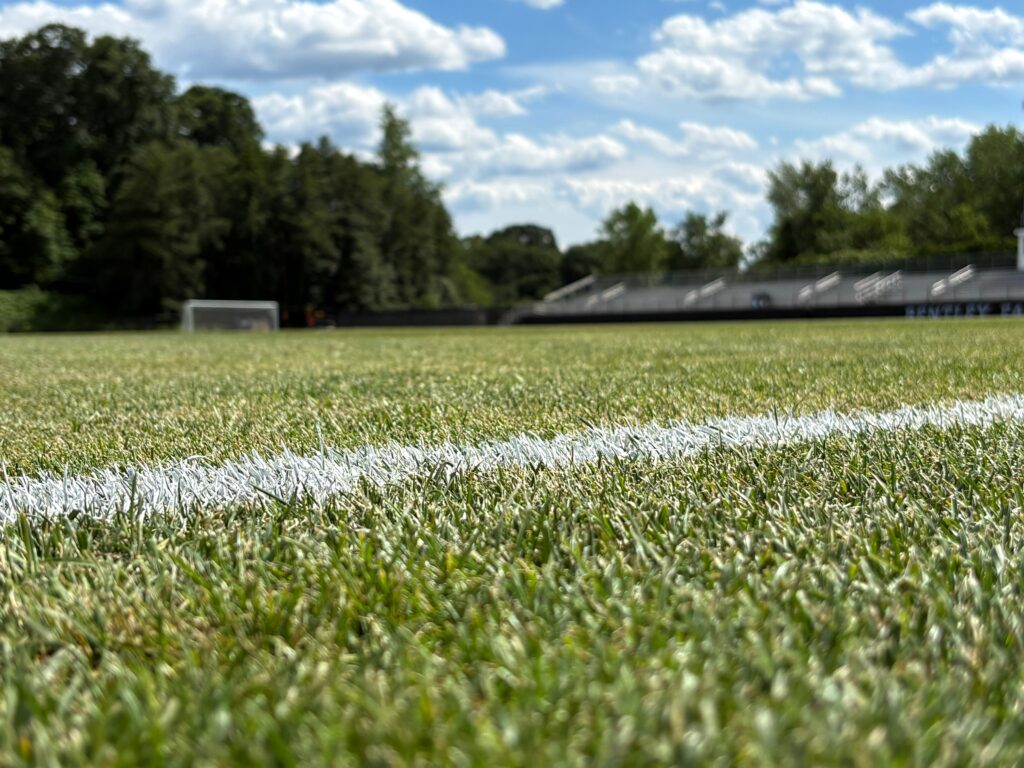
Well into April, the temperatures kept dipping below freezing overnight. Gaffey began nervously counting the days on the calendar. By the middle of May, the weather had finally turned, and toward the end of the month, the crew felt confident enough to mow the grass to FIFA’s regulated height of 9/10ths of an inch and into its specific checkerboard pattern.
Gaffey had heard that professional soccer players did relatively little damage to the fields on which they played. They’re so skilled and so fast that they “kind of float over the grass,” he Gaffey said.
While his crew members thought the field was in decent shape, they didn’t know for sure. “I would be lying to you if said I wasn’t nervous that it was good enough for these professional athletes who play in these beautiful stadiums,” said Morgan, 40.
Acosta, 33, felt the same way. Maintaining the field for a Division II college team was one thing, this was something else. In the nightmare scenario that kept running through Acosta’s head, France could theoretically refuse to play there.
The day France’s team arrived, Morgan and Acosta got to the field at 6 a.m. They checked for divots or other damage. They spent hours trimming and rolling the grass using their John Deere reel mower. They touched up the paint lines using a tool provided by FIFA.
In the distance, Acosta heard the sirens of the police escort for France’s team bus, arriving from the Four Seasons hotel in Boston. Then cheers from the crowd gathered outside the university’s gate. A little later, he saw figures in blue kits and pink cleats making their way from the arena’s locker rooms across the adjoining baseball field.
Then the first few players were on the pitch, jogging and stretching. We did it, Acosta thought. “It was a huge — I cannot stress enough — a huge sigh of relief,” he said.
Since then, Morgan and Acosta have been at each practice, setting up flags and rolling out the nets. The French players train each day at the time of their next match, and during practice, the coaches want certain zones of the field watered to simulate game conditions, something Morgan can control from an app on his phone.
On a recent afternoon, the soccer field gleamed in the sunshine. A new fence lined with black netting provided privacy, and two security guards walked the perimeter with sniffer dogs ahead of the team’s arrival.
The field itself was a kind of paradox: grass so uniform and precise that it resembled an enormous living carpet. Several people had even asked Gaffey whether it was real.
France held a friendly scrimmage that afternoon with young players from the training academy for the New England Revolution, Boston’s professional club.
A day earlier, France had triumphed 3-1 over Senegal in its opening match. On the sidelines of the practice, a member of France’s support staff said the surface in the New Jersey stadium where they had played had been “hard as rock,” something he attributed to its last-minute conversion from artificial turf to natural grass in time for the World Cup.
But this field? He gestured at the expanse of green glowing as the sun began to set. “It’s very good,” he said. “Frankly, it’s perfect.”
The post Three groundskeepers. 11 weeks. The race to prepare for a World Cup favorite. appeared first on Washington Post.