When the pandemic came to an end, many people who had been working from home assumed they would be allowed to maintain that habit at least a few days a week. But today in the U.S., a third of companies have forced everyone back to the office full time and have banned remote and hybrid work.
Some leaders say they insist on full-time in-person work because it boosts productivity, despite clear evidence that it does not. Others claim it’s about collaboration, creativity or culture. Our new research reveals that the objection to any work from home is more likely to be driven by something else entirely: ego.
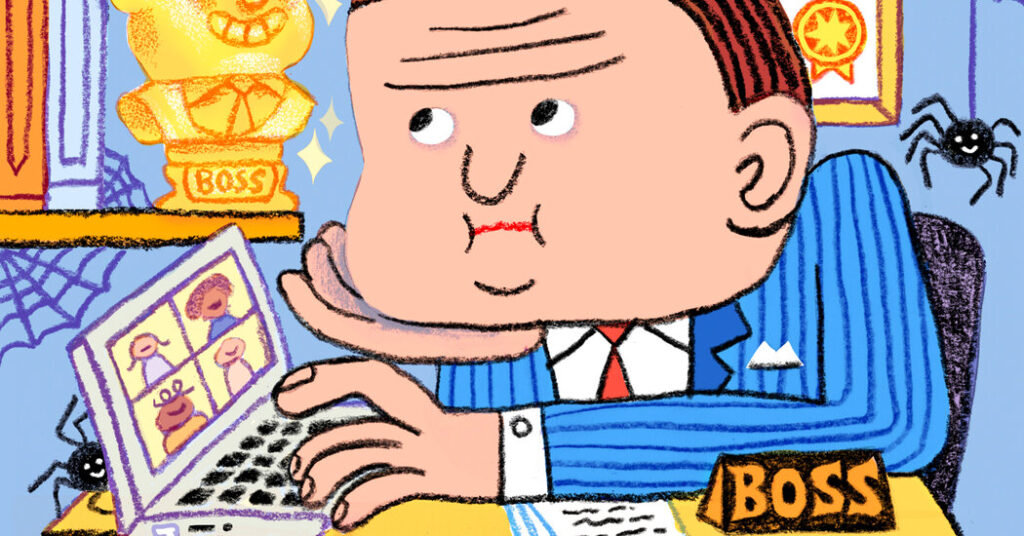
Case by case, there may be good reasons for teams to work together in person. As a general rule, though, it turns out that ordering people back to the office full time is a power and status move. It’s a signature strategy of leaders who exhibit narcissistic qualities. They see any kind of remote work as a threat to their authority and admiration. They want to be worshiped at the office altar.
Over the past six years, we’ve studied why some leaders continue to support remote work, while others resist it. We surveyed thousands of executives, middle managers and frontline supervisors on a host of personality traits. When we later asked them about their stances on hybrid and remote work, their answers didn’t correlate with how much they trusted their employees or how much they loved being around people. The only trait that consistently predicted objections to remote work was narcissism — the tendency to be self-centered and entitled. The higher the opinions of themselves leaders expressed, the more they coveted power and status — and the more they favored return-to-office mandates.
That pattern held for chief executives of Fortune 500 companies. Since we couldn’t directly measure the size of their egos, we measured factors that many previous studies have identified as reliable proxies for narcissism: the sizes of their pay packages, their signatures and their photos in their company reports. (No, the chief executives probably aren’t directly overseeing the page layout, but their underlings have to figure out what will and won’t please the boss.) Commanding outsize compensation and projecting an outsize image sends a message right out of Ron Burgundy’s playbook: I’m kind of a big deal. We found that the higher chief executives scored on this index, the more likely they were to seek power and status by becoming chairmen of their own companies and joining the boards of other companies. These were the chief executives who made the most negative statements about remote and hybrid work during the first two years of the pandemic.
The connection between narcissistic personality traits and wanting people in the office full time is not coincidental — it’s causal. In one experiment, we got leaders to reflect on the role that a bold, assertive ego played in the success of Steve Jobs as Apple’s chief executive and Larry Ellison as Oracle’s. After participating in that exercise, leaders were more likely to oppose remote work.
None of this is to say that individual leaders who reject remote work are necessarily egomaniacs. Many factors influence workplace policies around flexibility. But our data does show that overall, self-centered leaders tend to struggle with the idea of employees making independent choices about where to work. Psychologists have long suggested that narcissism is like a drug — it leaves people craving a regular supply of attention and validation. Remote work deprives leaders of access to that supply.
When people aren’t in the office, it’s harder to command and control. Leaders can’t intimidate by hovering over cubicle desks and slamming doors. They can’t establish their dominance by summoning people to a conference room and pounding their fists on the table. They can’t even make direct eye contact to stare people down.
Remote work also prevents leaders from basking in the glow of employee reverence. Instead of standing out in the corner office, leaders are lost in a sea of equal squares on a screen. Instead of rapt attention, they’re met online with boredom, fatigue and interruptions from partners, children and pets. Instead of being showered with immediate gratification, they get glitchy facial expressions and delayed replies. Sycophantic reassurances from employees just don’t have the same effect if they’re on Slack.
Self-centered leaders often respond to these threats by tightening their grip. They declare that people are shirking from home instead of working from home. They threaten to fire people who aren’t on site five days a week.
Rigorous evidence shows that forcing people to come in every day backfires. Take it from studies of over 450 companies and over three million employees: Return-to-office mandates fail to increase financial returns. They succeed only in motivating star employees to quit, reducing the satisfaction of those who stay and discouraging new talent from joining. Experiments at tech companies and nonprofits show that letting people work from home part of the week boosts happiness and decreases turnover by a third — without any cost to performance. In many cases, those employees even get more done, because they don’t have to spend time commuting and don’t get distracted by office interruptions.
There are limits to the benefit of flexible office policies. Research suggests that working from home for more than half the week can be isolating — it’s harder to build connections and cultures. It’s also more difficult to encourage creative collisions, informal learning and mentoring. But it doesn’t take five days a week to accomplish these goals. In fact, it turns out that people are most collaborative and creative when they work remotely part of the week. They can use a day or two at home to focus on individual deep work and reserve the rest of the week for communication and collective problem-solving. It’s well documented that too much togetherness breeds groupthink (not to mention germs). When we spend some time apart, we actually generate more innovative ideas and make smarter decisions.
Hybrid work does have its own challenges for leaders. It’s not fun to try to inspire through a recorded video message or lead a brainstorming session on a digital whiteboard. But to maintain a competitive advantage in an increasingly flexible world, it’s time for leaders to put their egos aside and master the art of managing from afar. Evidence supports a few basic guidelines.
One: Coordination counts. Teams need anchor days when everyone shows up — especially to welcome newcomers and mentor junior people. At Microsoft, new hires who spent at least a couple of days a month with their manager and their teams were more satisfied with their early experiences, which in turn meant they were more likely to stay over the next year and a half.
Two: Intensity beats frequency. The software company Atlassian has found that spending a few days with your team at a well-designed quarterly team gathering does more for connection and belonging than daily schleps to the office.
Three: Hybrid work is not one-size-fits-all. Different jobs require different amounts of time in person. So do different people; for example, flexibility proves particularly important in attracting and retaining women. And you need to gather together more if your staff operates like a basketball team passing the ball back and forth, rather than a gymnastics team whose members do their own individual events. (This explains why fully remote teams struggle to patent new technologies, but the people who examine patent applications are more productive when they can work from anywhere they like.)
Four: Most people care more about when they work than where. If they can choose the hours, they’re more willing to let leaders pick the place.
Organizational policies shouldn’t be vanity projects. The responsibility of leaders is not to mold the world to their needs. It’s to adapt themselves to the world’s needs, even if it means learning to live without the thrill of a live audience.
Adam Grant, a contributing Opinion writer, is an organizational psychologist at the Wharton School of the University of Pennsylvania. He is the author of “Think Again” and the host of the TED podcast “Re:Thinking.” Marissa Shandell is a Ph.D. candidate at Wharton studying the forces that drive people to feel and do their best at work, and the author of @researchdoodles on Instagram. Courtney Elliott is a Ph.D. candidate at Wharton studying how remote work, social media and technology influence workplace relationships.
The Times is committed to publishing a diversity of letters to the editor. We’d like to hear what you think about this or any of our articles. Here are some tips. And here’s our email: [email protected].
Follow the New York Times Opinion section on Facebook, Instagram, TikTok, Bluesky, WhatsApp and Threads.
The post The Real Reason Bosses Want You Back in the Office Full Time (It’s Not Productivity) appeared first on New York Times.