An anniversary is an arbitrary thing, a trick of the calendar, a marketing opportunity. But it’s also a tent pole: a structure upon which to unfurl the fabric of the nation and take stock of the toll of time. Our fabric as one people was woven long ago, with the ideals expressed in the Declaration of Independence as its warp and weft. Anniversaries invite us to inspect that cloth. Where does it remain strong and vibrant, and where has it faded and frayed? Anniversary commemorations can strengthen the national fabric or tug at its fragile seams.
Americans love anniversaries. Colonists publicly commemorated moments in their rights struggle well before 13 of Britain’s 26 American colonies declared independence. But John Adams felt certain that the moment Congress opted for independence would prove especially lasting — “the most memorable Epocha, in the History of America,” as he wrote in a letter to his wife, Abigail:
“I am apt to believe that it will be celebrated, by succeeding Generations, as the great anniversary Festival. It ought to be commemorated, as the Day of Deliverance by solemn Acts of Devotion to God Almighty. It ought to be solemnized with Pomp and Parade, with Shews, Games, Sports, Guns, Bells, Bonfires and Illuminations from one End of this Continent to the other from this Time forward forever more.”
He was talking about July 2, the date Congress passed Richard Henry Lee’s resolution stating that “these United Colonies are, and of right ought to be, free and independent States,” not July 4, when they adopted the Declaration explaining why they had done so and what, in the end, they stood for. Commemorations often get facts wrong. Sometimes they do so on purpose.
Regardless of the specific date, America’s experiment began at a discernible moment “in the course of human events,” as the Declaration puts it. Unlike the Rome that was suckled by a mythical wolf, or the Haudenosaunee nations born on a turtle’s back, this country’s origin corresponds to a day you can circle on a calendar. The American allegiance to anniversaries was born of this opportunity, but also of necessity: The founding documents and their ideals — not blood, not soil — were, from the beginning, what the people of “these United Colonies” shared, and perhaps all that we shared.
The 50th anniversary of that epochal moment in 1776 found the country bitterly divided, especially over the future of chattel slavery. In 1820, the Missouri Compromise patched the fault line along which the United States would sunder itself four decades later. Thomas Jefferson, primary author of the Declaration, knew the patch wouldn’t hold. He hoped for a gradual solution to the moral abomination of slavery yet sensed that was impossible: “We have the wolf by the ear,” he wrote, “and we can neither hold him, nor safely let him go.” The compromise offered “a reprieve only, not a final sentence.”
Six years later, the semicentennial celebrations tried to extend the reprieve by softening revolution into romance. Founders turned to marble: a 178-foot-tall monument to George Washington, begun in 1815, rose toward completion in Baltimore. Citizens invited Jefferson and Adams, two of the Declaration’s three surviving signers, to decorate local celebrations, like living statues. Both pleaded infirmity. Each breathed his last, uncannily, that July 4. Daniel Webster memorialized them for more than two hours, at Boston’s Faneuil Hall. “The tears which flow, and the honors that are paid, when the founders of the republic die, give hope that the republic itself may be immortal,” he said, making the noble dead “stars” and “suns.”
Fast-forward a bloody half-century, during which Jefferson’s wolf devoured the union. The 1876 centennial year fell just a decade after the end of the murderous Civil War, fought over slavery. Lincoln and nearly three-quarters of a million other Americans had perished in it. Hordes flocked to Philadelphia to glimpse the original Declaration — the faded parchment become a relic, a piece of the one true American cross.
Even then, with the dead only freshly buried, the history of the Civil War was being rewritten. As Reconstruction briefly cemented what would come to be called a Second American Revolution, those who opposed it recruited the founders into a Lost Cause narrative that cast the Confederacy as the fulfillment of 1776, rewriting the Declaration’s legacy in the process. “The assertion that ‘all men are created equal,’ was no more enacted by that declaration as a settled principle than that other which defined George III to be ‘a tyrant and unfit to be the ruler of a free people,’” wrote Jubal Early, a Confederate officer turned Lost Cause historian, in 1915. “Taken in its literal sense,” he continued, the phrase “might be construed to mean that all men are created equal in every respect, but does any one believe, or will any one ever believe, that the native Congo, the Hottentot or the Australian negro, is the equal, mentally, physically and morally, of the Caucasian?”
What the Declaration had established, Early and his fellow travelers insisted, was the “right of the states to withdraw and the wrong and criminality of the attempt to coerce them when they had exercised that right.” The document’s preamble was not, as Lincoln had insisted, “the electric cord … that links the hearts of patriotic and liberty-loving men together” for all ages. It was dead letter: a set of “abstract generalities uttered under the enthusiasm and excitement of a struggle for the right of self-government.”
Historians who labeled themselves “Progressive,” Northerners all, were disgusted by the Lost Cause narrative. But they shared with Early and his intellectual kin a commitment to cutting the nation’s founders down to size. Charles A. Beard, a professor of politics at Columbia, elaborated what he saw as the base motivations driving the leaders of the founding era to forge a union protecting their stocks, their bonds and their human property. “It may be truly said that the Constitution was a product of a struggle between capitalistic and agrarian interests,” he wrote the same year Early published “The Heritage of the South.” The capitalists — whom had Jefferson derided as “the paper men” — won the day. Yet Beard argued that Jefferson and the other agrarians who opposed them had been just as self-interested. Their paeans to public good masked passion for private gain. Founders like Jefferson might pretend to the universalism of Locke, but at heart, they were Hobbesians: would-be winners in a struggle of all against all.
The phrase “founding fathers” entered the American lexicon at precisely the moment the Progressive and the Lost Cause tribes were battling it out, serving as a kind of pedestal to counter a double dethroning. Its first major public use came in 1916, by Warren G. Harding, at the time a senator from Ohio. “We ought to be as genuinely American today as when the founding fathers flung their immortal defiance in the face of old-world oppressions and dedicated a new republic to liberty and justice,” Harding told that year’s Republican National Convention. The speech was a hit, and Harding went on, as president, to use the phrase many times. As it entered the vernacular, the F’s were often capitalized, as they generally remain. (The phrase’s usage is, today, at a historic high.) “Founding fathers” comprised a fixed set of proper names, Great Men whose nobility of character and fearless derring-do incarnated a nation. They were the ones without whom: no Jefferson, no Declaration; no Washington, no victory; no Madison, no Constitution; and so on down the line.
Veneration for these newly coined founding fathers, often shortened to “founders,” increasingly shaped the country’s memorial landscape. A life-size bronze Jefferson, standing atop the Liberty Bell, was erected in front of University of Virginia’s Rotunda in 1910, copying an earlier version that loomed over Louisville, Ky. An eight-foot-tall bronze Franklin carrying the satchel he brought to Philadelphia rose on the campus of the University of Pennsylvania, while a titanic Hamilton bestrode Chicago’s Grant Park. As the sesquicentennial neared, statues honoring Washington went up across the United States and beyond. Portraits of his cabinet graced cigar boxes. Heritage organizations proliferated. The Thomas Jefferson Memorial Foundation — ancestor of the nonprofit that today runs Monticello — was chartered in 1923, to preserve Jefferson’s house and burnish his memory.
Homage to the few accompanied a growing spirit to keep out or discipline the many. The very next year, Congress passed the most sweeping restrictive immigration law in American history. Virginia’s Racial Integrity Act, that same state’s Eugenical Sterilization Act and the Labor Appropriation Act creating the U.S. Border Patrol were likewise enacted in 1924, on the eve of the nation’s 150th. Real Americans, the message seemed to be, looked like the founding fathers.
When President Calvin Coolidge addressed the nation on July 5, 1926, he draped the founding few in a raiment of “reverence and respect.” Speaking just a few years after a devastating world war followed by a virulent global pandemic, Coolidge delighted in witnessing the “four corners of the earth unite in coming to Philadelphia as to a holy shrine.” Independence Hall — the old Pennsylvania State House, renamed in the 1820s and restored in the run-up to the Centennial — had become, by 1926, “hallowed ground,” and the Liberty Bell “a sacred relic.” So, too, Coolidge said, had the Declaration been “the product of the spiritual insight of the people. We live in an age of science and of abounding accumulation of material things. These did not create our Declaration,” he insisted. “Our Declaration created them. The things of the spirit come first.”
Take that, Charles Beard and Jubal Early.
Victory in World War II seemed to prove Coolidge right: The American spirit triumphed, through enormous effort and at equally enormous cost. In the postwar universities, a “consensus school” of American history embraced what Harvard’s Louis Hartz famously called “the liberal tradition,” with the founding fathers serving as its prime though not its exclusive exemplars. As Cold War politics infused the academy, the doctrinaire materialism of Beard and his fellow Progressives came to seem not just intellectually thin but also downright un-American. Hartz pilloried the Progressives’ “smoke and flame,” which in his view had produced so much more heat than light. In 1968, Columbia’s Richard Hofstadter offered a book-length epitaph for the Progressives. “Today Beard’s reputation stands like an imposing ruin in the landscape of American historiography,” he wrote. “What was once the grandest house in the province is now a ravaged survival, afflicted, in Beard’s own words, by ‘the pallor of waning time.’”
But the consensus school’s own time was already waning when Hofstadter published. A new war, in Vietnam, had opened a generational chasm, and old intellectual currents swirled in its wake. As the nation’s bicentennial approached, increasing numbers of young historians would come to find Beard’s materialism more persuasive than the idealism of Harding and Coolidge, Hartz and Hofstadter. The very notion of a singular American tradition, liberal or otherwise, seemed preposterous to a generation marching in the streets against an unjust war. New Left organizers chartered ethnic and gender studies departments to probe the historical experiences of Black, female, Native and Hispanic Americans: from one, many.
Social history, sometimes known as “history from below,” became a powerful insurgent methodology in the discipline. In a seminal essay titled “The American Revolution Seen From the Bottom Up,” published in 1968, the historian and Students for a Democratic Society leader Jesse Lemisch reviled the “antipopulism” of Jefferson and Adams, making them enemies rather than avatars of the people. Allergic to the consensus school and skeptical of reverence toward founding fathers, historians inspired by the New Left would strive to recover the struggles of unsung small f-founders, who seemed, by comparison, blameless for history’s shortcomings. “Those who have cried out for ‘liberty’ have often sought no more than the liberty of a few,” Lemisch inveighed. He set out to find the many: the seamen who rigged the boats, the laborers who thronged the streets, the soldiers who won the war.
Teaching American studies at SUNY Buffalo, Lemisch lampooned the commercialism of the bicentennial. In 1976, he offered a class, which created an exhibition, titled “Bicentennial Schlock,” featuring everything from surgical caps to dry-cleaning bags. Mordant laughter ensued. “It’s going to be hard to sell a straight version of American history,” Lemisch told The New York Times in 1976. “It’s all been translated into comedy.”
But Lemisch missed a bigger picture. Its zany kitsch notwithstanding, the bicentennial spurred a sustained commitment to serious American history. Towns and states across the country founded new institutions to preserve and study the nation’s past. A study of historical organizations conducted by the American Association for State and Local History documents that roughly 40 percent of such institutions active in the mid-1980s were established in the years bracketing the country’s 200th anniversary.
Both public and private money poured into scholarship, including the social history that Lemisch championed, the rebels becoming the establishment grant by grant. Founding fathers got their due, too; the newly created National Endowment for the Humanities underwrote archival projects that have formed the backbone of the field for two generations. Federal agencies, private foundations and learned societies funded towering studies of the founding era, including works like Edmund S. Morgan’s “American Slavery, American Freedom” (1975), which brought both social history and Black history into the mainstream of elite academia.
Yes, the bicentennial generated all manner of lunacy, from bobbleheads and saltshakers to the feature-length pornographic film “Spirit of Seventy-Sex,” starring the prodigious John C. Holmes (though not, I am sad to report, in the role of George Washington). But even today, the institutional resources of the bicentennial flow like sap, up and down the family tree of American history.
The decades following the bicentennial saw pathbreaking studies of unsung actors in the American Revolution. Alfred F. Young, one of the most committed scholars of common folks’ experiences in the war, edited in 1993 a pioneering collection titled “Beyond the American Revolution: Explorations in the History of American Radicalism.” The volume propelled the careers of numerous insightful scholars writing about struggling farmers, enslaved people, craft apprentices, land rioters, even (gasp) founding mothers.
In the years since, deft and strenuous archival work has recovered the revolutionary experience of ever broader swaths of the American people, changing not only our understanding of the American Revolution but also the very complexion of the past: how we picture the places it happened, the people who made it happen and even what “it” was. Scholars have surfaced the contributions of women to the battle of revolutionary ideas as well as to the war on the front lines, where thousands washed, cleaned, fed and cared for the army. They have recovered the doleful experiences of infantrymen and common seamen, who slogged shoeless through the mud that Washington rode above on his snow-white charger. And they have taught us, above all, about the ways that Black people held in bondage used the era’s liberty talk as a new tool in their longstanding quests for freedom, while Native nations leveraged the claims of the Declaration to delineate their sovereignty in the face of a United States bent on manifesting a continental destiny.
But over the past 50 years, as scholars diligently swapped margins and centers, a chasm widened between the histories academics produced and those the American people actually read. While ink-stained intellectuals toiled away on book after book about unsung actors in the American Revolution, often with words like “unknown,” “forgotten” and “hidden” in their titles, fat-spined biographies of founding fathers flew off the shelves. Writing in The Atlantic in 2003, the Texas A&M University historian H.W. Brands decried a phenomenon he called “founders chic,” lamenting that the stock of those capital-F Fathers was “currently at an all-time high.” This, he said, “isn’t entirely a blessing for their country.” For by “revering the Founders we undervalue ourselves and sabotage our own efforts to make improvements — necessary improvements — in the republican experiment they began.”
Yet if historians centering the unknown American Revolution and its forgotten founders revealed the limitations of great-man theories of history, they too fell short. By failing to bring together what was intellectually and politically distinctive about the American Revolution — and yes, genuinely exceptional about the nation it inspired — with the everyday struggles of ordinary people, those who abjured “founders chic” lost the plot as well as the public. All pluribus and no unum does not a national narrative make, any more than a war can be won without generals. Brands’s latest book, published in May, is a 640-page biography of George Washington titled “American Patriarch.”
Of course, generals also need an army. It is essential to remember William Lee, an enslaved teenager purchased by George Washington in 1768 for 61 pounds and 15 shillings, who served alongside the Continental Army’s commander in chief throughout the bloody war. Doing so not only insists upon Lee’s humanity; it also reflects the world as Washington knew it. Even so, it is impossible to sustain the case that Lee was as important to the future of the country as the guy who led the fight.
A self-governing republic needn’t choose between Washington and Lee, the generals and the infantry, the few and the many. Indeed, we can’t. Our history, our present and our future as a self-governing people needs the whole cast: the stars, the character actors, the extras, the crew and especially their progeny. Our founders, ourselves: Unless we can see not only our heroes, warts and all, but also our own imperfect likenesses in the cloudy mirror of the past, it will be impossible for us to discover the honest, reflective patriotism that carries our founding forward. If the search for that habit of mind and heart becomes the signal achievement of the semiquincentennial, this year’s anniversary will have done more and better work than any other.
Restoring our founders to their lives and worlds is the work my colleagues and I do every day at Monticello, the “little mountain” that was Thomas Jefferson’s home and plantation, where I serve as president and chief executive. With his granite likeness carved 60 feet high into Mount Rushmore, his portrait gracing the $2 bill, his profile on the front of the nickel and his iconic home on the back, Jefferson lives in our mind’s eye. Schoolchildren know — or jolly well should — that he was the primary author of the Declaration of Independence that we celebrate every July 4. “Our Guy Wrote It,” as the T-shirt in our gift shop says. It’s selling well.
We want our guests to understand the man in full — the lawyer, the scientist, the politician, the architect, the thinker, the farmer, the husband, the father, the sybarite, the debtor. And the man who held property in men: Jefferson was a philosopher of liberty who despised the institution of slavery and yet held more than 610 people in bondage over his lifetime, six of them his own children. His beloved Monticello was an expression of its architect’s mind, built by people of African descent, people he owned. Its very bricks bear the fingerprints of the enslaved children who formed them from Virginia’s red clay. You can fit your hand to theirs and imagine their lives. To do so does not diminish Jefferson. It restores him to the world he inherited and partially transformed.
When we think of the man who held the quill that drafted the Declaration, we need also to picture Robert Hemmings, Jefferson’s literate, teenage, enslaved valet, who would have fetched the paper and mixed the ink. No image of Hemmings survives, and certainly no statue. Yet he, too, was a founder, who worked to make the Declaration’s promises tangible and true. In 1812, Hemmings witnessed, with his meticulous, oversize, cursive signature, the marriage of his daughter, Elizabeth, to William Scott: a legal, state-sanctioned union, unlike his own. If Elizabeth and William had children — our researchers haven’t found them yet — they would have been born into a freedom longed for, and fought for, by generations of Hemmingses in North America before them and since. Their yearning for liberty, evoked but unrealized by the Declaration, carried the nation forward, slowly building the constitutional democracy that so badly needs our shared love today.
Hemmings was one of countless men and women whose choices and chances made the country but whose names are not on the tips of our tongues, much less their profiles on our money. Often their stories survive only in laconic sources: legal documents, military records, runaway advertisements, bills of sale. Many left not even a signature behind. To reckon with their contributions is to sift through fragments in order to see anew the country they helped to make, and that made them in turn.
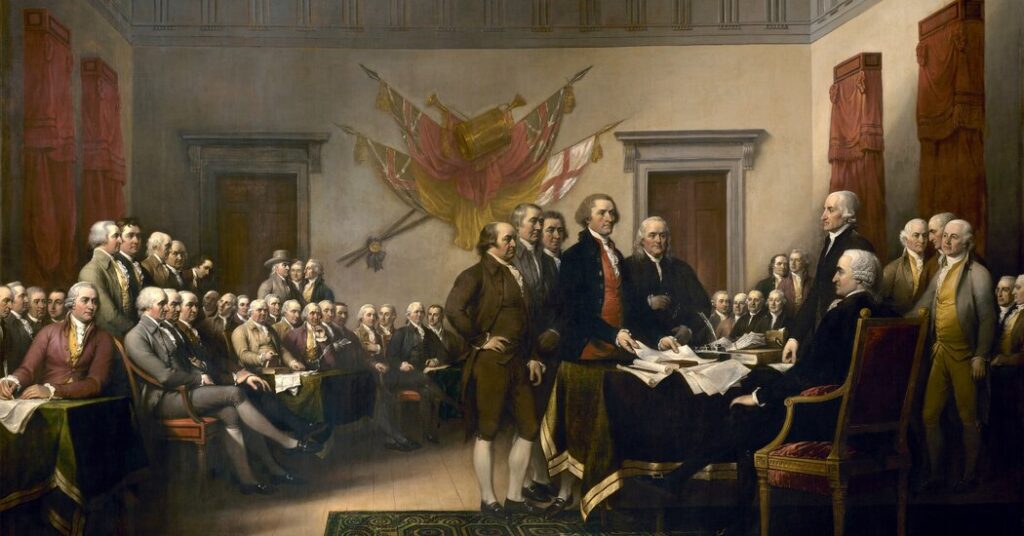
These small-f founders were not in the proverbial room where it happened, in the Pennsylvania State House on Philadelphia’s Chestnut Street. You won’t find them in any of the quasi-mystical depictions of that moment of bravery and unity following contest and compromise. But their efforts — on the battlefield, in the courtroom and in their homes and families — helped to win the nation and began the slow, patient work to wrestle it into congruence with the lofty vision of the Declaration. The 56 signers in that sweltering chamber in Philadelphia, and the confederation they created, emerge in sharper relief when we consider these less-famous founders, just as our understanding of Jefferson becomes more complete when we imagine Robert Hemmings alongside him.
It is hard work, as it always has been, to keep both the Founders and the founders in view. As the country nears its 250th birthday — this latest tent pole stretching our ancient national fabric — our founding has again become the subject of a vicious culture war pitting accounts of America’s origins and character against each other. On one side, picture a garden of unblemished alabaster heroes, a sanitized portrait that seems to realize John Adams’s fears, in 1790, that the “History of our Revolution will be one continued Lye from one End to the other. The Essence of the whole will be that Dr Franklins electrical Rod, Smote the Earth and out Sprung General Washington.” Opposite the garden, picture a graveyard of mustachioed villains: toppled statues of figures so often excoriated by today’s progressives, who insist that the moral depravity of the founding fathers was so profound that they can teach us nothing — indeed that the founding itself was irredeemably corrupt, as the nation remains.
Neither the garden nor the graveyard captures the dazzling complexity of our history. To fully comprehend the American Revolution, we need both the towering few and the faceless many, the guys who wrote it and the people who made it real. All were ordinary and made themselves extraordinary. All took advantage of a moment of possibility — of rupture — to pursue happiness for themselves, their families, their people, their country.
This project introduces a group of historical actors whose American minds — and hearts and hearths and boots on the ground — may be new to you. In sketching them, the authors provoke two important questions. Who else was a founder? And, dear reader, might you become one, too?
Every founder who played a role in creating the United States might be called a Patriot. Historians of the American Revolution often use that label to designate people who fought to bring the country into existence: to root for our team in the great imperial game. But the term is far more capacious than that shorthand suggests, and Americans used it longer, and differently, from the ways it would come to be deployed during and after the war.
Patriots love and honor their patria, derived from the Latin pater: father. Throughout the imperial struggles of the 1760s, patriots in colonial America struggled to perfect their home country, Britain, often pleading with George III, their political father. By late 1773, American Patriots had become more like a political party. “This is the most magnificent Movement of all,” John Adams, who found a lot of things most magnificent, wrote in his diary that Dec. 17, the morning after what would come to be known as the Boston Tea Party. “There is a Dignity, Majesty, a Sublimity, in this last Effort of the Patriots, that I greatly admire.” By throwing the Crown’s tea into Boston Harbor, Adams thought these Patriots had ensured that new “epocha” must follow — though not yet a patria, a new country.
After deadly hostilities at Concord and Lexington in April 1775 “cut off our last hopes of reconciliation,” as Jefferson put it, British provincials of the Patriot stripe came to think of themselves as an emerging polity. “What shall We say of American Patriots? or rather what will the World Say?” Adams asked in October 1775. The Declaration Jefferson drafted the next summer, with Robert Hemmings close at hand, answered the question: Americans were “a people,” in Jefferson’s first version, becoming “one people” after a punishing edit. That statement indeed marked an epocha in the history of the modern world: People could pick — could make — their patria, like children giving birth to their fathers.
For the next seven years, Washington’s army, founders all, bled to forge that new people. Nowhere was the journey more varied or more vexed than on the battlefield, as Thomas Paine memorably wrote in “The Crisis” at the bitter end of the revolutionary year 1776, when he lamented the character of the “summer solder and the sunshine patriot” who, confronted with the military crisis that gave its name to Paine’s series, would “shrink from the service of their country.” Paine’s message was that true patriots served, selflessly, for the common good — including when the army couldn’t pay or even clothe them.
During and after the war, as this project shows, service to country took many forms. Patriotism, both loving and critical, flowed from the pen, as Lemuel Haynes and Mercy Otis Warren practiced it, each demanding that these new United States live up to the Declaration’s soaring promises; Elizabeth Freeman used the Massachusetts courts to secure her personhood in the nation. Patriotism also ran in rivers of blood, as the young private Joseph Plumb Martin experienced. The tax protester and radical democrat Hermon Husband held to Quaker tenets of nonviolence and so did not take up arms. Instead, he fought for the rights of common farmers in the Pennsylvania Assembly and beyond. “Good Peter” Agwalongdongwas weighed his options and decided that the Patriot cause represented the best chance for the health and sovereignty of his people, the Oneida. He supported the American rebels even when others in his village declared allegiance to the British. The Baptist preacher John Leland helped to forge religious liberty as the essential partner of political freedom, first in Virginia and then in his native Massachusetts.
These founders contended with and contradicted one another. Each of them wagered, as Annette Gordon-Reed writes of Haynes, “a gamble for the future.” They made imperfect bets amid chaotic happenstance. They chose the nation made of choices, even when that nascent nation did not embrace them in turn. They did so for reasons public, personal and familial. Their faith was not always repaid — not quickly, not later, maybe not yet.
The Declaration’s 56 signers represented — which is to say they served — the masses of founders around them, and they knew it. Jefferson understood himself to be more scribe than author: When drafting Congress’s “appeal to the tribunal of the world,” he later explained, he had not aimed “at originality of principle or sentiment.” Rather, the Declaration “was intended to be an expression of the american mind.”
Late in Jefferson’s life, the Kentucky legislator William Barry wrote him an unctuous letter, offering “an inextinguishable flame of gratitude” for the great man’s “distinguished public services.” The people of Kentucky, Barry said, were “Accustomed … to look up to you as one of the Fathers of the people, and as the great benefactor of our common Country.” In reply, Jefferson swatted away the reverence, telling Barry, in essence, to look sideways, rather than up: “I was one only of a band devoted to the cause of independence, all of whom exerted equally their best endeavors for its success, and have a common right to the merits of its acquisition.” We need to recover that sideways view, which neither looks up in awe nor puts down in disdain, which encompasses both the center and the margins.
In the 1930s, in the midst of another season of division, W.E.B. Du Bois warned Americans against substituting propaganda for fact. “One is astonished in the study of history at the recurrence of the idea that evil must be forgotten, distorted and skimmed over,” Du Bois wrote in his magisterial history, “Black Reconstruction.” “We must forget that George Washington was a slave owner, or that Thomas Jefferson had mulatto children … and simply remember the things we regard as creditable and inspiring.” But as he insisted, “history loses its value as an incentive and example” when “it paints perfect men and noble nations, but it does not tell the truth.”
Jefferson’s own copious records make it clear that he would have agreed with Du Bois, even though he could not possibly have imagined him. “Here we are not afraid to follow truth wherever it may lead, nor to tolerate any error so long as reason is left free to combat it,” Jefferson famously wrote of his fledgling university in 1820, the school a nursery for the needful dispositions of American citizens. The famous father was wary of “sanctimonious reverence” in all things — toward the Constitution, toward his Declaration and especially toward the founders themselves. Jefferson insisted that those who imagined history as something “like the ark of the covenant, too sacred to be touched,” did a disservice to past, present and future alike. Touch the past, he seems to urge. Fit your hand to the warm bricks on the Fourth of July.
Jefferson dreamed of a future in which the “human mind … becomes more developed, more enlightened, as new discoveries are made, new truths disclosed, and manners and opinions change with the change of circumstances.” He knew that a variety of foundings and founders made us. They make us still. New founders, patriots all, would and must yet rise, and take their place not in a pantheon, but in a grand assembly of democratic purpose, choosing their country again and anew.
Jane Kamensky is president and chief executive of Thomas Jefferson’s Monticello and Trumbull Professor of American History emerita at Harvard University. Her 2016 book, “A Revolution in Color: The World of John Singleton Copley,” won the New York Historical Book Prize in American History.
The post The Many Founders of the United States appeared first on New York Times.