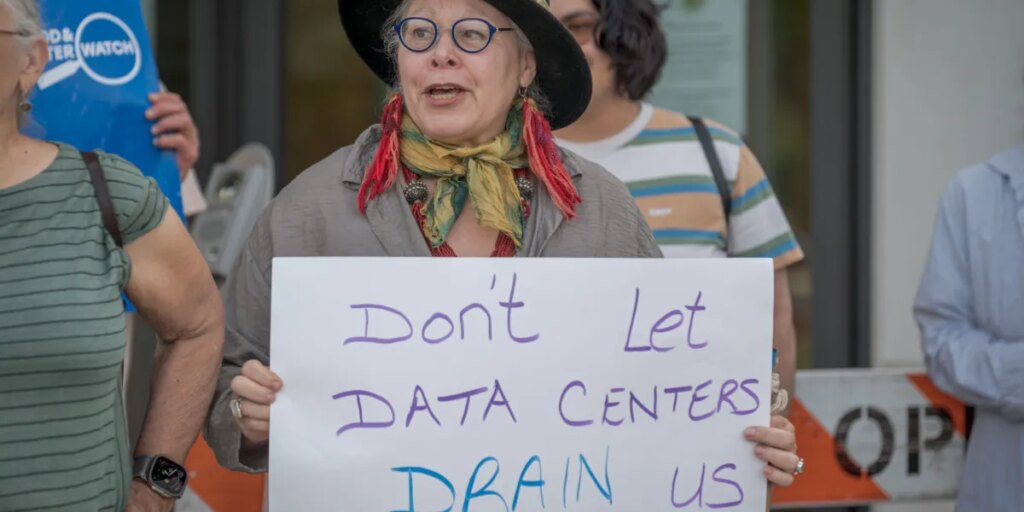
Tech giants jostling with small-town opposition as they embark on their massive data center buildout plans risk forgetting a crucial detail: disdain for data centers, and the AI backlash at large, has gone national.
Data center opposition is no longer contained to the individual towns and counties playing host to new construction, according to findings from a survey published Monday by Milltown Partners, a global advisory firm. According to the report, only 8% of Americans who say they oppose data centers actually live near one, suggesting an even steeper mountain to climb for AI companies racing to get the U.S. public on its side.
Public opposition has thrown a wrench into the AI industry’s sweeping data center construction plans. The largest U.S. tech companies have allocated a record $725 billion in capital expenditure for this year, the vast majority of which is earmarked for data centers—the massive server farms used to train, deploy, and maintain AI models.
Opponents have themselves heard, however. In the first quarter of 2026, public backlash delayed or blocked at least 75 data center projects nationwide, worth a cumulative $130 billion, according to the Data Center Watch Initiative, a monitoring project. That was not far off from the total losses companies incurred from blocked projects in all of 2025, and suggested a scale of discontent going well beyond the relatively small clusters where data centers are actually being built.
“Something that has changed right now is that now we have people that are against data centers even though they don’t have a data center in their backyard, because they see data centers as the embodiment of AI,” Miquel Vila, lead analyst at the Data Center Watch, told Fortune.
“What they oppose is AI,” he said. “They consider that stopping data centers is the way to stop AI development.”
Not to be outdone, politicians have seized on souring sentiment to descend on data centers, with local officials proposing more than 120 moratoriums on data center development in 38 states as of this month.
Tech companies have turned on the charm offensive in a bid to turn the tide. Late last year, Meta spent more than $6 million to roll out a folksy ad campaign in eight states and Washington D.C. extolling the virtues of data centers and their positive impact on the local economy. OpenAI and Microsoft have publicly pledged to foot the bill as their data centers run up massive energy costs, a dynamic that has played into consumer anxiety over rising electricity prices. Over the past month, several companies—including Nvidia, Amazon, and Google—have detailed plans and technological breakthroughs claimed to severely cut down data center-driven water usage.
But the AI backlash that has dominated discourse surrounding the technology in recent months runs deep, and some good PR might not be enough to absolve tech companies in the public eye.
The affordability crisis
The Milltown Partners report, which surveyed 6,872 registered voters across the country, found that while approximately half of Americans are concerned about data centers’ local environmental impact, a larger proportion cite kitchen table issues as reasons to oppose data center construction.
For instance, 67% of voters point to rising energy bills, and 59% bemoan the sentiment that AI-driven gains will materialize primarily on corporate America’s balance sheet and not in their pockets, a sentiment that has also manifested on political fronts. Politicians from across the spectrum, ranging from Sen. Bernie Sanders to President Donald Trump, have expressed support for a form of sovereign wealth fund to distribute AI riches to all Americans.
But while AI’s impact on affordability is top of mind for most Americans, few appear to be dealing with these issues directly. Only 23% of Americans say they think a data center might be located near their home, including the 8% who say they know for sure.
Other surveys have similarly suggested most Americans opposed to data centers are doing so through future-tinted glasses. A Gallup poll published last month found that over 70% of Americans are either strongly or somewhat opposed to the idea of a data center being built near them, with the most common grievances being the effect new construction would have on water and energy usage, as well as electricity prices.
Currently, around 38% of Americans live within a five-mile radius of at least one data center, according to an April report from the Pew Research Center. Because data centers tend to be built in clusters where public policy is forgiving and resources plentiful, the bulk of Americans who share their neighborhood with server farms live in a relatively small handful of states, such as Virginia and Texas.
In places where people do live in close proximity to data centers, the impact can indeed be severe. Wholesale electricity costs have more than doubled in residential neighborhoods that are also home to data centers, according to a Bloomberg analysis. But in most of the country, the AI infrastructure boom has likely had a more marginal impact on electricity prices compared to grid damage sustained by extreme weather events or the costs of utility companies’ capital expenditures that are passed on to consumers.
That has done little to sway Americans’ perceptions of AI and data centers, however. The recent Pew report found whether a respondent lives close to a data center “doesn’t have much of an effect on public opinion about the facilities,” while views on the impact of data centers on environmental quality, energy costs, and jobs also tend to be similar regardless of where people actually live.
The post Tech companies dealing with data center protests locally are fighting a losing battle: Only 8% of opponents actually live near one appeared first on Fortune.