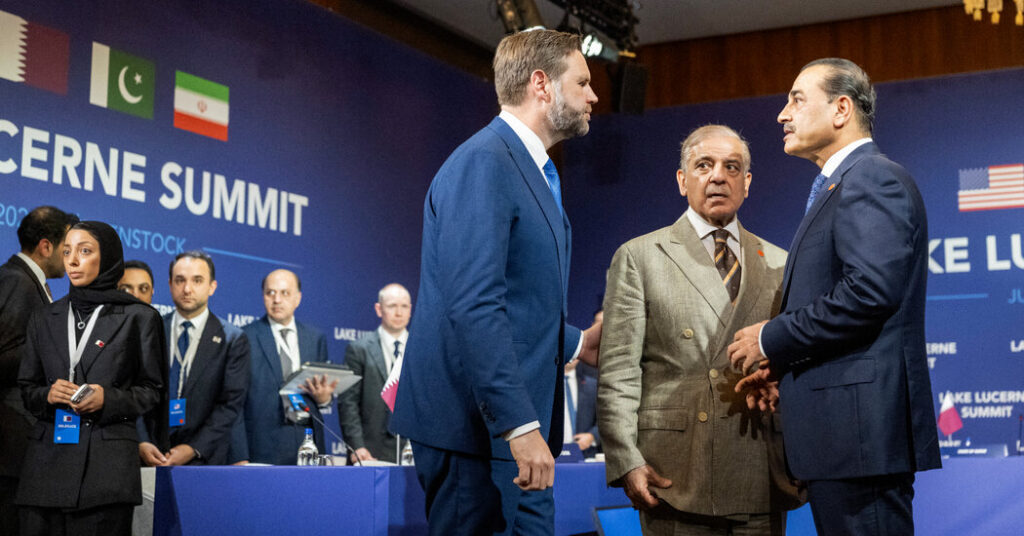
Oil prices retreated on Monday, reversing earlier gains, after Iran’s foreign minister said there had been “major progress” toward ending the fighting in Lebanon during the first session of high-level talks with the United States.
Pakistan and Qatar, which are mediating the negotiations in Switzerland aimed at securing a lasting peace agreement, said in a joint statement that “encouraging progress” had been made after the session concluded.
Oil prices had edged higher earlier in the day amid uncertainty over the status of the Strait of Hormuz. But optimism from the opening round of talks helped send oil prices lower.
Oil retreats.
-
The price of Brent crude, the global benchmark for oil, was down more than 1 percent to about $79 a barrel for September delivery, currently the most heavily traded contract,
-
West Texas Intermediate crude, the U.S. benchmark, was mostly flat at $76 a barrel for August delivery, currently its most popular contract.
-
Investors and analysts are focused on the continued disruption to shipping in the Strait of Hormuz, the narrow waterway between Iran and Oman that is a vital trading route for oil and natural gas that normally carries as much as one-fifth of the world’s oil supply.
Stocks are mixed.
-
Futures on the S&P 500 pointed to a modest decline when stocks resume trading in the United States on Monday.
-
Stocks in Asia, where countries import vast quantities of oil and gas, were mixed. Shares in Japan and Taiwan rose more than 2 percent, while Hong Kong stocks were down 1 percent.
Gasoline prices dip.
-
Gas prices fell again on Sunday, to a national average of $3.94 a gallon, according to the AAA motor club. Still, the cost for drivers has increased by 32 percent since the war began.
-
Gas prices don’t move in lock step with crude, usually trailing increases or drops by a few days.
-
The average price of diesel fell to $5.04 on Sunday, up 34 percent since the start of the war.
The post Oil Prices Fall as U.S.-Iran Talks Show Signs of Progress appeared first on New York Times.