When it comes to AI, much has been made of its democratizing potential. Many proponents believe that access to affordable models will act as a leveler, allowing smaller enterprises to innovate, test, and gain insights in ways previously that were previously much more challenging.
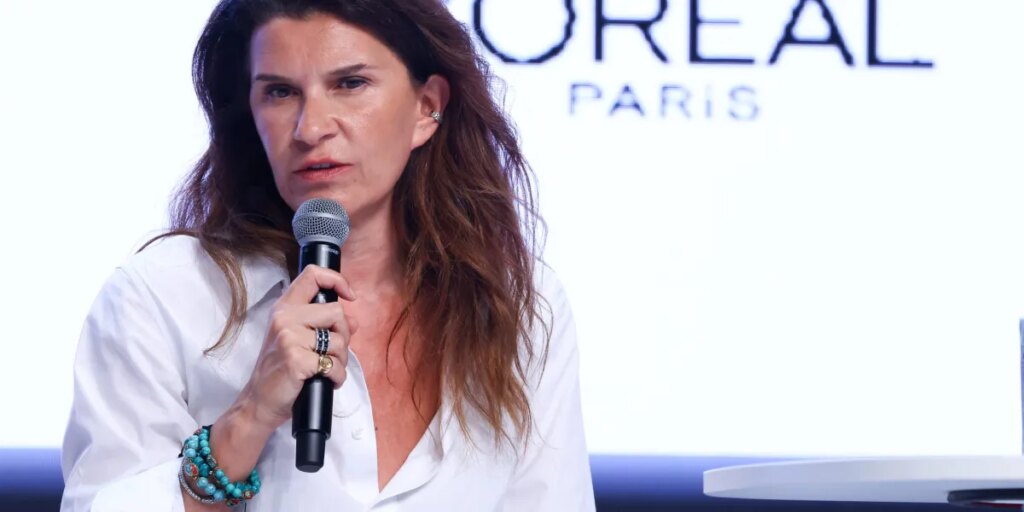
But, according to Delphine Viguier-Hovasse, chief innovation and prospective officer at L’Oréal, the reality may be more complicated. “We operate in a buoyant beauty market because it has never been easier to create a new brand,” she says. “You have AI inventing images and brand names, vendors providing formulas and molecules at a very fast pace—but you also have a lot of brands dying. Every two years you have a new brand and then it disappears.”
Contrary to the prevailing wisdom, Viguier-Hovasse says, “AI is fantastic for old companies.” As the executive responsible for innovation at a company which has been defining and redefining the beauty market for nearly 120 years, she knows what she’s talking about.
Innovation is a system, not a mindset
Despite its age, L’Oréal is routinely celebrated for its groundbreaking innovations—it has registered 725 patents and placed sixth on Fortune’s 2026 list of Europe’s Most Innovative Companies. This ability to consistently innovate relies less on speed and more on the decades of accumulated knowledge and the organizational structure to turn these insights into innovations customers want.
L’Oréal’s organization is structured in a matrix. In practice, this means having cross-functional departments which include both technical and non-technical disciplines. Every employee has two managers—one who is concerned with brand strategy and one who takes care of function or region-specific operations. Collaboration between departments is strongly encouraged.
“We are a company where we talk a lot and we challenge each other,” says Viguier-Hovasse. “So, the R&I [research and innovation] team will come up with a new formula, this is challenged by the business and legal divisions, and then you go back and rework the formula. We really are all working together.”
Viguier-Hovasse’s own innovation team comprises scientists, who create the products, and marketers, who can tell the story behind the science in a clear and compelling way. “Going back to the beginning of L’Oréal, we have always been strong on advertising and explaining what products can do,” she says. “We’re storytellers and we talk to the consumer in their own language.”
This culture of innovation is further supported by having a clear goal for the organization to focus on. “We have one KPI at L’Oréal,” she says, “gaining market share with new products. It’s very simple for everyone to follow.”
And this commitment is backed by investment—3% of L’Oréal’s turnover is reinvested into research. In 2025, this amounted to €1.3 million of investment. Viguier-Hovasse says: “Sometimes people question whether it’s too much, but that’s why this is a great job. At L’Oréal we really have the chance to invest a lot in research, it’s one of our big strengths.”
AI is changing the economics of experimentation
AI is also helping L’Oréal to innovate at pace. Historically, testing new formulations was a slow and expensive process. “To test 20 molecules on hair used to take several years,” says Viguier-Hovasse. “With AI, you can test a molecule in three months, so the cost of a mistake is considerably smaller now. It allows us to skim out the bad formulas much faster.” AI, she says, has given L’Oréal’s people the “luxury to fail.”
Employees also have a dramatic head start on competitors due to the sheer levels of data the organization has built over its long history. “We have accumulated a lot of data, not necessarily over the past 120 years, but over the past 40 years,” says Viguier-Hovasse. “We need AI to be able to read it and sort through it.”
“We have one KPI at L’Oréal. Gaining market share with new products. It’s very simple for everyone to follow”
Delphine Viguier-Hovasse, chief innovation and prospective officer at L’Oréal
This data has been meticulously cleaned and de-duped to a point where L’Oréal’s scientists now have a database of the skin color of women all over the world, information on how hair reacts to different environments, and what Viguier-Hovasse describes as an “atlas on wrinkles.”
“Last year, we ran 40,000 stability tests on our formulas. We’ve done 44,000 tests on people’s reaction to one skin cream,” says Viguier-Hovasse. “If you don’t have AI to organize all of this to show that a formula is safe, good, and efficient, you cannot manage at this scale.”
Seizing the moment
Having these vast quantities of data means L’Oréal can glean vital insights by looking backwards, but this becomes more powerful still when combined with a philosophy which has guided the company since its earliest days.
“Saisir ce qui commence” or “seize the moment” was a motto coined by the brand’s second CEO, François Dalle, who took over the company from L’Oréal’s founder in 1957.
This motto continues to underpin the company’s approach to innovation today. Viguier-Hovasse explains that her team uses this to describe their approach to trend detection, relying not only on forecasting reports or big data but also paying attention to what she terms “weak signals.”
“We very often listen to what one consumer is saying,” she says. “Everyone is actively listening to the market at L’Oréal. One of our strengths over the local or independent companies is that we are global—you might have a weak signal coming out of the U.S. but our teams notice the same in China and in Korea and it starts mushrooming.”
To illustrate, she uses the example of longevity. “We started working on longevity a long time ago, before the field was hot.” Her team noticed that, in the U.S., there began an obsession with the concept of living longer, characterized by the increasing popularity of hyperbaric oxygen therapy—where patients breathe in pure oxygen in a pressurized environment to promote cellular regeneration.
L’Oréal is developing its own longevity treatments at Episkin—its Lyon-based innovation center. Scientists at the center use reconstructed skin to test products, improve its understanding of skin biology, and accelerate innovation. The techniques and technologies it develops have also been used to help burn victims.
“We look to seize on trends early,” says Viguier-Hovasse. “It’s accelerated by AI but we work on them for several years before issuing anything publicly.”
Identifying these trends is only the first step. Translating them into meaningful commercial insights for the business requires a dedicated leader who can weave the various threads together.
Although the role of innovation officer is not a new one at L’Oréal, its recent elevation to the executive committee demonstrates the company’s continuing commitment to innovation as a strategic priority.
“Innovation is now really at the crossroads of tech, science, marketing, legal, safety, and sustainability,” says Viguier-Hovasse. “Being on the executive committee, I am involved in conversations across all functions. It’s a way to make sure I don’t have a blind spot on tech or sustainability.”
By bringing together ideas and capabilities from across the organization, she believes she can help L’Oréal innovate faster than its competitors. While the AI era may bring opportunities for startups, some of its greatest beneficiaries could be legacy companies with decades of accumulated knowledge.
L’Oréal’s approach suggests that winners may not necessarily be those who move the fastest, but those who combine long-term investment with institutional memory and the ability to learn. Innovation may no longer be about simply creating something new, but about making better use of the knowledge held within the organization.
The post Forget speed: L’Oréal’s innovation chief says AI rewards companies with history appeared first on Fortune.