In California, a sprawling 4,000-mile network of canals winds through citrus orchards and fields of tree nuts, delivering irrigation and drinking water to homes and farms across the state.
The canals are critical in an increasingly arid part of the country. But what if they could help fulfill another urgent need: renewable energy?
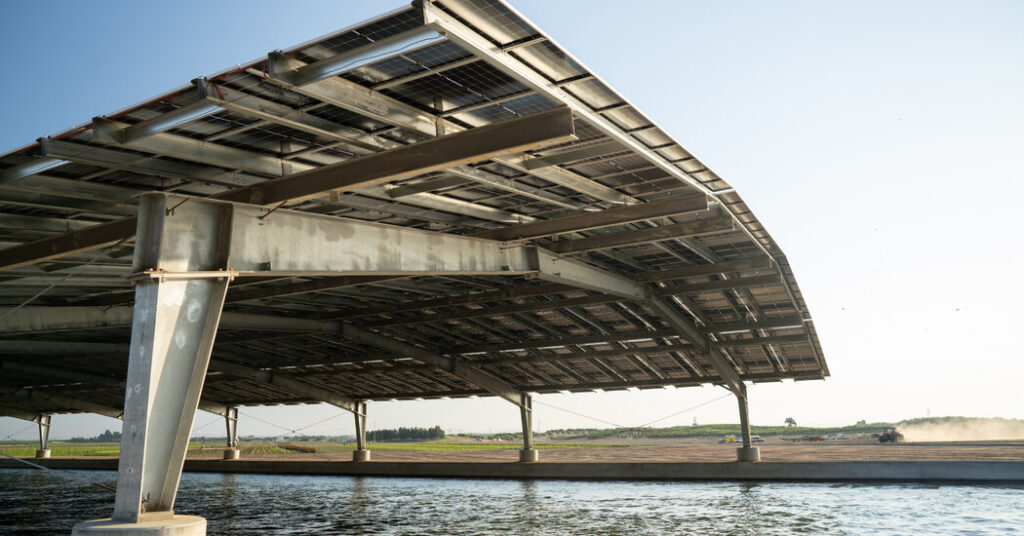
To test that idea, researchers, private enterprise and a public utility in the Central Valley are installing solar panels atop the man-made waterways.
The pilot program, called Project Nexus, is testing solar canopies that researchers say could generate gigawatts of power and save billions of gallons of water by providing shade that slows evaporation. It could be transformational if scaled up, researchers say, in helping the state to meet its ambitious climate and biodiversity goals.
California aims to generate 60 percent of its electricity from renewable sources by 2030 and to rely entirely on carbon-free energy by 2045. It also aims to conserve 30 percent of its open land by 2030. Placing solar panels above the canals, rather than on undeveloped land or competing for space with agricultural interests, could be a double win.
The project grew out of a 2021 study by researchers at the University of California, Merced, that aimed to assess the viability of solar installations throughout California’s canal network.
That simulation modeled the effects of covering all 4,000 miles of the state’s major open canals with solar panels. Researchers projected doing so could generate some 13 gigawatts of solar power (roughly half the new solar capacity needed to meet California’s energy targets) and save 63 billion gallons of water annually (enough to serve 2 million people or 50,000 acres of farmland).
The various shapes, conditions and locations of the canals make the study’s maximum projections nearly impossible to achieve in real life, said Brandi McKuin, a project scientist at U.C. Merced and lead author of the study. And the costs would be higher than building solar farms on land. “It’s probably unrealistic to assume that we’re going to cover all 4,000 miles of California’s canals,” she said.
But the modeling showed that building solar on even a portion of the waterways could make a meaningful contribution to energy production and water conservation.
The study received global attention and, soon after it was published, the state of California contacted Dr. McKuin with a question: Could she prove it?
The next year, with $20 million in state funds and a mandate to test their projections, Dr. McKuin and her colleagues found location in the agrarian corridor south of Modesto and a partner in the 139-year-old Turlock Irrigation District, the oldest canal operator in the state. The community-owned utility operates 250 miles of canals and distributes electricity to 240,000 people.
There, Project Nexus partners including the irrigation district, U.C. Merced and a development firm called Solar AquaGrid tested designs, eventually constructing steel scaffolding above two canals, a narrow one no wider than an alleyway and a larger one roughly the width of an eight-lane highway. Together, the installations cover an area about the size of one-and-a-half football fields, generating a combined 1.6 megawatts of power.
They built panels facing south and west, experimenting with a rail system that allows workers to pull the panels aside to access the canal below, all in an effort to prove that the concept might work for the myriad canal types winding across California and beyond.
Having gathered data over a full irrigation season, Dr. McKuin said the initial results from Project Nexus are encouraging.
Preliminary readings from sensors placed in the canal indicate that the shade from the solar panels reduced water evaporation by up to 70 percent. The panels also slowed photosynthesis, reducing aquatic weeds and algae by up to 85 percent.
Solar-covered canals aren’t an entirely novel idea. Two were completed more than a decade ago in Gujarat, in western India. And along I-10 south of Phoenix, the Gila River Indian Community built a project in 2024.
The Gila River project ended up generating 1.5 megawatts of power, 25 percent more than estimates, possibly because the cooling effect of water can make solar panels more efficient. Water temperature dropped a full degree as it traversed 3,500 feet of shaded canal, with no algae growth, said David DeJong, the irrigation project director. He predicted a “paradigm shift” in the West if the technology were to be widely adopted.
Despite the promising initial results, Dr. McKuin said more research would be needed before scaling up the concept. “It’s still really early to say what the economic feasibility of this is,” she said.
A new report from U.C. Merced, expected in the coming months, will be “critical” to determine whether the Turlock Irrigation District will invest in more solar canals, said Josh Weimer, the district’s director of external affairs. Putting solar panels above a canal is more expensive than installing them on an empty patch of desert, and for districts like Turlock to adopt the technology, Weimer said, the construction costs would need to be offset by the combined value of the conserved water, land-acquisition savings and the reduction in aquatic weed maintenance.
The California Department of Water Resources said it is watching closely as it considers solar canals for portions of the State Water Project, a large network of canals and other infrastructure that delivers water to 27 million people. Ultimately, the data from Project Nexus will be “essential” to understanding how solar canals perform in the real world, said Andrew Schwarz, the agency’s climate action manager, in a written statement.
The technology is “absolutely” ready to be developed at scale, said Roger Bales, professor emeritus of Civil and Environmental Engineering at the U.C. Merced who has worked on Project Nexus since its inception. Now, his goal is to build the first 100 miles.
Looking ahead, he thinks solar canals in California could feasibly generate up to a gigawatt of power in the next decade. “We have to get to a hundred miles, and then it might take off,” he said.
The key is finding the “low-hanging fruit,” said Jordan Harris, the chief executive of Solar AquaGrid, for example identifying places across California where canals are adjacent to a localized energy need. That could be a water-pumping station or an electric-vehicle charger along the highway, or anywhere local electrical lines can accept power without the need to build new transmission lines.
The post California Needs Water and Clean Power. It Might Have a Fix for Both. appeared first on New York Times.