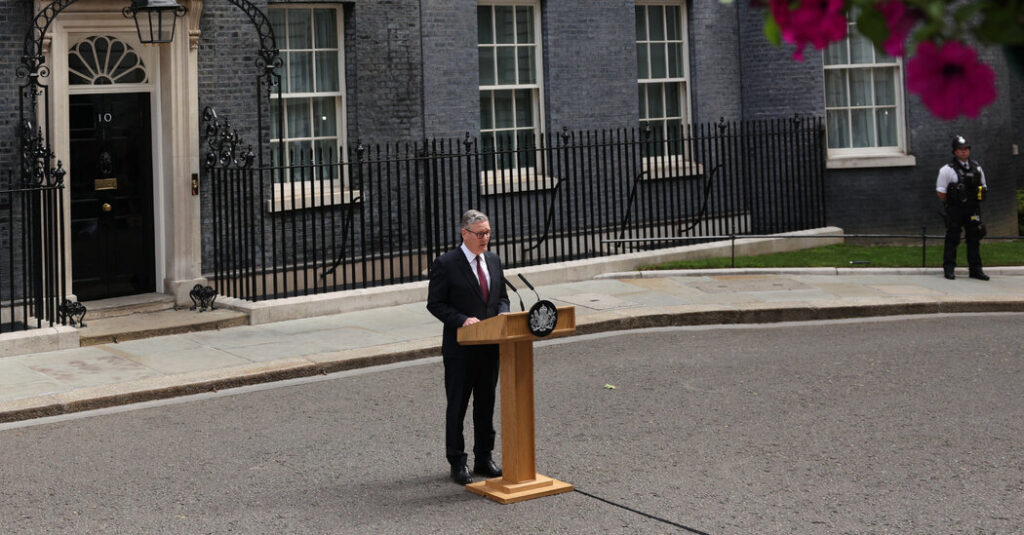
After weeks of speculation about Keir Starmer’s fate as Britain’s prime minister, when the moment of his resignation arrived, on Monday, the reaction in financial markets was relatively calm.
Traders appeared placated by the slight easing of political uncertainty as Mr. Starmer laid out a timeline to leave Downing Street by the end of summer. The pound recovered from earlier losses against the U.S. dollar and was trading slightly stronger. Britain’s government bonds, which had been underperforming against their European peers, fell back in line. The yield on 10-year bonds, known as gilts, dropped slightly.
The position of the next leader of the Labour Party, and therefore, prime minister, could still be contested. But the expectation is that Andy Burnham, most recently the mayor of Greater Manchester, will take up the role.
Still, there is plenty of uncertainty, especially about Mr. Burnham’s economic policies and what they could mean for the country’s finances.
When Mr. Burnham’s path to Downing Street became clearer last month, investors balked. Gilt yields rose as traders were concerned that Mr. Burnham would be inclined toward spending and tax plans that would lead to more borrowing, adding to Britain’s already large debt pile.
Mr. Burnham has sought to reassure investors, and Monday’s benign market reaction suggests he has mostly succeeded.
But several analysts have noted that Mr. Burnham will be constrained by Britain’s economic backdrop of slow growth and relatively high debt and interest rates.
“There is no clarity yet on any new direction in government policy as a whole and who the key personnel will be,” economists at Investec bank, a wealth management company, wrote in a note on Monday. “But what is certain is that while the faces at the top will change, the huge challenges facing the U.K. will stubbornly stay in place.”
For markets, the next most important question is: Who will be the next chancellor overseeing the country’s finances?
Rachel Reeves, the current chancellor who is deeply entwined with Mr. Starmer, is widely expected to be replaced. But Ms. Reeves has built up credibility with bond markets by adhering to strict fiscal rules to try to push down Britain’s debt levels, even when facing pressure from within the Labour Party to spend more. Mr. Burnham, as part of his efforts to the build trust of investors, has said he would keep Ms. Reeves’s fiscal rules in place.
Mr. Burnham and his advisers have signaled that he might seek to transfer what he did in Manchester, most notably franchising public transit, to the rest of the country. He calls the approach “Manchesterism.” He has been critical of Britain’s vote a decade ago to leave the European Union.
“The four horsemen of Britain’s apocalypse are deindustrialization, privatization, austerity and Brexit,” he has said. He has spoken of the benefits of bringing essential services and utilities “under public control” and giving more power to local governments.
The post After Starmer Quits, Investors Wonder Where the British Economy Goes Next appeared first on New York Times.