Clive Davis had been running Columbia Records for only about a year when he attended the Monterey Pop Festival in June 1967. It was a pivotal moment in the counterculture, a watershed for the budding sound of psychedelic rock. Davis was easy to spot. He was the guy in khakis and a tennis sweater, listening to Top 40 tunes on his transistor radio as he walked the Monterey fairgrounds, a square thronged by hippies.
Davis, who died on Monday at the age of 94, was a Brooklyn kid who had bootstrapped his way into Harvard Law School, and then was promoted to president of Columbia despite knowing nothing about music. “I never saw an attorney take so naturally to the music business,” the Elektra Records founder Jac Holzman said in his memoir. “He had an insatiable curiosity, wanting to learn everything, quick to ask questions.” Davis caught on quickly: When he saw Janis Joplin at Monterey, she became his first signing to the label.
He guided artists to huge success at Columbia and, later, Arista and J, but he was also vilified in certain circles for pushing his middle-of-the-road taste on artists. He signed a wide array of artists — Patti Smith and Anthony Braxton, the Outlaws and Gil Scott-Heron — and was a champion of R&B musicians. But his passion was hits, especially ones he’d masterminded. He was an auteur, despite having no musical expertise of his own, mostly because he could spot a hit.
Here’s a list of 11 songs in which he played a significant role.
Harold Melvin & the Blue Notes, ‘If You Don’t Know Me by Now’ (Columbia, 1972)
Columbia was not a hip label — its biggest moneymaker had been the soundtrack to “The Sound of Music” — and Davis knew it was lagging not only in rock, but also in R&B. In 1971, he signed two young writers and producers with a small track record, Kenny Gamble and Leon Huff, to a distribution deal. The duo formed a label, Philadelphia International, that helmed some of the most elegant and passionate soul and pop of the 1970s: “Back Stabbers,” “Me and Mrs. Jones,” “Love Train,” “When Will I See You Again,” “The Love I Lost” and “I’ll Be Around” are only the start of the story.
 Listen on Spotify, Apple Music or YouTube
Bruce Springsteen, ‘Blinded by the Light’ (Columbia, 1973)
In the Tom Petty song “Into the Great Wide Open,” an evil record executive uses a phrase that has become shorthand for the way corporate interference ruins art: “I don’t hear a single.” When Bruce Springsteen finished his debut album, “Greetings From Asbury Park, N.J.,” that’s what Davis told him. “Clive’s say was final,” Springsteen wrote in his memoir, so he dutifully went back to his dismal beachside apartment and wrote “Blinded by the Light” and “Spirit in the Night,” two of his most enduring early songs.
Listen on Spotify, Apple Music or YouTube
Barry Manilow, ‘Mandy’ (Arista, 1974)
In 1971, Scott English had a modest chart hit in England with “Brandy.” Davis heard past the cluttered arrangement and recommended the song to Barry Manilow, whose recent first album had done little business. Manilow disliked the song, but without much leverage, he relented. Under the title “Mandy” (to avoid confusion with “Brandy,” a 1972 smash by Looking Glass), it became the singer’s first No. 1 hit.
Listen on Spotify, Apple Music or YouTube
Dionne Warwick, ‘I’ll Never Love This Way Again’ (Arista, 1979)
Davis loved this dramatic ballad by Richard Kerr (one of the writers of “Mandy”) and Will Jennings, but he’d already stockpiled material for Manilow, so he wasn’t sure what to do with it. He signed Dionne Warwick, one of the most elegant, lustrous singers in pop music, at a time when she’d given up recording, because she couldn’t find material as good as “Walk on By” or “I Say a Little Prayer.” Manilow produced the comeback, which gave her a ninth Top 10 single, and Davis continued to match her with hits, including “Heartbreaker” and “That’s What Friends Are For.”
Listen on Spotify, Apple Music or YouTube
Aretha Franklin, ‘Freeway of Love’ (Arista, 1985)
Toward the end of the 1970s, as disco began to subsume R&B, Aretha Franklin left Atlantic for Arista and a fresh start. In what would become a familiar pattern, Davis planned to revive a great veteran artist’s career with pop hits. There were stumbles at first — covers of “What a Fool Believes” and “You Can’t Always Get What You Want” — but then Davis called in Narada Michael Walden, who gave her “Freeway of Love,” a song he’d written, and produced it in a modern style. It was her biggest song since the immortal “Respect.”
Listen on Spotify, Apple Music or YouTube
Whitney Houston, ‘Saving All My Love for You’ (Arista, 1985)
“Why did she only meet with me to pick out every song for her album? It was she and I, no one else,” Davis said in a 2021 Rolling Stone interview, emphasizing his role in Whitney Houston’s success. Other labels had wanted to sign her too, but Davis had an advantage: He’d worked successfully with Warwick and Franklin, Houston’s cousin and godmother. Houston had been singing “Saving All My Love for You” in her nightclub act, so Davis brought in Michael Masser, who wrote it with Gerry Goffin, to produce. It would “take an act of Congress to keep this woman from becoming a megastar,” a People magazine critic predicted when her debut came out.
Listen on Spotify, Apple Music or YouTube
Kenny G, ‘Songbird’ (Arista, 1986)
Kenny Gorelick’s breakthrough came because of a “Tonight Show” appearance where he’d promised to play his cover of a Junior Walker song but enraged TV producers by instead doing “Songbird,” a showcase for his mellow, highly reverbed playing, which the former New York Times critic Ben Ratliff has called “a corporate attempt to soothe my nerves.” (It wasn’t a compliment.) Davis wrote letters to pop radio programmers, imploring them to play it, and assembled what he later called “a military operation” to promote it. “Songbird” turns jazz into hold music, but as Davis would have pointed out, Kenny G has sold more than 75 million records, making him the most popular instrumentalist of all time.
Listen on Spotify, Apple Music or YouTube
Milli Vanilli, ‘Blame It on the Rain’ (Arista, 1989)
Pop music grew more and more crass and manufactured as the 1980s advanced, and Davis’s keen ear turned Arista into a hit factory: Billy Ocean, Thompson Twins, Taylor Dayne, Lisa Stansfield and Exposé all made good to great hits, none of which sustained a career. It led inexorably to Milli Vanilli, the ne plus ultra of manufactured pop. Frank Farian, the group’s mastermind, had already recorded “Girl You Know It’s True,” and when Davis got involved, he directed Farian to “Blame It on the Rain” by Diane Warren, the Pavarotti of Hallmark sentiment. It became Milli Vanilli’s third No. 1 smash, but once it was revealed in 1989 that the group was a fraud, and their two handsome frontmen hadn’t sung on the album, their Grammy was revoked and Davis minimized his role in the music, insisting that he, too, had been deceived by Farian.
Listen on Spotify, Apple Music or YouTube
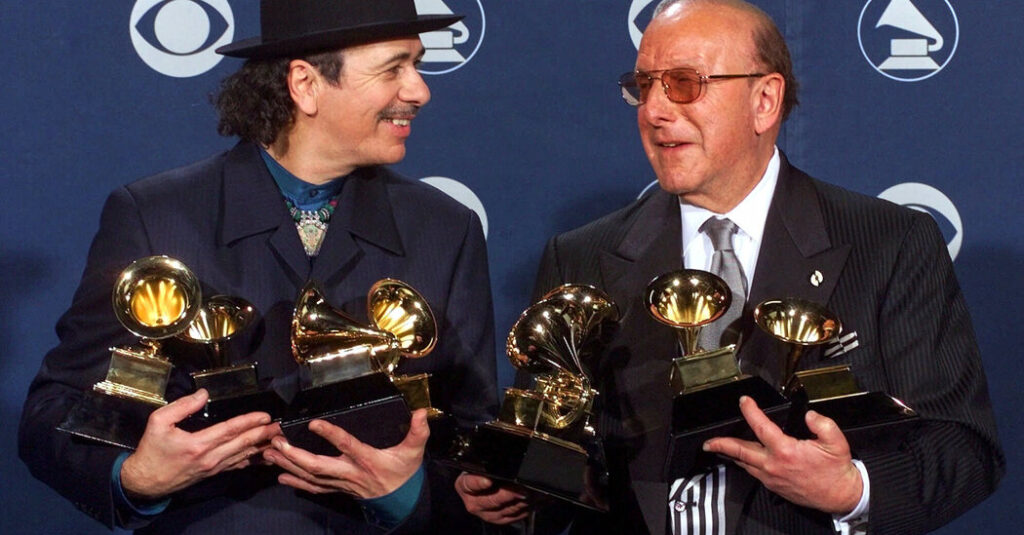
Carlos Santana featuring Rob Thomas, ‘Smooth’ (Arista, 1999)
When Carlos Santana was signed to Columbia with his band, Santana, he chafed at the pressure Davis put on him to make hits. Years later, Santana’s profile had declined, and he was eager for input. There are lots of guests on his Arista debut, including Lauryn Hill and Dave Matthews, but what drove the album to dazzling sales of 15 million in the United States was “Smooth,” which Rob Thomas of Matchbox Twenty sang and helped write. Santana hated it and turned it down, until Davis assured him it would be the most important song on the album. “Smooth” spent three months at No. 1 and Santana later said it had “the frequency of joy” in it.
Listen on Spotify, Apple Music or YouTube
Alicia Keys, ‘Fallin’’ (J, 2001)
The Arista executive Peter Edge spotted Alicia Keys, and Davis was so smitten that after he was bounced out, he made her the signature artist of his new label, J. Keys was an excellent writer, in addition to being a singer and piano player, so Davis didn’t have much of a role to play. But once this song was out, he used every bit of his influence to turn the young artist into a star, whether that meant making Keys the focus of his legendary pre-Grammy party or writing a letter to Oprah Winfrey, successfully lobbying her to book “music’s great new star.” Her debut album won five Grammys.
Listen on Spotify, Apple Music or YouTube
Rod Stewart, ‘These Foolish Things’ (J, 2002)
Rod Stewart was 57 when he signed to J. He hadn’t found a middle-age rendition of his youthful-playboy image and hadn’t had a million-selling album in 10 years. Davis liked the fact that Stewart wanted to record standards, but he had some conditions for the singer: He had to use only the best-known songs, focus on up-tempo numbers and ditch the jazz and blues tracks he’d been considering. It worked: “It Had to Be You: The Great American Songbook” sold more than three million copies and was nominated for a Grammy. Stewart settled into his niche, releasing four more albums of standards.
Listen on Spotify, Apple Music or YouTube
The post 11 Essential Songs Shepherded by Clive Davis appeared first on New York Times.