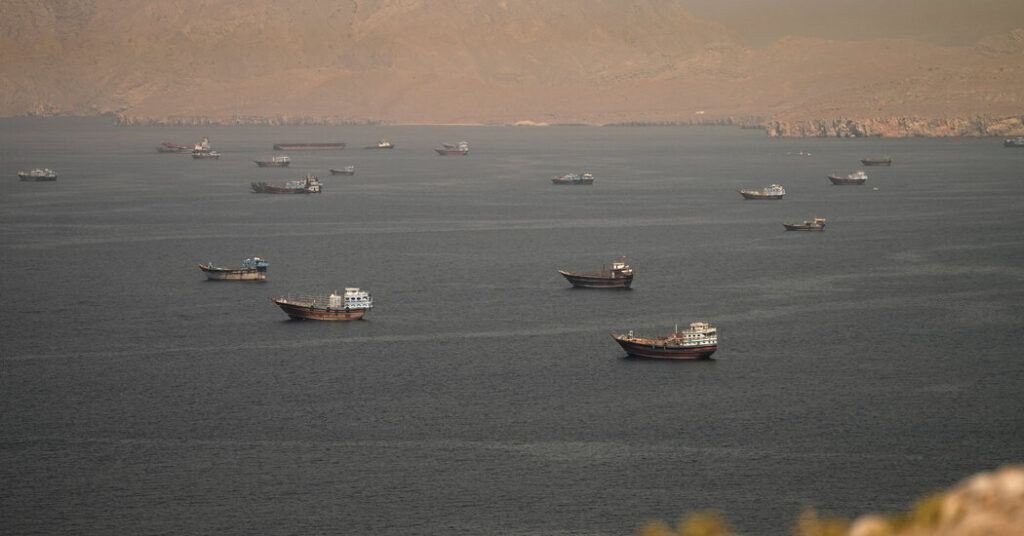
Uncertainty over the Strait of Hormuz remained on Sunday, a day after the U.S. and Iranian militaries offered conflicting accounts over whether the waterway was open to ships.
Maritime analysts observed a drop in the number of vessels passing through the strait on Sunday, according to the extremely limited data available, but the cause was not known. The crucial waterway for oil and gas shipping has emerged as one of the most contentious issues in U.S.-Iran talks aimed at eventually ending the war.
President Trump told a Fox News reporter on Sunday that he had spoken with unidentified Iranian officials overnight and warned them not to close the Strait of Hormuz.
“You close it and you won’t have a country,” Fox News quoted the president as telling the officials, as Vice President JD Vance led an American delegation in meetings with Iranian officials in Switzerland for a new round of talks.
Iran’s military said on Saturday that it was closing the waterway, which had been the conduit for a fifth of the world’s oil supply before the war began in late February. The military accused the United States of breaching the preliminary cease-fire deal signed last week, by failing to restrain Israel’s military actions against Hezbollah, the Iran-backed militant group, in Lebanon.
The naval wing of Iran’s Islamic Revolutionary Guards Corps warned any ships approaching the strait that they were putting their security at risk.
But hours later, U.S. Central Command said the strait was open. “Iran does not control the Strait of Hormuz. Traffic continues to flow, and U.S. forces are monitoring the situation to ensure this remains the case,” said Capt. Tim Hawkins, a spokesman for the command.
According to ship tracking data, which is limited to ships with their transponders switched on, it appeared that vessels had stopped trying to navigate through the strait’s northerly route since the latest Iranian threat on Sunday.
“The situation remains fraught,” said Daniel Mueller, a senior analyst at the maritime intelligence firm Ambrey, on Sunday. “The Iranians are maintaining the strait is closed again, though there have been no attacks.”
Windward, another maritime intelligence firm, said in updates shared on social media on Sunday that it had tracked 12 transits so far that day, amounting to a fall, it said, from the previous day’s numbers.
U.S. Central Command said on Saturday that 55 commercial ships had passed through the strait that day, the largest number in a single day since early in the war, though still far below the 130 daily prewar average.
On Sunday, the U.S. energy secretary, Chris Wright, claimed that 67 ships passed through the Strait of Hormuz in the last 24 hours as the U.S. military helped guide them through a shipping lane south of the main channel that Iranians heavily mined.
According to Windward, the few ships that crossed on Sunday tended to have their transponders switched off to avoid detection. “Hesitation is back in an already unpredictable corridor.”
The post Uncertainty Remains Over the Strait of Hormuz appeared first on New York Times.