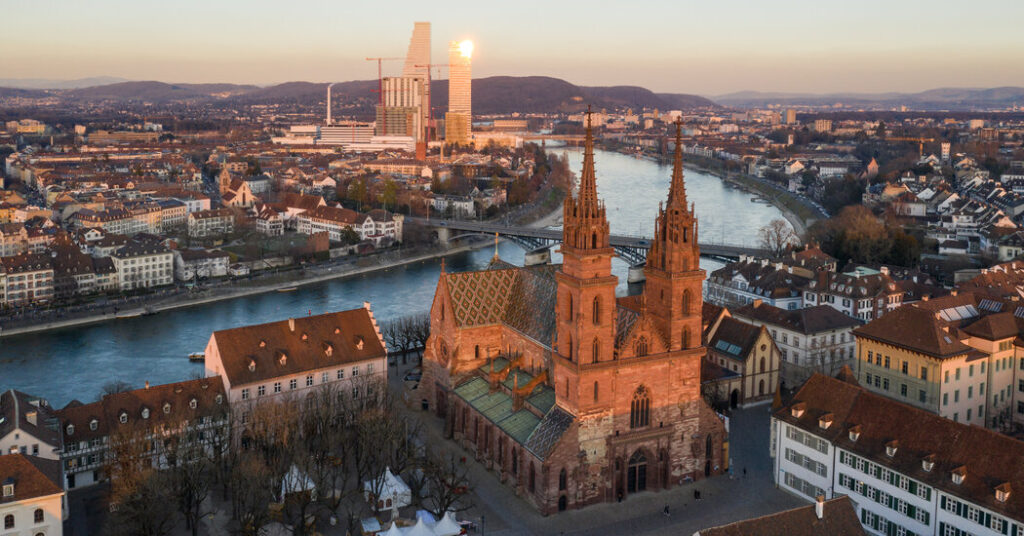
Basel, Switzerland, is a city of nearly 200,000 residents and nearly 40 museums — or about one museum for every 5,000 locals.
Once a year during Art Basel, the city’s population swells by tens of thousands as art aficionados from all over the world arrive to view and buy millions (possibly billions) of dollars’ worth of art.
“Attending the fair in Basel is just a deeply rich experience where you come to the city for this extraordinary fair, but the city itself becomes an extended campus of connectivity and engagement,” Noah Horowitz, Art Basel’s chief executive, said in a call last month.
But how did Basel, a relatively small city compared with Paris or New York, become a world-renowned destination for art?
“Basel sits at the crossroads of three countries, Switzerland, France and Germany,” said Isabel Friedli, a curator and the head of publications at the Schaulager, a museum storage facility just outside Basel that also exhibits its contemporary art collection. She said that trade routes in those countries came together in the 16th and 17th centuries, allowing for a greater cultural exchange.
Basel also has an extensive base of art patrons, many of whom grew wealthy in the city’s pharmaceutical industry.
The city’s cultural credentials date back to the Middle Ages.
1460: The University of Basel, the first university in Switzerland, is founded, after a papal edict from Pope Pius II. “The university is so central to why Basel became so important,” said Elena Filipovic, director of the Kunstmuseum Basel. “Over many centuries, though a small town, Basel became an important intellectual hub, cultural hub and a place of cultivated minds.”
1514: Desiderius Erasmus, a Dutch humanist, visited Basel for the first time, to work on his Greek translation of the New Testament, published in Basel in 1516 as Novum Instrumentum. In 1521, he took up residence in the city.
1515: Hans Holbein the Younger, the Northern Renaissance painter, arrived . He lived and worked in Basel until 1532, except for a two-year stint in England from 1526 to 1528. During that time, he created some of his best-known works, including his portrait of Erasmus, as well as “The Dead Christ in the Tomb,” and the “Passion Altarpiece.”
1536: Erasmus died, leaving his estate to his friend Bonifacius Amerbach, who combined it with his family’s large collection of books and coins, as well as of paintings by Holbein. Amerbach’s son added to it, collecting drawings, prints, and ethnographic and natural history objects, creating what would become known as the Amerbach Cabinet.
1661: When a collector in Amsterdam offered to buy the Amerbach Cabinet, the city of Basel and the University of Basel bought it instead, creating the first publicly owned art museum in Europe, the Kunstmuseum-Offentliche Kunstsammlung Basel, or Basel Art Museum-Public Art Collection.
1885-1900: Basel’s textile industry began to transition into a pharmaceutical industry in the late 19th century. Executives from companies like Ciba, J.R. Geigy SA, Sandoz and F. Hoffmann-La Roche & Co., often became major art collectors and museum patrons.
1932: Emanuel Hoffmann, a son of Hoffmann-La Roche’s founder and a serious art collector, died. The following year, his widow, Maja Hoffmann-Stehlin, established a contemporary art foundation in his name. In 1941, she gave the collection to the Offentliche Kunstsammlung on permanent loan.
1936: A new building was dedicated to the Offentliche Kunstsammelung, called the Kunstmuseum Basel. Today, that original building is known as the Hauptbau, and is one of three buildings that make up the museum.
1937-1939: The German National Socialists under Adolf Hitler labeled some 21,000 works of modern art as “degenerate,” and seized and destroyed many of them. The Kunstmuseum Basel’s director, Georg Schmidt, bought 21 “degenerate” works for its collection.
1945: Oskar Schloss, a book dealer based in Basel, died and left his bookshop to Ernst Beyeler, who reinvented it with his wife. They primarily collected lithographs by living artists, slowly transforming the shop into an art gallery.
1952: The Beyeler bookshop became the Galerie Beyeler, and focused its attention on German Expressionists and other European avant-garde painters, such as Käthe Kollwitz, Edvard Munch and Alexej von Jawlensky, as well as French graphic art.
1959: The Kunstmuseum Basel became one of the first European museums to buy Abstract Expressionist paintings by postwar American artists like Franz Kline, Barnett Newman, and Mark Rothko.
1967: Two Picasso paintings on loan to Kunstmuseum Basel, “The Two Brothers” (1906) and “Seated Harlequin” (1923), were about to be sold to an American collector. Basel’s citizens protested and the owner offered the city a chance to buy them first. Basel put the question to a public vote and the people decided to buy the paintings.
“That was unheard of,” said Filipovic, the Kunstmuseum Basel’s director. “There’s no other place where hippies, C.E.O.s, students, teachers, would all take to the streets to save two Picassos.”
Picasso, moved by the vote, later donated four more works to the city.
1970: Three gallery owners — Beyeler, Trudl Bruckner, and Balz Hilt — launched Art Basel. The fair had 110 exhibitors from ten countries and recorded 16,300 visitors, including the artists Robert Rauschenberg, Henry Moore, and Gilbert and George.
1974: Jean Tinguely, a Swiss artist, joined the Kuttlebutzer, a creative nonconformist group that performed at the annual Basel Fasnacht, or Basel Carnival, for more than four decades.
1980: Hoffmann-Stehlin, who had since remarried and went by Sacher-Stehlin, established the Museum für Gegenwartskunst, or the Museum of Contemporary Art in Basel, the first public museum in Europe exclusively dedicated to art made after the 1960s. Andy Warhol visited Basel and, while there, accepted a commission to create five silk-screen portraits of her.
1991: Tinguely, by then a well-established artist known for his playful machines and explosive performances, participated in the Kulturgüterwagen, a moving art train that traveled through Art Basel, in which each artist designed his or her own train car. He died a few months later.
1996: To mark its 100-year anniversary, the pharmaceutical company Roche established the Tinguely Museum in Basel, designed by Mario Botta, and built on a collection owned by Tinguely’s widow.
“Roche did it as a kind of thank you to the city of Basel, and it is still 100 percent financed by the Roche company,” Roland Wetzel, the Tinguely Museum’s director, said. “I’m not even allowed to fund raise, which is a very special situation.”
1997: Ernst Beyeler, one of Art Basel’s three founders, and his wife, Hildy, opened a new museum, the Fondation Beyeler, which contained their collection. It was designed by Renzo Piano and built on the grounds of Villa Berower in Rhiehen, just outside of Basel.
2000: Art Basel initiated “Unlimited,” a nearly 200,000-square foot space which could accommodate large-scale artworks that exceed the limits of the traditional gallery booth. Providing this flexible space for huge works became one of the fair’s most defining innovations.
2020-2022: Art Basel celebrates its 50th anniversary in 2020. The fair now has versions in Miami Beach, Hong Kong and Paris.
2026: Art Basel Qatar opened in February. Basel remains the fair’s premiere location, and this year it is set to host 290 international galleries from 43 countries, presenting works by more than 4,000 artists.
The post How Basel Went From Art to Art Basel appeared first on New York Times.