New York City’s oldest museum, the New York Historical (formerly the New-York Historical Society) was formed in Lower Manhattan in 1804 by citizens intent of preserving some of the clamorous recent American times they’d lived through. Two dozen years after the British had been routed and the Declaration of Independence signed, both the city itself and the new nation were still raw and small as, of course, was the fledgling museum.
Over the next century both would expand, and the museum would change locations, gradually moving uptown, finally settling, in 1908, at 170 Central Park West. And now, long-anchored there, it continues to grow. This week, in sync with the country’s 250th anniversary observances, the NYH will debut, in a “soft opening” mode, a major addition.
Named the Tang Wing for American Democracy, and stretching west on 76th Street, the four-story, 71,000-square-foot addition houses an open-air sculpture court, a roof garden, classrooms, the museum’s first on-site conservation lab and the future quarters, beginning in 2028, of the American L.G.B.T.Q.+ Museum.
Some of these spaces, designed by the architect Robert A.M. Stern, who died last year, are still in the polishing stages (the roof garden, with its views of Upper West Side rooflines, church steeples and Central Park, doesn’t have plantings yet). But others are ready for showtime.
One is a permanent gallery devoted to the Stuart and Jane Weitzman Shoe Museum, a charmer of an archival display of historic American female footwear dating from the 19th-century suffrage era to the present Age of Beyoncé. Another is a small corridor-like space packed tight with a show called “Queer Joy/Gay power,” featuring photographs by Fred W. McDarrah (1926-2007), who was on the spot that night in 1969 when Stonewall Inn patrons went rogue.
And nearby is a tribute to Tyler Cementi, a New Jersey teenager and budding professional musician who, in 2010, committed suicide after being cyberbullied by a Rutgers University roommate. Clementi’s violin and bow, given to the NYH by his family, are on display.
And a third new space, the Tang Wing’s primary, high-ceilinged, light-flooded special exhibition gallery, is home right now to a group show called “Democracy Matters.”
It’s the latest of three exhibitions the museum has organized in response to this year’s United States Semiquincentennial, though the only one drawn entirely from its own collection of more than 1.6 million objects.
The other two shows, on view in the museum’s older galleries, are conceived as nuanced historical narratives. One, “Old Masters, New Amsterdam,” is a portrait, through period art and artifacts, of the 17th-century Dutch culture that produced the original beta version of New York City we know. The other, “Revolutionary Women,” documents the female force, of both loyalist and revolutionary persuasion, behind the American War of Independence.
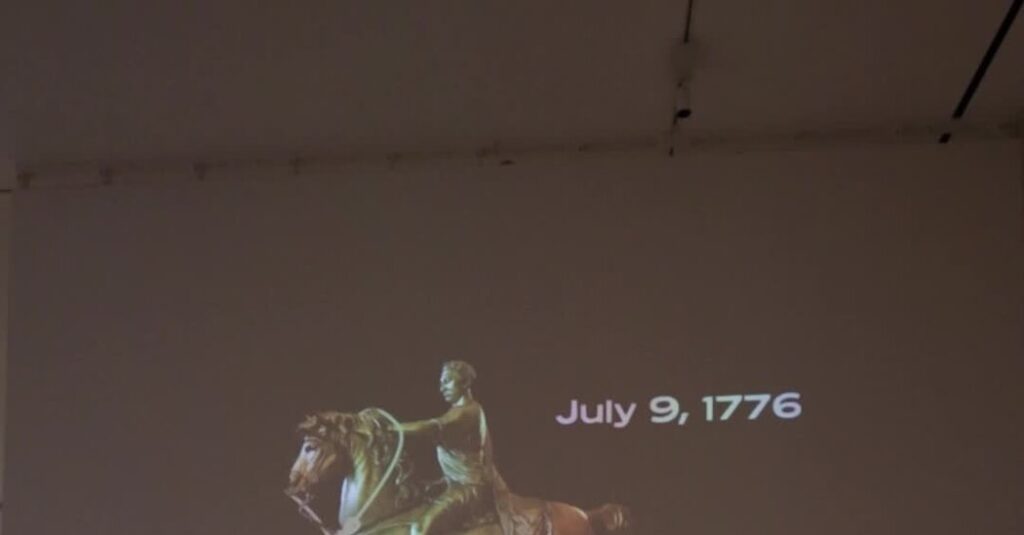
“Democracy Matters” follows a different model. It’s historically broad, thematically loose, unabashedly polemical, made up of equal then and now. It opens with a made-for-the-occasion work, a life-size video re-creation of a historic event. On a floor-to-ceiling screen we see a group of capering figures, depicted as featureless white silhouettes filled with text fragments from the Declaration of Independence, attacking an equestrian monument that explodes before their eyes.
It references a real event. In Lower Manhattan on the evening of July 9, 1776, after the first public reading of the new Declaration, patriot soldiers toppled a gilded cast-lead equestrian sculpture of the British King George III and chopped it up. Most of the fragments were melted down to make bullets; a few survived and a handful (including the tail of the royal horse) are in the NYH collection. Encased here in glass, they introduce the first of the show’s five thematic sections.
Titled “Right to Protest,” its first entry is another image of the same event, this one hinting at complications built into the American-style version of democracy from the start. In a mid-19th-century painting by the German-American immigrant artist Johannes Adam Simon Oertel, the pulling-down is in progress, but the crowd here is large and visibly multicultural. It includes a Black man who looks in danger of being crushed in the melee; a Native American family half-lost in shadow, mute witnesses; a huddle of emoting women set apart from the fray.
A wall label describes Oertel’s image as commentarial: a view of a revolution in which the vaunted idea of liberty was only “selectively applied,” a view of a new nation in which, under slow-to-change laws, women were technically second-class citizens, Native Americans had few civil rights, and a population of captive Africans had no rights at all.
Letting history, as embodied in art and artifacts, speak critically — positively and negatively — is the basic strategy of the exhibition, organized by Wendy Nālani E. Ikemoto, NYH’s vice president and chief curator.
The opening section, “Right to Protest,” encompasses not only the 1776 sculptural relics, and Oertel’s editorializing picture, but also one of McDarrah’s classic Stonewall Uprising photos and a 2017 Betye Saar assemblage sculpture, “Extreme Times Call for Extreme Heroines,” incorporating an Aunt Jemima figure armed with an assault rifle. (A solo show of Saar’s work, honoring her 100th birthday this year, is also on view in the museum.)
A section called “Right to Vote” has this cautionary, thumbs-up, thumbs-down mix. The presence of the plain-style mahogany armchair in which George Washington sat for his inauguration in 1789 — far from a throne — is a reminder of how radical, in the monarchic-dominated Western world of the time, the very idea of voting for a leader was.
The placement nearby of a post-Civil War plaster sculpture titled “Challenging the Union Vote,” in which an armed ex-Confederate poll worker guards a ballot box, suggests how easily voting can be manipulated.
A hand-lettered evening gown urging the passage of the long-stalled Equal Rights Amendment (E.R.A.), worn by the Democratic New York congresswoman Carolyn B. Maloney to the 2021 Met Museum gala, is a reminder that women have equality to claim way beyond suffrage. Finally, a spectacular painting by the graffiti star Lady Pink (a.k.a Sandra Fabara) blows the word “Vote” up, bubble style, to mural size and fills it with figures and words: images of street demonstrations, the Liberty Bell, the Constitutional phrase “We the People.”
Who are “the People”? The show gives us a sampling of some. One, seen in a 19th century portrait, is a historical figure, Dred Scott. An enslaved Black man, in 1857 he sued for his freedom on the grounds that he was resident of a state (Illinois) where slavery was banned. The U.S. Supreme Court’s response? Not only was he not free, but no people of African descent could be considered American citizens.
And some of “the People” are fictional, as in the case of a Native American man shown wrapped in a stars-and-stripes flag in a print made for the 1976 Bicentennial by the artist Fritz Scholder (1937-2005). He could be taken for a patriot except that he wears the flag sacrilegiously upside-down.
There’s no way to know, short of reading the wall label, that a tiny wood-brooch in the form of a bright-colored songbird bird was made by a pair of artists, Yoneguma and Kiyoka Takahashi, husband and wife, who were, with their three children, among thousands of Japanese Americans labeled “enemy aliens” and confined to internment camps during World War II.
Nor is it easy to know who or what we are seeing when we look at a 2024 sculpture by Suchitra Mattai, an artist of South Asian descent born in Guyana and now based in Los Angeles. Titled “She Arose (from a Pool of Tears),” and acquired by the museum this year, the piece is a life-size female figure dressed in a pink body suit in a classical Indian dance pose — arms stretched high, legs extended — as if emerging from, or touching down on, a circular rippling pool formed from braided saris.
And she’s surrounded and framed by one of the NYH’s single greatest American art treasures, the five-part series of 1830s paintings by Thomas Cole titled “The Course of Empire.” The series depicts the imagined rise and fall of a civilization, from its roots in a verdant wilderness, to its rise to urban extravagance (here resembling a Classical, gold-plated Trumpian Washington), to a descent into chaos and ruin.
But in the final painting the ruin is beginning — just — to sprout signs of fresh life. And maybe that’s where Mattai’s buoyant cross-cultural figure comes in. A versatile global dancer (references to Afro Beat, Bachata, Balanchine and Bharatanatyam can be read in her pose), dressed all in hot pink (a mix of red, white and blue), she’s an alternative Lady Liberty, and an apt advocate for a new American democracy.
Democracy Matters
Through Nov. 1, at the new Tang Wing for American Democracy, The New York Historical, 170 Central Park West, Manhattan, (212) 873-3400. Extended pay as you wish hours — 5 to 8 p.m. Thursday to Saturdays through July 4; nyhistory.org/on-our-250th.
The post The Newest Wing in the City’s Oldest Museum Celebrates Democracy appeared first on New York Times.