China’s national team failed to make the World Cup this year, again. But the country’s soccer fans have found someone else to cheer for on the field: a referee.
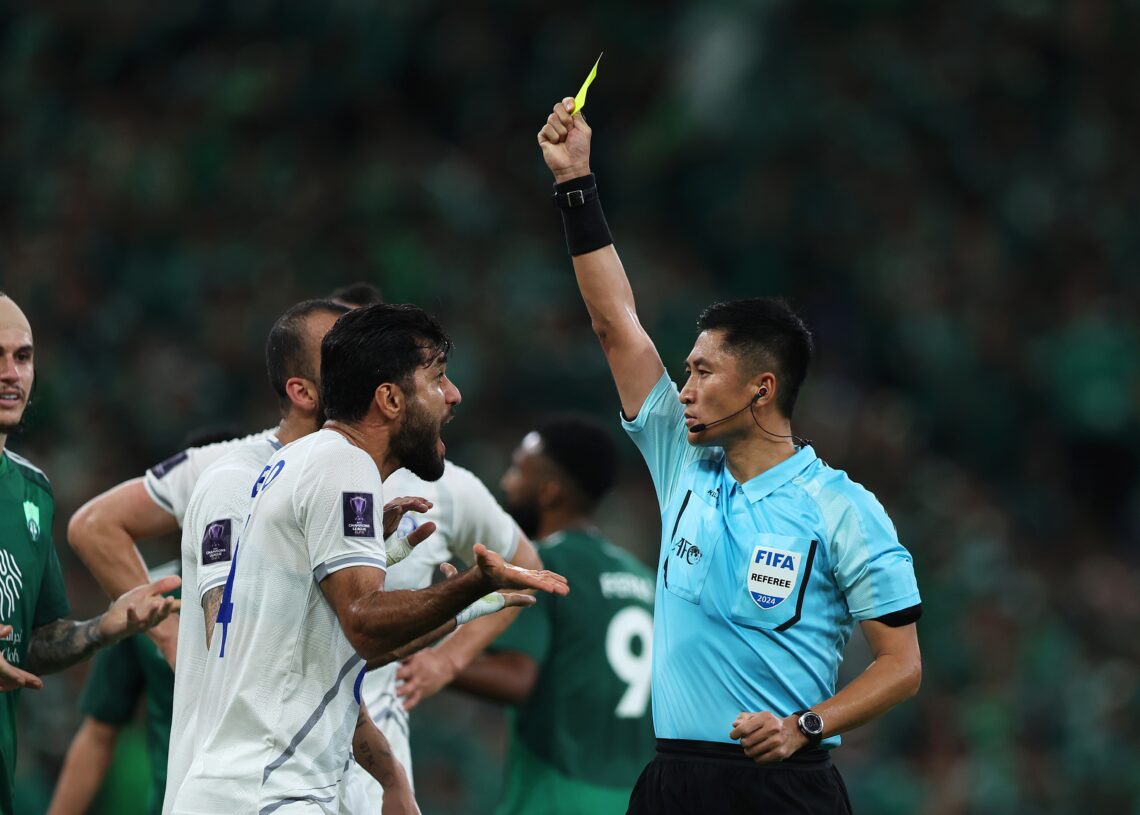
With no players on the pitch, Ma Ning, 46, is the most prominent Chinese participant in this year’s tournament — and he’s parlayed his officiating experience, strict on-field demeanor and social media savvy into unlikely stardom back home, where he’s landed media interviews and major sponsorships.
Ma is the first Chinese official selected for two World Cups. After making his debut in Qatar four years ago as an assistant referee, he‘s now taken the whistle as a match referee. His first assignment comes Saturday, when Ecuador and Curaçao meet in Kansas City, Missouri. (He is joined on soccer’s greatest stage this year by countrymen Zhou Fei, an assistant referee, and Fu Ming, a video assistant referee.)
A basic maxim of sports officiating is that if you’re doing it right, no one notices you. The fans come to see the players; referees typically strive for anonymity.
Ma has taken a different approach.
Before departing for the United States last month, the whistle-blower launched an account on RedNote, the social media platform broadcasting the tournament in China. Posting his training record and behind-the-scenes videos, he has gained more than 310,000 followers and counting.
Before now, Ma’s reputation has been complicated. As a referee in the Chinese Super League, he’s known as Card Master — a nickname earned during a 2015 Shanghai derby match, when he issued nine yellow cards and three red cards. The match ended with 11 players on one side, eight on the other, a 5-0 result and fans divided about Ma’s role.
“It’s said that when Ma goes on trips, he brings two suitcases of cards,” one RedNote user commented. “One full of yellow cards and one full of red cards.”
Some accuse Ma of seeking attention. He says he is misunderstood. “I behave differently on the pitch,” he told the state-run wire service Xinhua. “People only like or notice a stronger side of my personality.” His friendliness with players, he says is often overlooked.
But now, with no Chinese team in the tournament to suffer his wrath, the country’s fans have united behind him, more or less: “Although we don’t have a team that makes others tremble,” another user quipped, “we do have a referee who does.” Memes depicting Ma brandishing red cards have gone viral.
His unusual prominence has helped him secure sponsorships from, among others, the electronics giants Lenovo and Hisense and the dairy company Mengniu.
Not long ago, China was seen as a potential rising power in soccer. The Dragon Team won the East Asian Football Championship in 2005 and 2010 and managed victories over perennial powers Argentina in 1984 and France in 2010.
But the Chinese Football Association, the national federation, has been bedeviled by corruption and bribery scandals. The men’s team has qualified for just one World Cup, in 2002; it lost all three group games without scoring. It’s currently ranked 91st in the world, behind Zambia, a country one-sixty-fourth its size. (China’s women’s team has enjoyed more success, including second-place finishes in the 1996 Olympics and the 1999 World Cup. It’s ranked 16th.)
Ma is the second Chinese official to serve as a match referee in the World Cup. Lu Jun also became popular while officiating in 2002; he was later jailed for match-fixing in the Chinese Super League.
Ma, from China’s northeastern province of Liaoning, worked for years as a physical education teacher before he was selected in 2011 as an international referee. He continues to teach as an associate professor at Nanjing Sport Institute.
Now he’s approaching the age at which international referees typically retire. He told state broadcaster CCTV he would make a decision after the tournament.
It’s not so different, he said, from the process aging players go through. ”We dedicate our youth, our best years, and everything we have to refereeing,” he said.
And in Ma’s case, to giving Chinese fans a reason this year to tune in. “Other countries watch their teams at the World Cup,” a third RedNote user said. “We watch our referees.”
The post Shut out of the World Cup again, China roots for a referee appeared first on Washington Post.