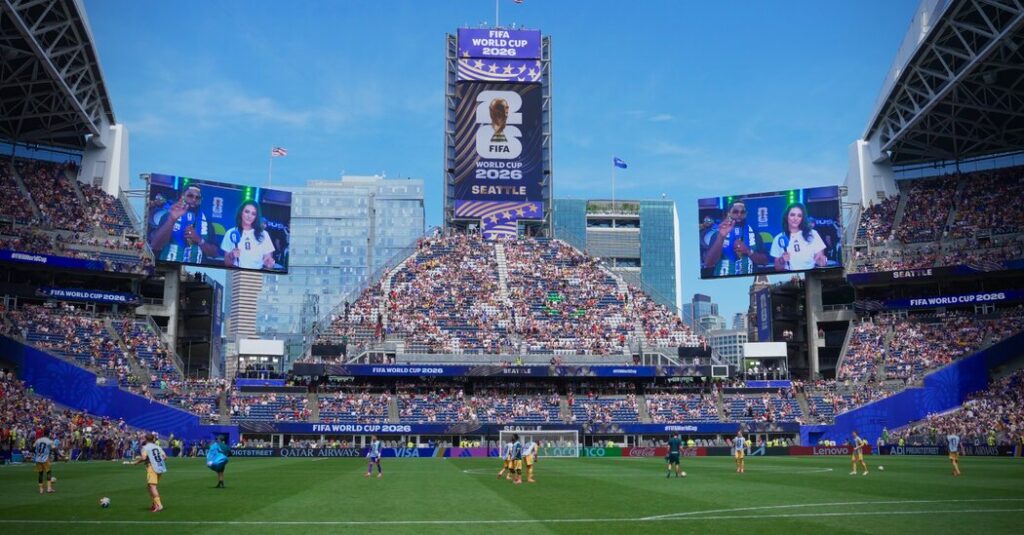
For Seattle soccer fans, the ghosts of 1994 are finally being exorcised.
Long one of the nation’s most passionate soccer cities, Seattle lost out when FIFA selected game sites in 1994, the last time the United States hosted the World Cup. The snub remains a sore point for local soccer lovers, who attribute it to uncertainty over whether matches would have been played in the Kingdome or at the University of Washington’s Husky Stadium, as well as concerns about the facilities themselves.
This time around, there was little doubt that Seattle would make the cut: Lumen Field, though home to the NFL’s Seahawks, was designed with soccer in mind. The Seattle Sounders FC have become one of Major League Soccer’s flagship franchises, routinely drawing crowds of more than 30,000. Their counterparts in the National Women’s Soccer League, the Seattle Reign FC, helped establish Seattle as one of the country’s leading women’s soccer markets.
And, by the 2010s, Seattle had become a destination for some of the biggest names in American soccer: Clint Dempsey retired as a Sounder, while Megan Rapinoe spent her entire NWSL career with the NWSL Reign.
“This is just a great soccer city,” said Lenny Peters, who came to a pre-match pep rally near the waterfront wearing a Seattle Mariners baseball jersey and hat.
He said he had been in high school when Seattle failed to secure World Cup games in 1994, though he didn’t remember much about the communal disappointment. “But of course it’s here now,” he said.
Seattle, long an also-ran in professional athletics, is on a roll. The Seahawks won the Super Bowl in February. The Mariners were just eight outs away from reaching their first World Series last year. The city has a popular new National Hockey League team, the Seattle Kraken, and the NBA is close to bringing back the Seattle SuperSonics. The team moved to Oklahoma City in 2008, in the Puget Sound region’s other lingering sports heartbreak.
Seattle is hosting six World Cup matches this year, including Friday’s game between the United States and Australia. Though hotel bookings in the city have been below expectations, every match is expected to be a sellout or close to one, and tens of thousands more people have crowded watch parties at bars, malls, a floating dock on Elliott Bay and in Pioneer Square. On Friday morning, the crowd waiting to watch the U.S.-Australia game on a screen in Brick Park was shoulder-to-shoulder two hours before kickoff.
“You cannot beat this environment,” said Simon McPherson, an architect from Melbourne, Australia, who is attending games in Seattle and Santa Clara, Calif., and has also visited Portland, Ore., on a week-and-a-half World Cup trip. He was eating a cheeseburger and wearing a newly purchased Mariners hat, along with a Socceroos jersey, as he walked along the crowded waterfront Friday morning.
“I wasn’t sure what to expect, but everyone here is just so excited and warm,” he said.
The pre-game flurry on Friday, with downtown and the stadium district packed with U.S. fans wearing American flags on every piece of clothing imaginable, felt like a culmination for Seattleites. Before the tournament, civic leaders had worried that either no one would come, or that federal immigration officials would use the tournament as an opportunity to crack down on one of the country’s most liberal cities.
Seattle’s mayor and City Council members squabbled almost up until the start of the tournament about whether to turn onclosed-circuit security cameras around the stadium; the mayor and some civil rights groups feared that federal law enforcement officers might use the newly installed cameras to target immigrants.
“I was kind of scared at first,” said Kat Garsi, who wore a Sounders scarf over her U.S. women’s national team jersey Friday morning. “But it’s all just been so joyful.”
Now if they can just get the SuperSonics back.
The post ‘Just a Great Soccer City’: Spurned in 1994, Seattle Is Now a World Cup Draw appeared first on New York Times.