Last year, the phones were ringing off the hook at Stiebrs Farms, a family-owned egg producer at the foot of Mount Rainier in Yelm, Wash.
Avian influenza, or bird flu, was sweeping across the country, slicing deeply into the nation’s egg-laying hen population. Egg prices surged to record highs of more than $8 a dozen, prices desperate buyers were willing to pay.
Since then, wholesale egg prices — prices paid by grocery stores and restaurants — have plunged 93 percent to below 60 cents a dozen. The phones have fallen silent at Stiebrs Farms.
“This is a third-generation farm, and we’d love to see a fourth generation continue with it,” said Sara Stiebrs, who owns the 500,000-hen operation with her husband, Yany. “But how can you be sustainable when prices are below the cost of production?”
Last year’s quandary of not enough eggs has reversed. Egg producers, either hedging against potential losses from another bird flu outbreak or trying to cash in when prices were sky high, added production capacity, significantly increasing the nation’s supply.
“Some of the big commodity egg players, those with the really big productions, way overpopulated the number of hens,” said Tom Flocco, the chief executive of Pete & Gerry’s, which produces premium-priced organic and pasture-raised eggs. “By our estimate, the industry has a 12 to 15 percent oversupply right now.”
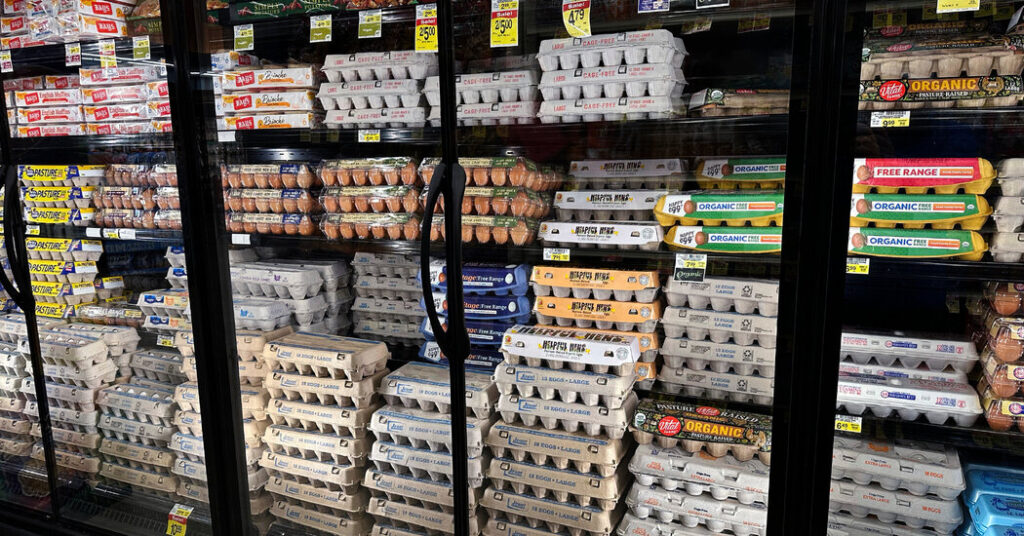
With the market swimming in eggs, prices have plunged. At grocery stores, egg prices in May were $2.19 a dozen, a steep drop from the record high of $6.23 in March last year, according to the Bureau of Labor Statistics.
Some producers, particularly smaller family-owned operations, fear being financially squeezed if the low prices stick around for an extended period.
It’s unclear if consumers will see the superlow prices for eggs because grocery stores, large manufacturers and big restaurant chains locked in six-month or even one-year contracts at higher prices to ensure they had a steady supply, said Brian Moscogiuri, a co-founder of KHM Trading, an egg brokerage firm that connects farms and buyers.
“Last year, you saw diners and restaurants increase prices on menus or add surcharges for eggs,” Mr. Moscogiuri said. “I’m not sure those prices have been pulled back.”
For restaurants, which have been squeezed by cutbacks in consumer spending and higher costs for beef and other ingredients, eggs may be a source of potential profits, he added.
President Trump, who campaigned on reducing grocery store bills for Americans, trumpeted the drop in egg prices during the White House Easter Egg Roll in April.
“And within a short period of time, eggs came down,” Mr. Trump said during the event. “They came down 40 percent, 50 percent.”
While sharp swings occur often in commodities, the roller-coaster ride is unusual for egg producers. For decades, prices stayed in a fairly tight range, with the number of egg-laying hens basically balanced with demand in the United States.
“The historic base line was around 310 million birds,” said Emily Metz, the chief executive of the American Egg Board, a national marketing association. After the number dipped to as low as 270 million hens last year, she said, as many as 340 million may be currently laying eggs. “We’re quite a fair bit higher than we’ve been.”
At current price levels, egg producers, particularly smaller operations, are most likely losing money. The four-month average cost to produce a dozen eggs was running around 78 cents at the end of April, according to a report from the Egg Industry Center at Iowa State University.
Other producers said they feared that another wave of consolidation could hit the industry. The five largest producers control roughly half of the U.S. egg market.
Many of those producers are under investigation by the Justice Department over possible antitrust violations. Investigators have spent the better part of the past year examining whether the companies shared sensitive information about pricing and supply that contributed to the spike in prices.
The Justice Department declined to comment on the status of the investigation.
Chad Hart, an economics professor at Iowa State University, said the egg industry was likely to go through some consolidation and slow production down a bit to come back in line with consumer demand.
“Because of the weakened state the industry is in right now — prices are low, revenues are low and costs are high — some of those in the egg business are financially stressed,” Mr. Hart said. “They’ll start to look for partners.”
In early April, Cal-Maine Foods, the nation’s largest egg producer, reported a 53 percent drop in sales, to $667 million, in the quarter ending Feb. 28, compared with a year earlier. The company attributed the slide to lower prices as well as lower volume, or demand. Its gross profit fell 83 percent, to $119.3 million, in the quarter.
Cal-Maine’s stock, which hit a record high of $120 last July, has dropped to about $78 a share.
Still, the company continues to invest in its egg operations. In March, it announced plans to acquire Creighton Brothers, an egg producer in Indiana, and its egg-processing business for $128.5 million.
“Eggs continue to be well positioned with the long-term consumer shift toward high-protein diets supported by their strong nutritional profile, and affordability is a huge plus for us right now as a tailwind,” Sherman Miller, the chief executive of Cal-Maine, said on an earnings call in early April with Wall Street analysts and investors.
Cal-Maine did not respond to requests for comment.
Besides promoting the message that eggs are a relatively inexpensive source of protein, the egg industry is racing to find new customers outside the United States.
The American Egg Board has gone on trade missions with the Department of Agriculture to push for exports of eggs to countries like Indonesia and the Philippines, Ms. Metz said.
“South Korea has a request for U.S. in-shell eggs,” she said. “It’s willing to pay freight to fly eggs in-shell there.” Most other countries are interested in liquid or dried eggs, which are easier to ship and have longer shelf lives, she said.
And yet, bird flu has not gone away.
Avian influenza, caused by the H5N1 virus, landed in the United States in 2022, but in the fall of 2024, the outbreak intensified sharply. Over four months, tens of millions of birds — roughly 15 percent of the country’s egg-laying chickens — were infected or killed.
Wholesale egg prices surged 255 percent, according to data from Expana, which tracks the prices of eggs, as consumers, restaurants and food manufacturers raced to lock down precious cartons. The shortages were compounded as consumers bought more eggs than they needed.
“We couldn’t produce the eggs fast enough. It was insane,” Ms. Stiebrs said. “We had people calling from all over the United States, salad dressing companies and companies we hadn’t done business with before, saying: ‘We need eggs. We need eggs.’”
So far this year, while the number of bird flu outbreaks has fallen, several cases have been reported, particularly in Indiana, according to the Animal and Plant Health Inspection Service inside the Department of Agriculture.
While some egg producers have pushed the Trump administration to quickly develop and administer vaccines to the nation’s bird population, others warn that those vaccines are likely to be expensive and could, in fact, hinder export opportunities.
But Ms. Stiebrs said the illness was what worried her, and other egg producers, the most.
“Every single day, you say a prayer that your flocks are going to be protected,” she said. “You pray for your farm and for the farms of your friends and for the farmers who have suffered.”
The post Good News: Egg Prices Are Down. Bad News: They’re Hurting Farmers. appeared first on New York Times.