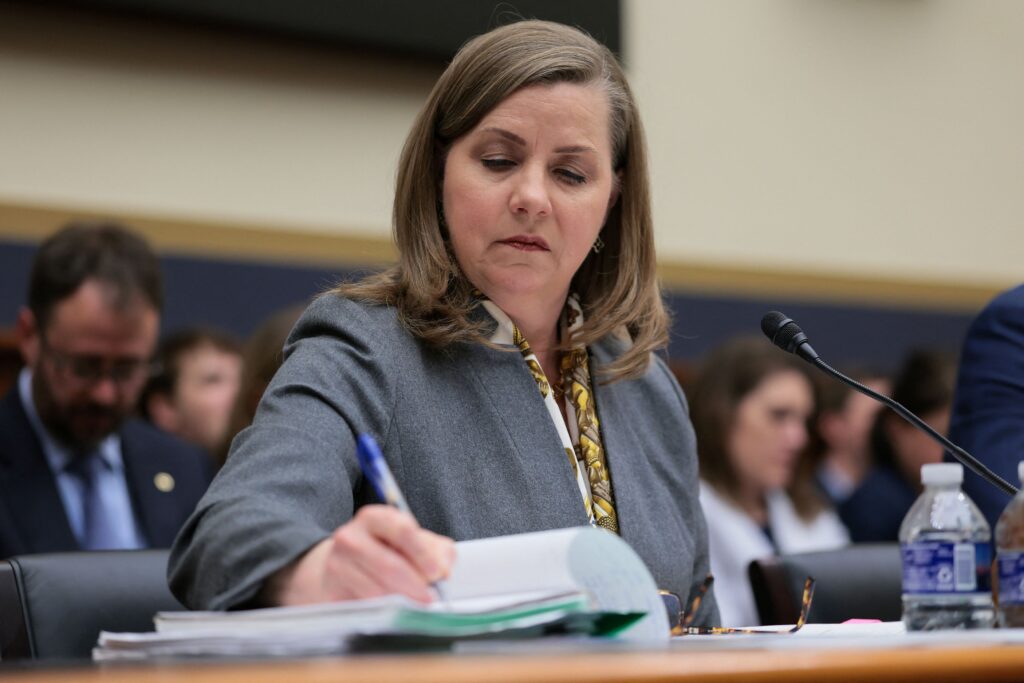
Michelle Bowman, the Federal Reserve’s top banking regulator, spoke at a private dinner that Bank of America hosted for clients on Wednesday, according to three people familiar with the event, during the Fed’s “quiet period,” when officials are restricted from interacting with the public.
The dinner took place in New York, hours after the central bank announced that it was holding interest rates steady, and featured executives from hedge funds and other Wall Street firms, according to the people, who spoke on the condition of anonymity to discuss details of a closed-door event.
The timing of the dinner was near the end of the Fed’s communications quiet or blackout period, which prohibits officials from commenting on monetary policy in the days surrounding a policy meeting, so the Fed can clearly communicate its interest rate decision and individual officials don’t undermine the message. The quiet period extended through the end of Thursday. Related Fed restrictions also aim to guard against the appearance of favored access.
The event was organized by Hayley Boesky, Bank of America’s executive vice chair for public policy and client engagement, and involved more than 20 business clients of the bank, according to two of the people.
Bowman’s participation in the dinner was earlier reported by the Wall Street Journal. She is a Republican on the Fed’s seven-member board of governors and was appointed to her position by President Donald Trump in 2018.
In a statement, Bowman said she did not share her views on monetary policy at the dinner. “I have consistently complied with all applicable FOMC and ethics rules and remain firmly committed to doing so,” she said, using an referring to the acronym for the Federal Open Market Committee, which sets interest rates.
When Boesky introduced Bowman, she noted that the blackout rules barred her from discussing monetary policy, one of the people said. Two Fed staff members who accompanied Bowman also reminded attendees that she could not address monetary policy, the person said, adding that Bowman’s remarks focused on bank regulation.
Patrick Harker, who led the Philadelphia Fed for a decade before retiring last year, said the quiet period and related rules against favoritism that he and his staff followed left no room for ambiguity. He could not speak publicly until the Friday after a policy meeting, and private dinners with a single firm’s clients were off-limits regardless of what was discussed, he said.
“The rules are not ambiguous here,” Harker said. “It doesn’t matter if you talk about monetary policy or not during that dinner, you just don’t do it.”
The Bank of America dinner occurred hours after the conclusion of Kevin Warsh’s first meeting as Fed chairman, during which nine of the 19 officials who participate in those meetings signaled they could support an interest rate increase by year’s end — a sharp reversal from March, when none did.
This meeting starkly contrasted with past meetings, because Warsh shared far less information about how Fed officials see the economy unfolding in the months to come. Warsh said he wanted to move away from sharing such forward guidance.
The Fed’s general communications policy for board members and bank presidents instructs officials to refrain from sharing personal views on monetary policy with anyone who could profit financially from that information, unless those views have already been made public. It also directs them to avoid giving any profit-making firm a “prestige advantage” over competitors, and to weigh that principle carefully when considering invitations to speak at events closed to the public and the press.
The policy identifies a private meeting with selected clients of a for-profit firm to discuss monetary policy as the kind of contact that would not be consistent with its principles.
Whether Bowman’s appearance crossed the line is unclear. The policy — adopted by the FOMC in 2011 and reaffirmed as recently as January — does not specify how potential violations would be handled.
Richard Painter, who served as the White House’s top ethics lawyer under President George W. Bush, said attending the dinner would not have been permitted under the standards his office enforced. Federal gift rules allow officials to attend events sponsored by trade groups, such as the American Bankers Association, but not by a single company, he said. Separate ethics rules bar the appearance that a federal official is endorsing a specific firm, regardless of whether any actual endorsement occurred, he said.
“It’s absolutely critical that the Fed not be perceived as favoring one bank over another,” he said. “This is like a referee in a game going on the field wearing one of the team’s jerseys. It doesn’t give the appearance of fair play.”
The post Fed governor spoke at Bank of America dinner during Fed’s ‘quiet period’ appeared first on Washington Post.