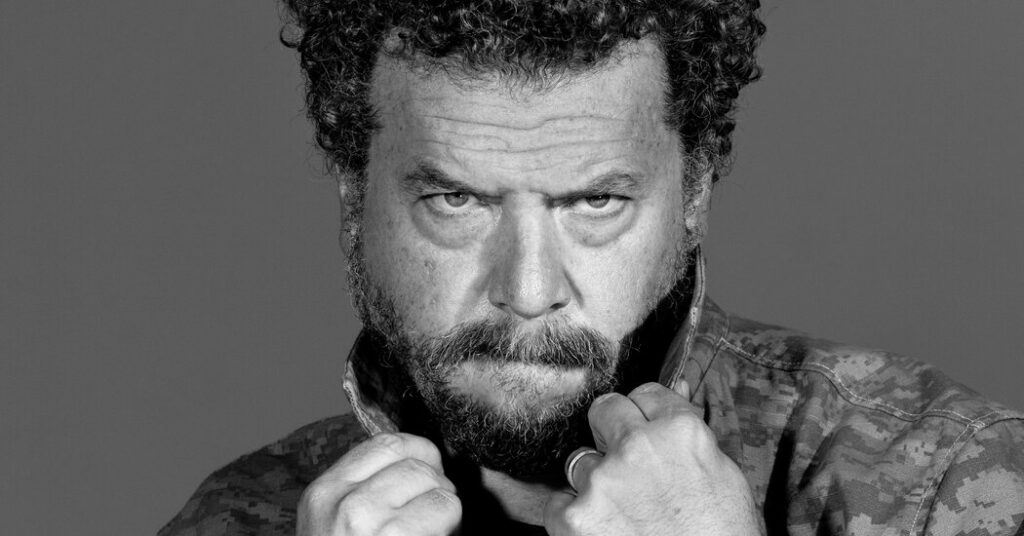
Danny McBride’s three HBO series, “Eastbound & Down,” “Vice Principals” and “The Righteous Gemstones,” all of which he starred in and helped to create, weren’t just satirically sharp, hilariously profane and sneakily heart-tugging — the shows also worked as an almost anthropologically detailed study of a certain type of modern American manhood. McBride’s antiheroes were arrogant, insecure, unapologetic, vulgar and money- and status-obsessed, and they nursed all kinds of petty grievances. That’s despite being, in various ways, near the tops of their own particular heaps. They were also widely beloved.
Now McBride is turning his gift for satire and character study to short stories, with his first book, the forthcoming collection “Thrilling Tales of Modern Men.” Some of the stories fit neatly into his canon of wounded protagonists who lash out. (A canon that also includes his work as a writer for the rebooted “Halloween” horror films.) Others tip toward a quieter emotional depth, albeit one still laced with obscenity and the occasional violent outburst. But they’re all undeniably the work of a storyteller interested in entertaining while also poking at what makes men tick and then go boom.
Subscribe: Apple Podcasts | Spotify | YouTube | Amazon | iHeart
The themes of the book speak very clearly to one of the great themes of this moment, what people call a crisis of masculinity. Do you have a sense of why that’s a problem now? Maybe because everyone says that there’s something wrong with men now? [Laughs] Growing up in the ’80s, you were being sold machismo, action, “kill ’em all, let God sort ’em out.” That was pounded into anyone’s brains that came up on cable television or watching movies. I think it took me a little while to realize that’s not real life. That’s not how things work. Maybe there is this slow waking of, like, everything I’ve been told isn’t necessarily how it’s supposed to be, and then it’s that awkwardness of finding out what is important to you or what your values are.
There’s one story in the book titled “The Institute of Men” which is about a guy who goes to a hair-growth clinic and has to take an intake survey that has some strangely emotionally direct questions. I want to ask you a couple of those. Wow, how clever of you. Here we go!
When was the last time you were in a physical altercation? It was a long time ago, it might have been 2000. I got into a scuffle with an ex-girlfriend’s boyfriend who was being abusive. I went to pick her up, and I got into a fight in the middle of Burbank. I was a young man. This was my first real serious girlfriend; we moved out to L.A. together. She got mixed up with another guy. She wanted to end it with that other guy, and he wasn’t happy about that. She called me up and said: “Hey, can you come pick me up? I’m at this guy’s place, and he’s giving me a hard time.” So me and two of my roommates, we’re all guys who went to art school — nobody here’s a bruiser — but my heart was broken, and I’m like, We’ve got to go get her. And we’re looking around, like, “Do we have weapons? There’s a golf club!” So we drive in my Hyundai Elantra to Burbank, and my ex-girlfriend’s waiting outside, and the guy’s with her, and the dude is like 6-foot-5. He’s massive. My first instinct was, Damn, she went for a really strong guy after me. I finally get out of the car. My buddies, who I thought were going to get my back, just stayed in the car, and my one buddy just rolls down the window and hands me the golf club. I wasn’t even asking for the golf club, but I took it because I wasn’t sure what to do. That escalated things because the guy’s like, “What are you going to do with that golf club?” I was like: “I’m not really sure what the plan was for the golf club. I guess hit you with it? I don’t know what’s happening right now.” And he came at me. I swung and aimed for his knees. I hit him with the shaft, and it just easily broke across his knees. Didn’t slow him down at all, and I’m just holding the handle of the golf club. He looks at me like, What the hell? Then he socks me, we’re on the ground tussling, and then the girlfriend comes in, she pulls him off by his hair, we all get back in the car, my nose is bleeding, we rescue her and go. That was the last physical fight I was in.
I hate to implicitly endorse physical violence as a means to solving a problem, but you were the good guy in that story. Someone had to stand up for what was right.
Another one of the intake questions in the short story is “When was the last time you cried?” Oh, God. It doesn’t take much these days. My son just graduated from eighth grade. There was a ceremony, and they put together this little slide show. I definitely found myself like, “Oh, damn, I hope the lights don’t come up right now. I’m welling up; I’m leaking here.”
A lot of the characters in the book are struggling to find purpose in their life, or they’re looking for meaning. Maybe because they feel emasculated or feel anxiety about their status. Where do you think people find meaning and purpose? I grew up going to church. My mom was a puppet minister. My parents were really involved. After they got divorced when I was in sixth grade, we just stopped going. So now I have kids, and church isn’t really a part of our life either. And I started thinking, there are all these basic things I learned from going to church, basic morals and values, and I’m taking for granted that my kids are going to pick all that stuff up from the world around them, but they’re not. You do have to think about that. It’s a dangerous time, honestly, with how much influence these phones have and what people can be getting exposed to without really realizing it. Even the algorithm can be tainting what you think is right and wrong.
Can you tell me about your mom’s puppet ministry? Maybe I’m betraying my own ignorance here, but I wasn’t really aware that was a thing. You seem like you’d be really into puppet ministry.
I actually like puppet ministry, but I mean puppets of the band Ministry. [Laughs] When I was a kid, we went to this little Baptist church in Spotsylvania, Va. My mom bought these puppets, and she would write these plays and do the children’s sermons during church. On Sunday mornings, we would load the stage and the puppets into the car and go to church early to help her get set up. Then, before the big sermon would happen, my mom would do these little morality tales about why you shouldn’t steal or covet what your neighbors have. Our family didn’t have a computer, but my mom bought a typewriter, and I used to watch her in the kitchen, typing up these scripts for these puppet ministries. I thought it was cool that she was creating something in our kitchen and then, two days later, I’m in the middle of church watching people react to it.
And do you think that’s part of why you got into storytelling? I think it was. There was something about it that I just found fun — to know that there was something concocted for the benefit of other people. I kept those puppets for a long time. I didn’t know what to do with them. They’re kind of creepy. They were in Tupperwares in my house in Virginia, and then finally I gave them to my sister. I don’t know what she does with them. It’s kind of a weird thing to get rid of though. You have these puppets that your mom had when you were a kid. The idea of them sitting in a dumpster somewhere is heartbreaking.
Why did your family stop going to church? This was back in the ’80s, and divorce wasn’t as accepted as it is now, especially in the church. It was my first taste of the hypocrisy of the people that can go to church. My parents get a divorce, and my dad’s in Florida, my mom’s raising me and my sister by herself, we’re going to church, and they’re all whispering behind her back. It became an uncomfortable place for her. So she stopped going and would drop me and my sister off each Sunday. Then after a few weeks of that we were like, “I think we’re good with church. We’ll take care of ourselves now.”
Did that mean you stopped being a believer? No. When you’re a kid, you’re not really thinking about whether you believe or not. I took a lot of those beliefs for granted. As I’ve gotten older, I definitely think about spirituality a lot. I wonder where we’re from and where we’re going, if we’re going anywhere. I don’t feel like I have the answers, and so I’m very open to what other people’s answers could potentially be.
You said that when you’re a kid, you’re not really thinking about whether you believe or not, but I had the opposite experience. My mom was Jewish, and my dad converted to Judaism, but he was born Roman Catholic. So sometimes I would end up at Mass, and sometimes I’d be at temple, and I remember thinking: Is any of this true? They’re saying one thing over here and a totally different thing in the other place. Yeah, I spent most of my time in church drawing pictures over the minister’s face in the programs. I wasn’t soaking the whole message in.
Are there ways in which your dad was an influence on the kind of work that you ended up doing or the person you became? Maybe just because he was a piece of [expletive], he’s inspired a lot of these jackasses I’ve played. [Laughs] No, I’m just kidding.
You’re not kidding. No. I mean, he wasn’t much of a storyteller, except for maybe the stories he would tell me and my mom and my sister about what he was up to.
What kind of stories was your dad telling you? Nothing good.
How much was “The Righteous Gemstones” an outgrowth of your church experience? You know, it was. I left Los Angeles in 2017. My son was about to go into kindergarten. I was looking around the city and wasn’t sure how I was going to raise my kids there. We lived off Mulholland Drive, and I remember my son wanted to learn how to ride a bike, and my thought was: “Why? You’re never going to ride a bike down Mulholland. That’s silly.” But it got me thinking: “Do I want to try to give them something similar to what I had? Do I want to see what it would be like for them to live in a smaller town, live somewhere where they can ride a bike down the road?” That’s what brought us to Charleston. I started looking around and seeing all the churches that were in Charleston. There were so many, and every other radio station here is a religious radio station. It just got me thinking about when I was a kid and going to church. I got curious about how church had changed, and I started doing research. That’s when I started finding out about the megachurches. It just became fascinating to dive in and see how different everything was.
What was the most interesting feedback you got about “The Righteous Gemstones” from a churchgoer? Before I did the show, I interviewed a bunch of different megachurch pastors. I didn’t tell them what I was working on, but everybody was gracious. People opened up their doors to me. And I wasn’t asking questions about religion. I was asking questions about the business: when it’s time to expand, or when it’s time to do another one, or when to shut one down. You would think they would decide to put a church somewhere because there are no churches in that town — it’s the exact opposite. You put a church where there’s already a bunch of people going to church because you know you have the audience there. So even thinking about planting churches in such a business way, that felt rich, that felt like what I wanted to make the show about. But in doing that, I met all these different pastors, and I always wondered when it was over with, if they put two and two together or what they thought of it. One time I was out, and I ran into one of the pastors I talked to, and he just came up to me and whispered in my ear, “I can’t tell anyone I watched it, but you nailed it.”
Is it right that you were briefly a substitute teacher? Yep, there was a brief moment where all was lost in Los Angeles, so I moved back home and I was substitute teaching by day and bartending by night. That’s where I got the idea for “Eastbound & Down,” just sitting in these local high schools in Spotsylvania, Va., trying to convince these kids that I’m not like the rest of the teachers, that I’m trying to do something with my life, trying to be famous in Hollywood. The kids don’t care. All the kids cared about then was what kind of car you drove. The moment I told them it was a Hyundai Elantra, I think I lost all of their respect.
So when you were back in L.A., you got yourself in the door with “The Foot Fist Way” (2006), and then started to make your name with R-rated comedies like “Pineapple Express” (2008) or “This Is the End” (2013). People talk about how Hollywood doesn’t make those kinds of comedies now, but you seem to be able to do the work that you want to do and write what you want to write. Do you have any sense of being inhibited or ever feel like someone’s looking over your shoulder giving you notes? I’ve never gotten a note that’s like, Don’t make this R-rated, don’t have this point of view. I think different things are important to different generations. There was a time in the ’50s where it was just westerns. In the ’80s, it’s teen movies and action movies. Movies always go through that. I just think that the younger generation came up after this height of these R-rated movies, and it just wasn’t what they were interested in. Or maybe that’s what Hollywood thought.
Do you know what your son is interested in when he wants to see something and laugh? It’s YouTube. I have a hard time getting him to watch movies. I’ll drag him to the theater, but if it’s in the house and it’s an hour and a half, good luck. It’s constantly me policing him. “Get back here! Get back and finish this! You have to finish this part!” There’s so much stuff that’s competing for their attention. When we were kids, there were like 12 channels on the TV. You got what you got. Now everything is so customized, and YouTube is amazing. I mean, every time my son or my daughter get a new interest, boom, there’s a million things that they can watch of people who have that same interest. I find it fascinating.
You know, I was talking to somebody at a party not that long ago who has a 13-year-old son. I was asking him about how he handles phone stuff with his son, and he was explaining that it’s a battle. Then I asked about the pornography aspect and if he’s had to talk to his son about that. He paused for a second and then said, “I just think he’s not interested.” I thought, Yeah, you have the one teenage boy in America who’s not curious about it. [Laughs] I’ve kept my kids off of phones. We have computers in the house that they’ll use, but I can see what the hell’s going on. His friends have phones. He has access to all the stuff. It’s nice to be able to get in touch if they’re at a friend’s house, but not at the expense of them all just sitting around a friend’s house staring at their phones and not hanging out, making memories, getting out in the world.
I think it’s fair to say that a lot of your work falls under the category of satire. And something that I’ve seen people talk about since 2016 is the ways in which satire has become more difficult in the Trump years because it seems hard to outdo the world. Is that something that you find yourself coming up against — how to calibrate the satire in a world that can seem insane? The world is always going to seem insane, no matter what time period you’re in. I’m sure that after the Civil War, people were like, Damn, this is insane right now. If your satire is just about the anxieties of what’s happening today, then you might not be hitting upon a truth that’s universal. I like going after human flaws as opposed to the flaws of just this moment. Guilt, shame, feeling inadequate — these things are timeless.
But do you think we’re fooling ourselves into thinking we’re dealing with new problems? I mean, obviously every time period has unique problems. But we’re all the age we are right now for the very first time, dealing with the world the way it is for the first time for us. I was thinking the other day about U2. There was a single that showed up on my wife’s iPhone, a new song. And I was like, U2 has been around since the ’80s. When we were kids, that would have been like listening to a band that was around in the 1940s. All of culture has been preserved. I don’t think other generations had easy access to stuff that was made so long ago.
That easy access can mean the culture feels more static, too, because it crowds out space for newer, younger stuff to come through. I totally agree. It does feel like the culture is a little flat. You’re not seeing the decades be as distinct as they used to be, and it probably has something to do with the fact that we have so much stuff. Even with TV: You make this thing, you put all this energy into it, you never even experience it with the audience. You don’t ever get that final “Oh, did it work? Did it not work?” And then as soon as your last episode airs, there are 20 new shows, and then 20 more. Nothing has its moment in the sun.
Wait till your book comes out! [Laughs] That’s what I’ve been hearing.
Also, I don’t mean this as a dig, but on the idea of culture recycling: You rebooted the “Halloween” movies! Totally. [The director] David [Gordon] Green came to me with that and was like, “They want me to reboot ‘Halloween.’” My first thing was, “Don’t do it.” And he’s like, “I think I’m going to.” Then it was like, “OK, I have to do it with you to make sure we don’t mess it up.” So, yes, to a certain extent we’re contributing to the repackaging of old things, but we’re trying to at least put some integrity into it.
Earlier I asked whether you ever get notes about comedy, but do you ever get notes about something being over the line when you’re making a horror film? In a “Halloween” movie you did, there’s one scene where Michael Myers cuts off a guy’s tongue, and I was like, I’m out, that’s too much. It’s funny writing comedy and then writing horror. People can get offended from jokes, obviously. But for some reason with horror, there’s none of that. We’re just coming up with cool ways to kill people, and nobody’s upset about it. You’re allowed to. But say the wrong joke and you might get in trouble.
Your frequent co-star Walton Goggins called you the funniest person he’s ever met. Who’s the funniest person you’ve ever met? I’m going to say my daughter, Peanut. She’s 11 years old. She says whatever she wants. She doesn’t listen to anything that her parents say. She is just legitimately funny. She came to the set of “Gemstones” when we were shooting the Civil War episode, and she saw the dead bodies and the blood, and she was like, “What is this?” I’m like: “This is fake blood. When we have people die on sets, we’re not killing them for real.” She was like: “Oh, OK. Can I get some of that blood?” So our prop master made this big bottle of blood and gave it to her. Then the next day, me and my wife are downstairs, and we hear: “Hey, guys. Come upstairs.” We come, and she’s staged a death scene in the shower. There’s blood everywhere, and she’s lying there. It was like, What is going on in your brain that this is what you’re doing? Since then, that blood has gotten a lot of use.
Going back to the book: Something else that stands out for me is the way in which the characters in the stories share a sense of envy. They don’t know what they really want; they just know that they want what other people have. In real life, how do you think people figure out what they want? Is it all just copy-catting someone who seems more successful? That’s a good question. I don’t know. Maybe it is that. To me, a character that’s jealous just feels juicy. That’s one of those flaws that says so much about someone because it shows what’s important to them and how they look at themselves and feel like they’re not complete. A character who’s jealous or envious, it’s such a rich place to start.
How did you figure out what you wanted to do in your life? I’m lucky because this is just always what I wanted to do. I have spiral-ring notebooks of stories from when I was in fifth and sixth grade. They were all garbage, ripping off other stuff. I think it was in sixth grade I wrote something called “K9” that was basically just “Cujo.” [Laughs] But I always wanted to do this. I made movies in my backyard in middle school and high school with neighborhood friends. Even when I went to college, I went to the North Carolina School for the Arts to learn filmmaking. I feel grateful for that because I didn’t waste any time trying to figure it out. I’ve just spent all my time trying to execute.
It’s a real gift to have that sort of clarity about what you want to do, and an even greater gift to then be able to do it. But what do you think you might be doing if your career hadn’t worked out? Puppet ministry maybe. I could have been a nepo baby!
This interview has been edited and condensed. Listen to and follow “The Interview” on Apple Podcasts, Spotify, YouTube, iHeartRadio or Amazon Music. Follow us on Instagram and TikTok.
Director of photography (video): Tre Cassetta
The post Danny McBride Thinks Men Learned All the Wrong Lessons From Movies appeared first on New York Times.