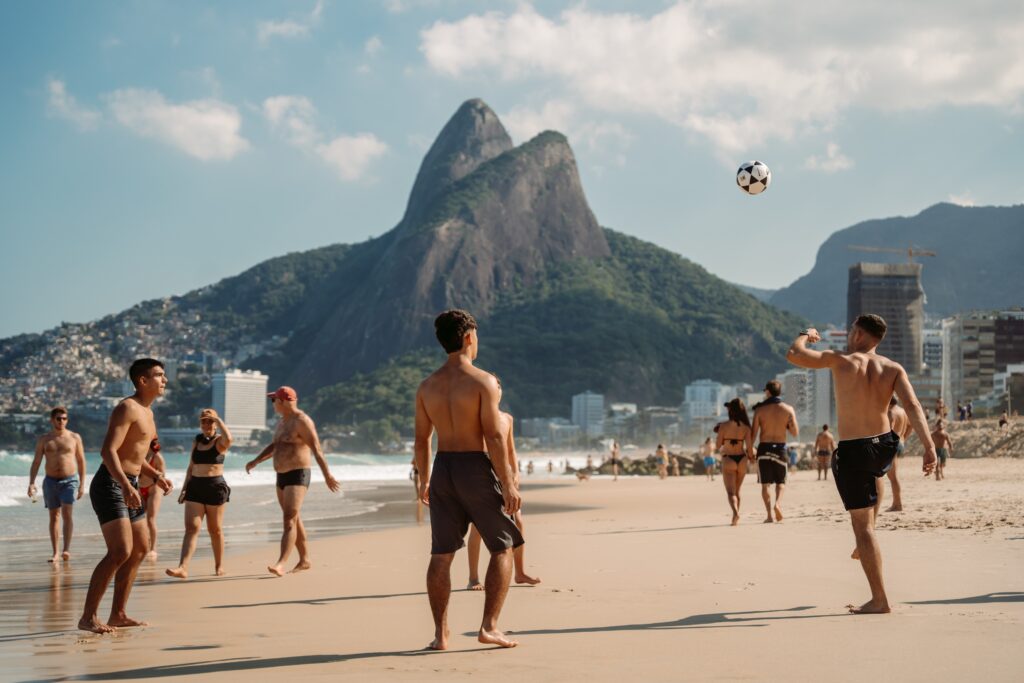
Ordering food from one of Rio de Janeiro’s beach vendors used to require a mix of faith and Google Translate. Now, at Barraca do Antônio on Ipanema Beach, one of hundreds of long-standing kiosks on the sand, a newly laminated menu offers a small but telling update: Beneath the words aipim frito sits the English translation, “fried cassava.”
Manoel Gomes Alves, the kiosk’s manager, proudly holds up the menu as I spot a slightly botched translation farther down the page: The typical Brazilian cut of beef known as “contrafilé” is translated here, quite literally, as “against (contra) fillet (filé) with fries.”
Behind him, young men are mixing caipirinhas and showing off their portunhol, a Portuguese-leaning Spanish mix heard in touristy spots. “They learned on the beach,” Alves says. Alves, who has worked at the same spot for 14 years, says this summer has been his best yet.
The scene points to Rio’s often improvised adaptation to a growing international audience. For decades, Brazil existed somewhat outside mainstream travel, its famous beaches often overshadowed by concerns about safety and political instability. But that perception is quickly changing.
Last year, the city welcomed a record 2.1 million international tourists — 45 percent more than the year before — led by visitors from Argentina, Chile and the United States. And more than 1 million have already arrived this year, according to official tourism numbers.
English menus and multilingual staff may seem like small details, but they reveal something bigger: a city learning how to welcome the world without sacrificing the people and customs that make it what it is.
We’re already seeing that tension play out on the sands.
Rio’s beach economy, for one, has long been informal, with prices fluid and open to negotiation. The city recently started cracking down on vendors who charge tourists more than locals for food, drinks and souvenirs, a practice known as the “gringo price.” Officials have even launched a study to explore ways to standardize pricing across the board, an unusual move in a city whose beach culture is often guided by personal relationships.
Recently on Copacabana, a Spanish-speaking promoter handed me a flier for a Reggaeton party. She doesn’t even attempt Portuguese. “Latin Funk,” the neon paper reads, followed by the phrase Bem Brasil: “very Brazilian.” Yet nothing about this interaction felt very Brazilian, mainly because Reggaeton isn’t a popular genre here.
Beyond the beach, the city’s dining landscape is going through its own transformation. Rio’s culinary scene has long been defined by caipirinhas in plastic cups and unfussy post-beach meals, all typically enjoyed at the same gritty dive bar. Food was never meant to be the main event here, but increasingly, it is.
When I moved to Rio from New York City six years ago, brunch wasn’t even a concept. Instead, sustenance was buttered toast and a quick espresso at the neighborhood bakery. Today, the long, lingering ritual is powering entire restaurants.
One of those eateries is SO_Lo Cafe, a health-forward all-day brunch spot with locations in Rio’s tourist-friendly Leblon, Ipanema and Copacabana neighborhoods. From the start, owner Fernando Kaplan says, the cafe offered flexible hours and a light menu to fit Rio’s beach-centric routine.
“SO_Lo was created to really serve the carioca public,” Kaplan says, referring to people born and raised in Rio. “So much so that we have customers who go two or three times a day — for a coffee, then a sandwich and maybe later a yogurt.”
And the cariocas like it. In less than three years, the cafe expanded to four locations.
The local-first model still holds, but the crowd is noticeably shifting. At the Copacabana location, especially, foreigners make up a growing share of Kaplan’s clientele. He is now hiring staff who speak English or Spanish and is developing an in-house English program, where employees will learn hospitality-specific language.
“We consider this super important,” Kaplan says, “because it makes foreigners feel much more welcomed.”
Other restaurants that would have felt out of place just a few years ago are also flourishing and spilling onto the sidewalks, including Teva, a vegan spot modeled after a New York deli; Fatchia, a living-room-style disco bar serving pizza; and Virtuoso, a natural wine bar where veg-forward small plates cost more than a traditional Brazilian lunch of rice and beans.
Some of these new food and bar concepts are opening in more local neighborhoods, the ones that have rarely appeared on tourist itineraries. In Laranjeiras, for example, Mercado São José, a historic building that sat shuttered for seven years, was recently transformed into a food hall inspired by such venues as New York’s Chelsea Market and Lisbon’s Time Out Market.
“I’ve noticed a higher flux of tourists in Laranjeiras, and that used to be really rare,” says Lara Stahlberg, who lives in the neighborhood. Every now and then, she’ll even hear a foreign accent at her local gym.
The new attractions are also pulling visitors beyond the typical tourist spots of Ipanema and Copacabana, including to Rio’s favelas.
Recently, on my way to a yoga class in Vidigal, a hillside community perched above Rio’s wealthiest neighborhoods, I watched two women step off the backs of motorcycle taxis at a bend in the road that gives way to a sweeping view of the beaches below. Wearing matching Brazil-themed T-shirts, they paused for a photo before continuing uphill.
The scene would have been far less common a decade ago. Rio’s favelas, traditionally low-income neighborhoods, have long been associated with crime and drug trafficking and were considered largely unsafe for outsiders. It wasn’t until the lead-up to the 2014 World Cup and 2016 Olympics, when the city launched a security and tourism initiative to “pacify” the most visible favelas, that more tourists began visiting.
Today, places like Vidigal and Rocinha have become tourist attractions in their own right with their panoramic views and rooftop bars, but the latest crowds have been enticed by viral social media videos.
At Rocinha’s Porta do Céu, or “Gateway to Heaven,” tourists line up to partake in the latest trend: to have a drone capture them stepping through a weathered door on a rooftop terrace and walking toward the edge as the drone pulls away. In front of them, a sea of brick homes stretches across the hillside down to the ocean, and the massive Pedra da Gávea mountain rises in the distance.
On the day I visited, I met a couple from northern Brazil and one from Canada. It was the Brazilian couple’s second time touring the favela. As the man opened the door for his partner, the drone zipped overhead, capturing the pair as they walked toward the ledge, sat together in a chair and kissed for the camera.
The videos began going viral this year, driven largely by my guide, Carlos Alberto Soares da Silva, who started posting drone videos of the favela in 2018. “I used to carry the drone in my bag and offer: ‘Want a video?’ I would charge 50 reais at the time. The videos were terrible back then,” he says.
This is now one of the most sought-after spots in the favelas; there can be waits of up to three hours to access the Porta do Céu rooftop during high season. On the roof, there are at least a half-dozen drone pilots, each with their own equipment and tourist groups.
“A lot of the kids around here were lost, caught up in crime,” Soares da Silva says. “Today I see a ton of them working in tourism. It’s really cool. They start an Instagram, start making their own videos — kids who were going down the wrong path found a new purpose.”
Later, I met a family who opened their own rooftop for a similar, yet more intimate experience. They painted a mural on the ledge and run a tiny bar from their kitchen, selling lemonade, sodas and caipirinhas. Owner Marcelo Campos says his wife loves teaching Brazilian dance steps to visitors, making the visit feel more interactive. Most of the family now works in the business.
“I’m very happy to see Rocinha being viewed differently,” says Laryssa Silva, a yoga teacher who lives in the neighborhood. For a long time, she says, the community was seen as a “forbidden place.”
But while that perception is changing, and bringing money in for new projects for children and basic sanitation works, not everyone is convinced that the benefits are being distributed evenly. And the makeup of the neighborhood is shifting, with many longtime residents leaving, renting or selling their homes for surreal prices, all because outsiders are willing to pay.
“Nowadays, you barely recognize anyone anymore,” Silva says. “Rocinha has always been crowded and chaotic, but now, within an hour, you’ll see more than five groups of 15 tourists each being guided through the community.”
Adam Newman, an American who moved to the Vidigal favela in 2014, worries that much of today’s tourism is designed to move visitors through the favelas as quickly as possible, with little lasting benefit for the businesses there.
That’s what drove him to found Favela Inc. The nonprofit organization includes Brota, an incubator for community-led projects, and Favela Experience, a tour company that changes the focus from “seeing” the favela to “meeting” the people who live there.
Newman’s tours take visitors to see local social projects, such as AmeViva, which offers free yoga and jiu-jitsu classes to children and adults in underserved communities. Visitors can participate in different activities in each project — such as a self-defense class at AmeViva — and are given the opportunity to donate.
At Brota, locals can access free WiFi, laptops, a recording studio and podcast equipment. The goal, Newman says, is to fuel opportunities within the community and give residents the resources to build businesses of their own.
“If you walk through the community from one year to the next, the majority of businesses will have changed names or disappeared,” he says. “My major concern is that 10 years from now, the majority of people living here will not have been from Vidigal.”
Weeks later, back on Ipanema Beach, the translations on the Barraca do Uruguai menu remain imperfect. Contrafilé com fritas is still rendered as “against fillet with fries,” which somehow feels fitting for a city learning to speak to the world on its own terms.
But a fresh coconut is going for 15 reais, whether you’re a local or not. When I arrived six years ago, it cost 6 reais. The question facing Rio now isn’t whether tourists will come. It’s how the city will adapt without losing the people and places that made visitors fall in love with it in the first place.
“If profit isn’t the only thing that’s prioritized, and the well-being of the community is,” Newman says, “everything happens differently.”
The post As tourism booms in Rio, the city tries to adapt without losing its identity appeared first on Washington Post.