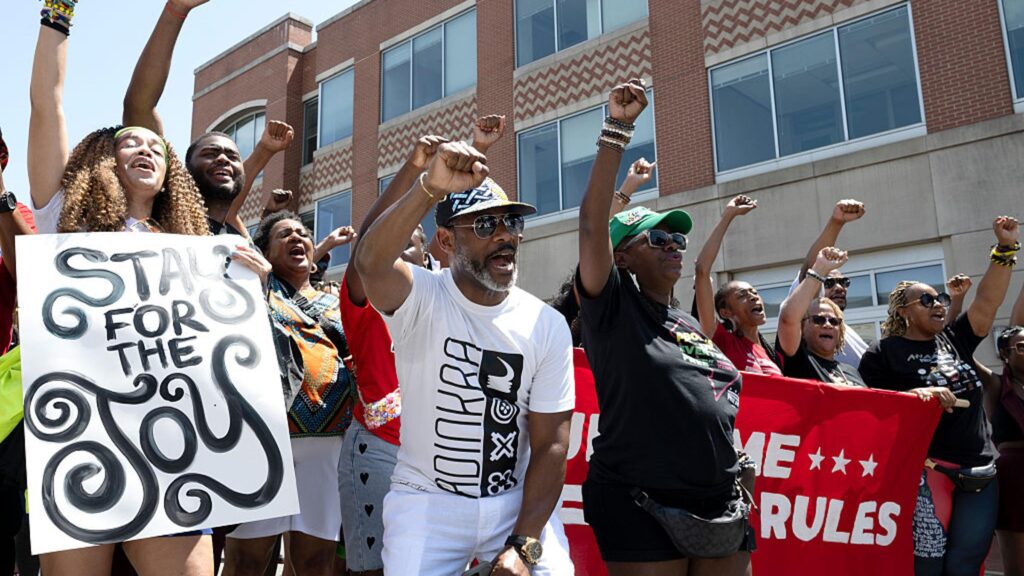
This Friday is Juneteenth—a day that Black Americans have been celebrating for more than a century, but that only became a federal holiday a few years ago.
The day has often been overlooked in American history books, and many people likely didn’t study the event it commemorates in school. So what is Juneteenth, and how did it become a federal holiday?
What is Juneteenth?
President Abraham Lincoln took a historic step toward abolishing slavery in the midst of the Civil War with the signing of the Emancipation Proclamation, which stated that “all persons held as slaves” in Confederate states rebelling against the Union “are, and henceforward shall be free,” on Jan. 1, 1863. But the war, and the process of freeing enslaved people across the country, continued for years after the order was issued.
Confederate General Robert E. Lee’s famous surrender at Appomattox in April 1865 began the final chapter of the conflict more than two years after Lincoln signed the Emancipation Proclamation. Then, on June 19, 1865, Union troops arrived in Galveston, Texas, and U.S. Major General Gordon Granger informed enslaved people of their freedom by reading General Orders No. 3: “The people of Texas are informed that, in accordance with a proclamation from the Executive of the United States, all slaves are free.” The day became known as Juneteenth, or “Freedom Day” or “Emancipation Day.”
While Juneteenth is the oldest recorded celebration that pays tribute to the end of slavery in the U.S., the day—like the one when the Emancipation Proclamation was signed—didn’t mark the official abolition of slavery in the country. That came later, when the 13th Amendment, which made slavery illegal nationwide, was adopted on Dec. 6, 1865.
Even so, many Black Americans have observed June 19 for generations.
Tommie D. Boudreaux, a founding member of the Galveston Historical Foundation African American Heritage Committee, says the day recognizes that Black Americans “played a major part of building America.”
“It is a major, a major part of Americans’ history,” Boudreaux says.
How did it become a federal holiday?
Texas became the first state to formally recognize Juneteenth as a holiday in 1980. Dozens of other states followed suit to recognize it as a holiday or an observance in the ensuing decades as grassroots campaigns to expand its official acknowledgement built up.
Former President Barack Obama marked the day multiple times during his time in the White House. But it wasn’t until 2021, a year after the police killings of George Floyd and Breonna Taylor sparked racial justice protests across the country, that then-President Joe Biden designated Juneteenth a federal holiday.
“As those who were formerly enslaved were recognized for the first time as citizens, Black Americans came to commemorate Juneteenth with celebrations across the country, building new lives and a new tradition that we honor today,” Biden said in his proclamation. “In its celebration of freedom, Juneteenth is a day that should be recognized by all Americans. And that is why I am proud to have consecrated Juneteenth as our newest national holiday.”
“Juneteenth is a day of profound weight and power,” he continued. “A day in which we remember the moral stain and terrible toll of slavery on our country—what I’ve long called America’s original sin. A long legacy of systemic racism, inequality, and inhumanity. But it is a day that also reminds us of our incredible capacity to heal, hope, and emerge from our darkest moments with purpose and resolve.”
Boudreaux says that designating Juneteenth a federal holiday was “long overdue.”
“So many waited so long to be at least recognized that they played a major part of making America what it is today,” she says.
The post What Is Juneteenth and How Did It Become a Federal Holiday? appeared first on TIME.