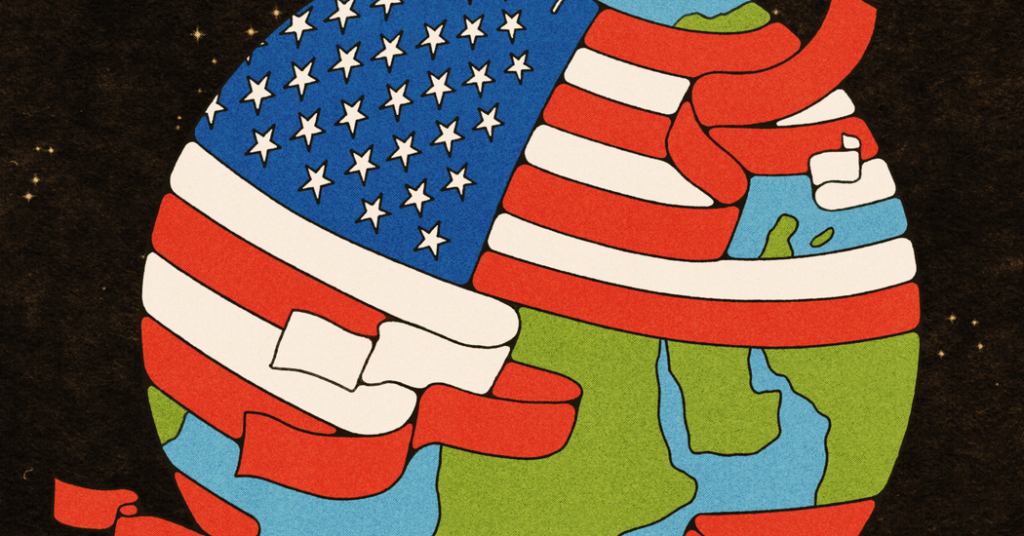
Is America an empire? That is what the political scientist Herman Mark Schwartz argues in a recent article at the digital magazine Phenomenal World.
If it is, how does the logic and power structures of empire shape actions of President Trump and his advisers — and what does it mean for the global order, particularly in the aftermath of the war in Iran and the increasing power of billionaires?
Mr. Schwartz, the author of “States Versus Markets: Understanding the Global Economy,” reflected on how American empire is shaping our world in a written conversation with John Guida, an editor in Times Opinion. It has been edited for length and clarity.
John Guida: What does it mean for America to be an empire?
Herman Mark Schwartz: First, it’s important not to think of empire in purely territorial and despotic terms, akin to the European empires in Africa in the 19th century. America’s empire is ultimately built on overwhelming military, economic, financial and knowledge power that induces some elites in most other countries to cooperate not so much out of fear — though that certainly operates at the outer edges of the empire — as out of the potential economic gains that cooperation produces.
If you’re an Australian automotive engineer in an empire-less world, you might rise to the top of some moderately sized local firm, but in the context of empire you can, like Jacques Nasser, become C.E.O. of Ford and then a presence on the corporate boards of global firms. Or if you’re Novo Nordisk, you can sell into the enormous U.S. pharmaceutical market. But in both cases you do so on terms set by the imperial center.
Guida: You said that a modern empire is not necessarily defined by geography, so what is the “imperial center” of the American empire?
Schwartz: The United States is clearly the territorial center, but it’s better to think of the center as a collection of interlocked state agencies and their business constituencies. Indeed, parts of the United States as a territory are peripheries of the center, as people in any mining region will tell you. By contrast, some industries outside the U.S., like the London financial industry, may be even better integrated than parts of the U.S. itself. But all these peripheral areas relate to the center on terms that are always asymmetrical (the center sets the terms), hierarchical and heterogeneous: Different polities get different deals, and the United States retains the ability to decide how long those deals persist.
This does not mean that the United States can dictate terms all the time, everywhere, to anyone. Rather, U.S. firms, government bureaus, elites and elite institutions typically sit at the center of global institutions and networks, shaping their behavior. Consider NATO: The U.S. provides most of the command-and-control elements and has “boots on the ground” in Europe, while no European nation has bases in the U.S. or the capacity for even a sustained regional conflict, let alone a global one. Or the Federal Reserve, which backs up global U.S. dollar credit creation by non-U. S. banks while other central banks basically back at most a region or only their own banks.
Guida: Do the parts of power that you mentioned — military, economic, financial and knowledge — work in alignment? If they appear out of alignment, as you could argue was the case with the war in Iran, is that revealing of a shift in the terms of empire?
Schwartz: Exactly. As the German legal theorist Carl Schmitt said, we know who has power because it gets to decide what happens in times of crisis. The Nixon administration changed the rules of global money in 1971, shifting the global monetary system from fixed exchange rates to floating exchange rates. Similarly, the U.S. was able to export its intellectual property law to the rest of the world through the World Trade Organization’s intellectual property rights accord. This involved not just the creation of the agreement but also actively training lawyers and patent offices in other countries so they’d be able to enforce the agreement.
But coherent policy is not necessarily a given outcome, since policy is made by fights among different bureaucratic actors backed by their business constituencies. And people are human; they don’t always accurately perceive reality or anticipate their opponent’s reactions. This seems to be a major factor in the war with Iran.
Guida: How has Trump 2.0 balanced those elements of power?
Schwartz: What we see is an effort to change the global order in an incoherent and probably ineffective way. It’s important here to separate what the big bureaucratic machine at the heart of the empire wants, and what is specific to the two Trump administrations — I’ll call them the “Project 2025 movement” and Trump himself.
The asymmetric power at the heart of the U.S. empire means that the U.S. state can periodically rewrite the terms by which the global economic and military order operate. These rewritings happen when the normal processes of decay — processes that create the conditions for their own undoing — undercut those core foundations of U.S. power. All large-scale social phenomena suffer from their own success. Successfully build out a transport network based on internal combustion engines, and eventually you run out of cheap oil and exhaust the carbon budget.
Thus, for example, the Obama administration was already trying to renew U.S. power by instituting protectionist policies and weakening the World Trade Organization in order to reverse U.S. deindustrialization, seeking to extricate the U.S. from the Mideast in order to contain an increasingly powerful China and promoting fracking to reduce U.S. dependence on Mideast oil.
Guida: How does what you call the Project 2025 movement fit into rewriting the terms?
Schwartz: The Project 2025 folks are attacking all the foundations of U.S. power in favor of enhancing the power of the billionaire class — gutting universities and politicizing research, which harms the knowledge part; using erratic tariff policy for transactional purposes, which actually hinders reindustrialization through policy uncertainty; running up big deficits and essentially deregulating finance, which will probably cause another debilitating financial crash; and engaging in ill-conceived wars that burn up a decade’s worth of procurement for virtually no gain. As for Trump himself, he does not appear to have any theory of global order except that he gives the orders. You can’t run an empire that way, because it undercuts the willing cooperation that makes empire work effortlessly.
Empires don’t come with an instruction set, and it’s perfectly possible to get things wrong. What distinguishes Trump 2.0 from earlier administrations is that it is destroying the empire for the sake of domestic goals that benefit only a narrow slice of Americans.
Guida: Are the people involved in the Project 2025 movement seeking new terms for an empire, which would presumably be, based on your description, shaped by the billionaire class?
Schwartz: The billionaire class has priorities that sometimes conflict. But the most important priority from the point of view of owners is probably the ability to control their labor force. Secondarily, it is the ability to control other people’s labor forces through the construction of global supply chains that feed in cheap components and services.
Business support for the Trump administration right now is a reaction to efforts that started in the Obama administration to limit the ability of businesses to shed responsibility for their work force by constructing elaborate subcontracting chains. Legally, in the U.S., under the Employee Retirement Income Security Act, if you provide benefits to one employee, you need to provide benefits to all your employees. But if some people doing work for you are subcontractors or technically working for a different firm, you are not responsible for them and do not have to provide benefits for them. So the end game here is to attain the kind of regulation (or deregulation) to make everybody into a gig worker.
Guida: By “everybody,” you include the world?
Schwartz: Yes, everybody means in the rest of the world as well, which is the one point where the transnational billionaire class has some degree of overlapping interests.
Guida: In an empire like this, what are the benefits and costs to an average American?
Schwartz: There is no average American! But if you want to posit an average American, then the benefits and costs look something like this. Empire allowed the United States to avoid a trade-off between guns and butter — between military and social program spending. From 1992 to 2024 the U.S. ran more or less continuous current account deficits. We imported more than we exported and gave the rest of the world pieces of paper (U.S. Treasury and agency bonds, equities, corporate bonds) that promised them something real in the future, while we got TVs, cars, oil, tropical fruits, etc.
In other words, the empire’s peripheries in some sense funded our military footprint in exchange for promises to pay something, someday. So the U.S. avoided having to raise taxes or cut consumption to fund the military.
In the U.S., this was great for folks who wanted BMWs, avocado toast and vacations in Italy without having to pay higher taxes to sustain U.S. military power, and for corporations that wanted access to cheap offshore labor and, again, lower taxes. And in some ways it was good for the working-class people who bore the costs of those imports in the form of lost jobs or lower income, because for them U.S. military dominance also largely meant stability or even falling prices for things like clothing, and no call on their bodies for any mass war. But those imports and offshoring did cause mass deindustrialization and the loss of the notionally good jobs associated with manufacturing and support for manufacturing.
And successive administrations did very little to help those communities. To the extent that we had industrial policy it aimed at the high-tech industries, which did not re-employ laid-off manufacturing workers, were largely concentrated on the coasts, and of course were highly diverse in all sorts of ways that conflicted with white and rural working-class norms. Finally, at the national level, the hollowing of manufacturing meant a loss of production power in favor of China.
Guida: Based on the deep political dissatisfaction with politicians and institutions in countries across the world, particularly in Western democracies, can we assume that many voters have finally come to dislike the terms of empire?
Schwartz: Yes. Countries on the sharp end of U.S. imperialism, as in Latin America, have been opposed at both the mass and, to a lesser extent, elite level since the early 1900s. But even looking at Europe, the bargains underlying cooperation with the U.S. are unraveling because of the costs imposed on average workers.
European workers have been asked or forced to restrain wage growth for almost two decades now to promote export competitiveness. This shows up very clearly in the much lower rates of G.D.P. and G.D.P. per capita growth in Europe relative to the U.S. Those export surpluses benefit European firms but not European workers, who, on average, have not seen significant increases in their ability to consume. In the worst case, for example, per capita incomes in Italy have not risen much since 2000.
But these underlying conditions need some trigger and some political focus to be meaningful. Thus the billionaire class has been trying to direct this underlying anger at immigrants, trans people, etc.
Guida: How do empires usually fail?
Schwartz: Empires usually die from suicide related to their own successes. . Elites in a reasonably stable and successful society come to believe that they don’t need the state, and so they basically termite the state, hollow it out, in order to engage in status competition with other elites.
Guida: Do you agree with Walter Scheidel’s argument that, historically, leveling — i.e., reduction in inequality — almost always requires some form of cataclysm (war, revolution, state collapse or epidemic)?
Schwartz: Yes, the Scheidel argument is broadly correct. But I don’t think that we are doomed to have a cataclysm. There are plenty of very positive things occurring right now, including, most important, a huge shift in energy production away from fossil fuels toward renewables, as Ember and Tim Sahay and Kate Mackenzie have demonstrated.
Guida: China has been a leader in that energy-production shift. There is a debate about the world (roughly) separating into electro and petro states. But you clearly think American empire still structures the global order. Do you see China changing that, or even a second empire emerging in competition with the American empire?
Schwartz: The electro state versus petro state split is an overly simplistic framing. The economics in favor of renewables are incredibly strong, which even the oil industry recognizes. We are all going to be mostly electric.
But the U.S. versus China conflict over who will set the terms regulating the global economy is real. I don’t think that at the moment — and “at the moment” is a very important qualifier — China has the ability to construct something akin to the empire that the U.S. constructed after the World War II.
China clearly has dominance in production and is militarily dominant in the western Pacific but is not yet a global military power. Its dominance in production clearly extends to some of the major potential future leading sectors in the economy, particularly in energy and electric vehicles, and increasingly in biotechnology.
But at the same time China has an extremely fragile financial system and horrible demographics. There’s a big difference between trying to move your money offshore to avoid taxation, which is the typical U.S. pattern, and trying to move your money offshore to prevent possible expropriation or a financial collapse, which is what’s going on with rich Chinese. And China lacks the kind of emerging cultural dominance that characterized the U.S. in the 1920s and 1930s and matured after the war. The most likely outcome is a regionally fractured world economy similar to the late 1920s early 1930s.
Guida: In that period and in most, leadership plays a critical role in shaping politics and economics. Do you see new leaders who can emerge to reform and reshape a global political and economic order that functions at least a little more fairly for more people?
Schwartz: While I believe that political orders come and go, I do not think that we are locked into the kind of scenario that ended with global war as in the 1930s. The 1920s and ’30s was an era with a lot of different contending visions for political order: Fascism, Catholic corporatism, social democracy, Communism, continued imperial control and what we would now think of as neoliberal markets. It wasn’t obvious which would succeed.
What mattered was the quality and nature of leadership in different countries and most important in the major powers. In the U.S., the administration of Franklin Roosevelt more or less succeeded in establishing the institutions that gave us stable economic growth after the war, and in reacting to the worsening global security situation. It did so on the back of broad social movements calling for economic security and income redistribution. Elections do matter, and it’s generally a good idea to elect people who have what Max Weber called an ethic of responsibility.
Herman Mark Schwartz, a professor of politics at the University of Virginia, is the author of, most recently, “States Versus Markets: Understanding the Global Economy.” John Guida is a Times Opinion editor.
The Times is committed to publishing a diversity of letters to the editor. We’d like to hear what you think about this or any of our articles. Here are some tips. And here’s our email: [email protected].
Follow the New York Times Opinion section on Facebook, Instagram, TikTok, Bluesky, WhatsApp and Threads.
The post There Are Two Trump Administrations Right Now. And an Empire? appeared first on New York Times.