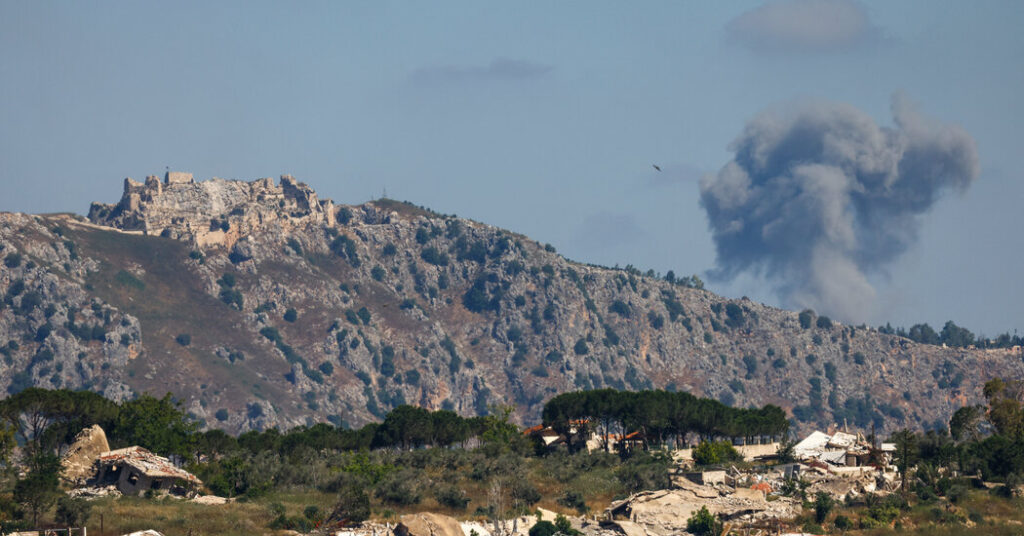
Israeli airstrikes across Lebanon on Friday killed at least 47 people, Lebanese health officials said, putting new pressure on the already fraught agreement to end the war between the United States and Iran.
Israel launched the attacks after Hezbollah, the Iran-backed militant group, killed four Israeli troops during an ambush in southern Lebanon, the Israeli military said, prompting it to respond with more than 150 strikes across the south and east of the country.
There were casualties reported in nearly two dozen towns, according to Lebanon’s health ministry, and President Joseph Aoun accused Israel of targeting “innocent civilians.”
As the fighting continued, talks between Washington and Tehran that had been scheduled for Friday in Switzerland were postponed without an explanation from either side. The peace deal the two sides reached calls for fighting to stop on all fronts, including Lebanon.
Three diplomats, who spoke on condition of anonymity to discuss sensitive details, said Iran had withdrawn from the meeting in response to Israeli strikes on Lebanon, though they did not clarify whether they meant Friday’s bombardment specifically.
Iran’s Foreign Ministry spokesman Esmail Baghaei said that the United States — Israel’s closest ally — bore “direct responsibility” for the latest escalation. He warned that Iran would “take all necessary measures to safeguard its interests, security, and the rights of itself and its allies.”
An Israeli official and a diplomat, who spoke on condition of anonymity to discuss sensitive diplomacy, said a new cease-fire between Israel and Hezbollah had been reached and would take effect at 4 p.m. local time.
It remained unclear, however, whether the arrangement would hold; a series of previous truces all but collapsed in a cycle of attacks by both sides.
There was no immediate comment from Hezbollah.
Israel’s strikes on Friday followed one of the deadliest attacks on its forces since the latest war between Israel and Hezbollah began in early March. The Israeli military said that four soldiers had been killed after their tank was hit near the town of Kfar Tebnit in southern Lebanon.
In a series of statements, Hezbollah said that it had ambushed Israeli troops attempting to advance on Ali al-Taher, a strategic ridge overlooking the city of Nabatieh that Israel has repeatedly targeted with heavy airstrikes in recent years.
Two senior Lebanese officials, who spoke on condition of anonymity to disclose sensitive strategic matters, said that one of Hezbollah’s largest underground facilities is embedded in the hillside. Israeli forces have been advancing toward the ridge in recent days, the officials said.
For weeks, security for Lebanon has emerged as one of the key sticking points in President Trump’s effort to end a regional war that has rattled the global economy. Despite a nominal cease-fire, fighting has continued and Israeli forces have pushed deeper into southern Lebanon, where Shiites make up the core of Hezbollah support. The strikes have dashed the hopes of thousands of displaced people that they could soon return to their homes.
Even as Mr. Trump has piled pressure on Israel to refrain from attacking, Israeli leaders have suggested that they are not bound by the deal. Prime Minister Benjamin Netanyahu said this week that Israeli forces would not withdraw from the country.
“My directive is clear: Israel will not tolerate attacks against our soldiers or our territory, and will exact a very heavy price from Hezbollah for these attacks,” Mr. Netanyahu said in a statement on Friday.
Israel’s stance, and the latest escalation, has made Lebanon a test of whether Washington can keep the wider agreement from falling apart over a cycle of violence that has become a major sticking point in negotiations.
“Without firm U.S. leadership, persistent fighting in Lebanon will keep any U.S.-Iran understanding on a knife’s edge, liable to fall over at any moment,” said David Wood, the senior Lebanon analyst for the International Crisis Group, a research organization.
Adam Rasgon, Ronen Bergman and Erika Solomon contributed reporting.
The post Deadly Violence Rocks Lebanon in Threat to U.S.-Iran Deal appeared first on New York Times.