Vice President JD Vance delivered an extraordinary rebuke on Thursday to Israeli officials who had disparaged the U.S.-Iran deal as he began a campaign promoting the agreement in the face of criticism in Israel and Washington.
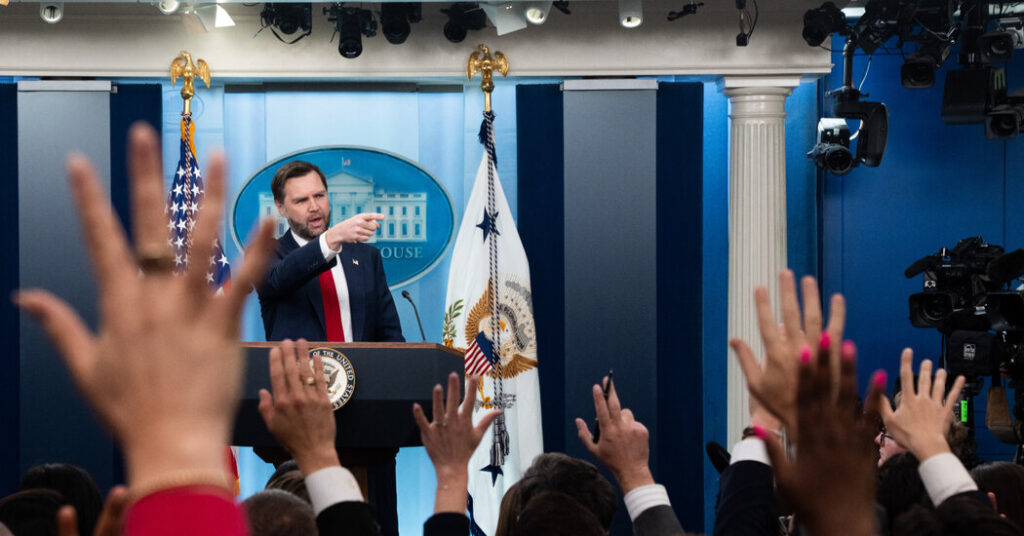
Speaking to reporters at the White House, Mr. Vance said he had a message for members of Prime Minister Benjamin Netanyahu’s cabinet who had denounced the deal and had “very personally attacked” President Trump.
“Donald J. Trump is the only head of state in the entire world who is sympathetic to the nation of Israel at this moment in time, and he happens to be the head of state of the world’s superpower,” Mr. Vance said. “If I was in the cabinet of the Israeli government, I might not be attacking the only powerful ally that I have anywhere left in the entire world.”
Mr. Vance said he wanted to remind the Israelis that two-thirds of the weapons that “protected your homeland” were American-made and paid for by U.S. tax dollars.
His blunt message — effectively telling the Israelis that they have been diplomatically isolated and have Americans paying for their defense — was the latest sign of tensions between Mr. Trump and Mr. Netanyahu, just over three months after they launched a joint bombing campaign against Iran.
Israel is not a party to the deal to end the war, and its fighting with Hezbollah, the Iranian-backed militia in Lebanon, had threatened to derail the U.S.-Iran talks, to the frustration of American officials. Mr. Vance’s remarks came a day after Mr. Trump admonished Mr. Netanyahu over the Israeli military onslaught in Lebanon.
Mr. Vance also pushed back on criticism from some Republicans in Congress who have argued that the deal grants Iran major financial concessions while punting critical decisions about its nuclear program into a 60-day negotiation period.
Mr. Vance said the Iranians had to “change their behavior” under the deal and that the United States maintained economic, diplomatic and military leverage over Tehran if it did not comply.
“We have all the cards,” Mr. Vance said. “If the Iranians want the benefits of the bargain, they have to give us the things that are necessary to get the benefits.”
The deal calls for a cease-fire while U.S. and Iranian officials begin discussions on the future of Iran’s nuclear program over the next 60 days. Mr. Vance said that he would lead those negotiations and that technical discussions could begin as soon as this weekend. He said he might travel to Switzerland to start those talks with the Iranians.
“As they dial up their good behavior, we can dial up the economic relief,” he said. “If they dial down their good behavior, we can turn it off. It’s the good thing about having the leverage, and it’s a good thing about being the United States of America, where we just fundamentally have so much influence in the world financial system.”
The deal, however, lays out several benefits for Iran that begin immediately “upon the implementation” of the memorandum of understanding, which Mr. Trump and President Masoud Pezeshkian of Iran have signed.
Those benefits include the unfreezing of Iranian assets and the removal of the U.S. naval blockade on ships entering and leaving Iranian ports.
The agreement also calls for the U.S. Treasury Department to immediately waive sanctions on Iranian oil exports, allowing Tehran to sell oil at higher prices to a wider array of buyers. Other elements of the agreement, like broader sanctions relief, would take place on “an agreed-upon schedule as part of the final deal,” to be negotiated over the next 60 days.
Mr. Vance said that by temporarily lifting sanctions on Iranian oil, “we’re actually going to be able to see a little bit where their financial system actually sends money and receives money, and that’s a real benefit to the American people.”
But some Republicans say the deal throws the repressive Iranian government an economic lifeline.
“Reagan is rolling over in his grave,” Senator Bill Cassidy, Republican of Louisiana, wrote on social media. Mr. Cassidy, who lost a primary election last month after Mr. Trump targeted him for defeat, added: “Iran’s nuclear ambitions were not curbed, and they have learned that threatening the Strait of Hormuz works and will undoubtedly leverage it in the future. Now, Iran gets to build brand-new infrastructure under this deal.”
Senator Roger Wicker, Republican of Mississippi and chairman of the Armed Services Committee, referring to the U.S. military operation against Iran, said in a statement that he was “concerned that the memorandum of understanding negotiates away the victories of Operation Epic Fury in ways that are completely out of step with the president’s goals.”
He singled out a $300 billion fund outlined in the deal and designated for the reconstruction and economic development of Iran. Even though it would not be financed by American taxpayers, Mr. Wicker said it “would make Iran’s payoff under President Obama’s 2015 deal look like a pittance by comparison.”
President Barack Obama’s government signed a deal with Tehran in 2015 that tied sanctions relief for Iran to specific goals related to its nuclear program.
Mr. Trump and Mr. Vance have emphasized that no U.S. government money will be spent on the $300 billion fund and that it will be used as a conduit for private investment. But the fund has become a sore point for Mr. Trump, who has spent years railing against Mr. Obama for releasing $1.7 billion of Iran’s own cash after his administration brokered the nuclear agreement.
Mr. Vance noted that this deal also called for commercial vessels to once again sail freely through the Strait of Hormuz, the critical oil shipping route that Iran effectively closed at the start of the war, driving gas prices higher. He pointed out that gas prices had fallen since the agreement was announced.
On Thursday, the average price of a gallon of gas in the United States dropped below $4 for the first time in months. Still, gas prices remained about $1 higher than before the first U.S.-Israeli strikes began in Iran in late February.
In his first statement on the deal, Iran’s supreme leader, Ayatollah Mojtaba Khamenei, said that Mr. Trump had agreed to the terms “out of desperation” and warned that Iran would not submit to “excessive demands” from the United States during the next 60 days of talks.
Mr. Trump has threatened Iran with more attacks if he believes it is not abiding by the deal. But his advisers have said privately that it’s hard to imagine he would return to military action against Iran, especially before the U.S. midterm elections.
The agreement also seeks to end the war between Israel and Hezbollah by requiring the United States and Iran — along with their allies — to immediately and permanently end their military operations “on all fronts, including in Lebanon.”
But Israel and Hezbollah have indicated that they will not be constrained by the agreement. In brief remarks on Thursday, Mr. Netanyahu said that Israeli troops would remain in southern Lebanon for “as long as Israel’s security needs demand it.”
He added that “additional challenges lie ahead of us” that will require “calmness, a firm stance on our security interests and, at the same time, maintaining the important connection with our American friends.”
Some members of the Israeli government took a harder line. Bezalel Smotrich, the far-right finance minister, called the deal “bad for Israel and for the entire free world. Period.”
Itamar Ben-Gvir, the national security minister, said Israel would not be bound by the agreement. “We love the USA and are grateful to President Trump,” he wrote on social media. “And yet, the State of Israel is not a banana republic.”
Reporting was contributed by Rebecca F. Elliott, Shirin Hakim, Pranav Baskar, Ephrat Livni and Catie Edmondson.
The post Vance Lashes Out at Israeli Critics of U.S.-Iran Agreement to End the War appeared first on New York Times.