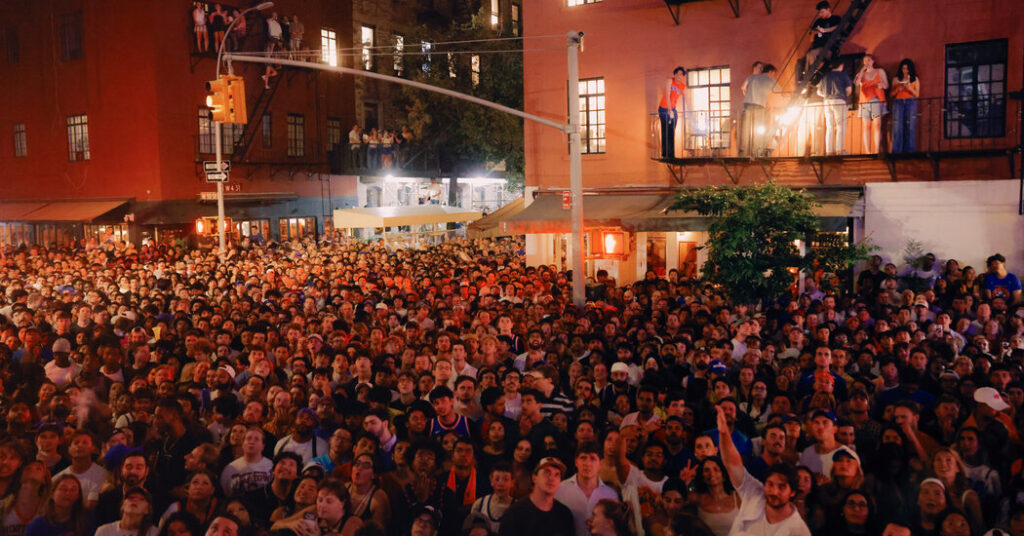
Millions of jubilant fans are expected to congregate in Lower Manhattan on Thursday morning for the Knicks championship parade, a celebratory coda to a postseason run that united New York City like no other event in recent memory.
The celebration comes six years after Covid arrived in the city, forcing New Yorkers to sequester in their homes for months, isolated or in small groups. Sports were barely a refuge: The N.B.A. playoffs that year were held in a bubble, cut off from the broader world. (The Knicks, with their 21-45 record, were also cut off.)
For months, if not years, afterward, many in the five boroughs have seemed reluctant, if not fearful, of gathering in enclosed spaces. But as the Knicks rattled off 15 wins in 16 games en route to a finals victory over the San Antonio Spurs, sharing in those moments felt like a necessity, a vibrant reminder of what New York could feel like again.
Thursday’s parade officially begins at 10 a.m., but crowds were expected to assemble as early as Wednesday evening in order to secure the best spots. The police will officially begin admitting people at 6 a.m., not long after sunrise. Attendance at the parade is free, but as is so often the case in the capital of capitalism, a cottage industry sprang up this week, with hopeful attendees offering hundreds of dollars to strangers to save them places along the route.
Workers whose offices were located downtown made plans to witness the scene from above the so-called Canyon of Heroes, the skyscraper-cordoned path that has been the site of many of the city’s most epic celebrations, for the Mets, Yankees, Rangers, Giants and Liberty, but also Vietnam War veterans, American hostages returning from Iran, Olympians and astronauts.
But it will be a first for the city’s most-favored basketball team, whose last championship, won more than 50 years ago, was met with a comparatively modest City Hall ceremony in the last year of John Lindsay’s mayoralty.
Fans who guard their parade positions closely will be hoping to glimpse the Knicks’ stars in person: Karl-Anthony Towns, who led the team to a victory in Game 2; OG Anunoby, whose last-second tip-in won Game 4; and the finals M.V.P., Jalen Brunson, whose 45-point performance in Game 5 sealed the championship.
The Knicks playoff run, which stretched from April to early June, helped mask the tensions that currently roil the city: between the wealthy and the wanting, city native and transplant, “real fan” and bandwagoner. If the 2020 pandemic laid bare some of those fissures, the undeniable likability and constant success of the team has seemed to paper them over.
“This is one of the few things I’ve seen New Yorkers across gender and race united around,” said the Rev. Al Sharpton in an interview before Game 3. “You walk around, everyone has Knicks’ gear. It’s healthy.”
But even amid the euphoria, some of those conflicts still surfaced during the finals. They were reflected in the exorbitant ticket prices at Madison Square Garden; the squabbling between the Knicks’ owner, James Dolan, and Mayor Zohran Mamdani and his police commissioner, Jessica Tisch; and in the sporadic mayhem on city streets that attended the Knicks’ final victories.
Mr. Mamdani has never been a lifelong, die-hard Knicks fan, but as the team surged and New Yorkers united behind it, he cloaked himself in the team’s spirit and colors, using his position to nab a standing-room-only ticket for Game 3, signing an “executive order” suspending bedtime for young Knicks fans, and staying up until 3 a.m. after the team finally clinched the championship.
His self-appointed role as chief Knicks cheerleader has not relieved him of another less-ceremonial responsibility: overseeing the nation’s largest Police Department, which over the course of the finals aroused the ire of many fans by opposing watch parties outside Madison Square Garden, then imposing strict security restrictions on the streets around the arena.
In the Knicks’ final championship week, those stances sparked a remarkably public dispute between Mr. Mamdani and Mr. Dolan, with the famously prickly businessman describing the mayor and police commissioner as hopelessly inexperienced government hands, and the mayor’s press secretary decrying Mr. Dolan for stoking “rancid vibes.”
But Mr. Dolan may have issued the lowest blow, accusing the mayor and Ms. Tisch of being fake Knicks fans.
Championships, however, are a powerful salve. Mr. Mamdani and Mr. Dolan appear to have mended fences, to some degree. The two have spoken multiple times since the flare-up last week, a City Hall official said, and have been working closely together to plan the ticker-tape parade.
A spokeswoman for Madison Square Garden had no immediate comment.
The finals drew New York’s elite to the heart of Midtown. Tickets cost thousands, and in some cases, tens of thousands. The Garden crowd was raucous, lustily booing both President Trump and Victor Wembanyama, the San Antonio Spurs’ 7-foot-4 star who became a sudden Gotham villain. It was also a magnet for celebrity superfans like Timothée Chalamet, Ben Stiller and Spike Lee.
Fans fortunate enough to attend a game at the Garden were subject to intense security, particularly before Mr. Trump’s appearance at Game 3. When some heightened security measures — such as a “frozen zone” in the area surrounding the arena — were kept for the next game, Mr. Dolan went nuclear.
The parade will also be heavily regulated. On Wednesday, the Police Department warned that spectators would be ushered into pens, but only after they were confirmed to be bag free.
If conflicts eased by the Knicks’ victory seem likely to regather their momentum in the coming weeks, the parade may wind up serving as one final moment of togetherness and good feeling.
Richard Emery, an 80-year-old civil rights lawyer who has been a Knicks fan “forever,” said that the feelings of unity around the team were “real, tangible, palpable and unlike anything we’ve ever had in this city, maybe during my lifetime.”
“What it is really at a fundamental level is it’s a recognition of character,” he said, praising the Knicks at length, particularly Brunson, their leader. “It’s so rare when character is the thing that people appreciate and love and make heroic, as opposed to histrionics, self-promotion and the garbage of Page Six.”
“There’s no resentment in this,” he added. “It’s just pure admiration. It’s pure heart and soul.”
The post Together We Stand: A Knicks Celebration and a Pause for Communal Joy appeared first on New York Times.