It took more than a decade of planning, a messy court battle with preservationists and years of plodding construction, but the Obama Presidential Center was finally unveiled on the South Side of Chicago on Thursday.
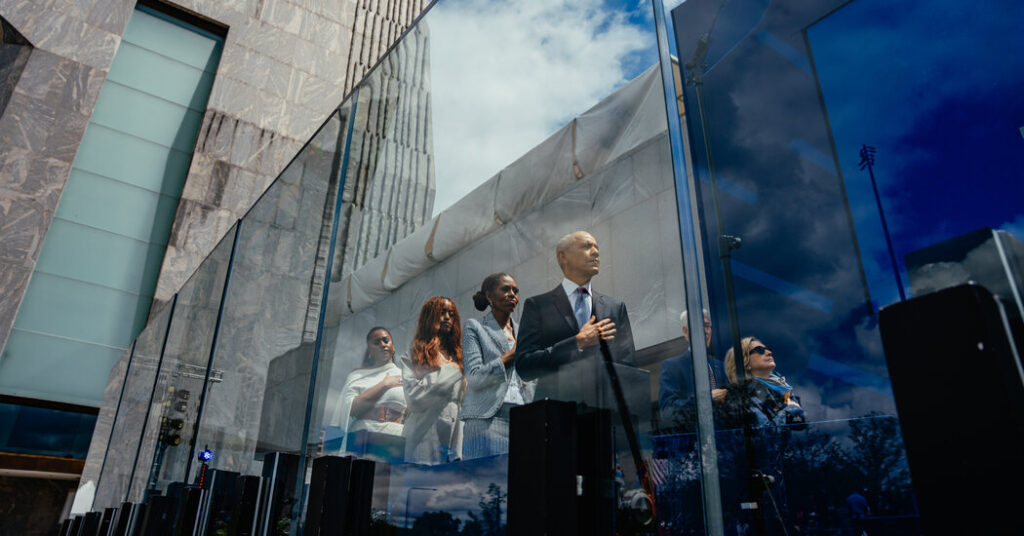
The opening itself was a star-studded party, concert and celebration, the rare event that drew four former presidents standing together onstage — George W. Bush, Bill Clinton and Joseph R. Biden Jr., along with Barack Obama himself. (An invitation was not extended to President Trump, who recently compared the center to a trash heap.) The Roots kicked off the event; during a vocal performance by Jennifer Hudson, who grew up in Chicago, Michelle Obama, the former first lady, dabbed away tears.
Joshua DuBois, a faith adviser to Mr. Obama, led the crowd in prayer, asking God to bless the museum.
“Let it be an epicenter of innovation, a balm of restoration,” he said.
For Chicagoans, the opening of the $850 million, 19-acre museum campus has been a long time coming. It was two mayors ago, in 2015, when President Obama announced that the museum would be built in his adopted hometown of Chicago. Since then, the museum and everything that has come with it — a playground, a public library, a sledding hill — has slowly come together in Jackson Park, near the University of Chicago campus.
The museum is not just a reminder of Mr. Obama’s presidency, said Rahm Emanuel, a former chief of staff in Mr. Obama’s White House who was also mayor of Chicago in 2015 and helped with what he called the “hustle, calculation, maneuvering and jostling” to bring the museum to the city.
“For the city as a whole, it’s a billion-dollar infusion of an investment that pays dividends way beyond the billion dollars, specifically on the South Side,” Mr. Emanuel said. “This is generational.”
The Obama Foundation, which has paid for the new center with private donations, said that 250 people would work at the museum, and one million people were expected to visit the campus each year. Tickets are $30 for adults, and $26 for Illinois residents.
On the morning of the opening, under sunny skies, Chicagoans unfolded lawn chairs and blankets to watch on a giant screen from the grassy expanse of the Midway Plaisance, blocks from the museum.
And hundreds of invited guests gathered at the museum next to the 225-foot granite-covered tower that is sometimes called the Obamalisk. They included former Vice President Kamala Harris; Representative Nancy Pelosi of California; Gov. Gavin Newsom of California; foreign dignitaries; and a who’s-who of Chicago boldface names.
Representative Mike Quigley of Illinois, a Democrat, milled around the crowd, saying that as he looked at the museum before him, he was remembering when Mr. Obama lost his first bid for Congress, more than 25 years ago. The two sat down for breakfast at a greasy spoon in Chicago, and Mr. Quigley assured the young, dejected Mr. Obama that better things were ahead.
“I never imagined this,” Mr. Quigley said.
LL Cool J, the actor and rap luminary, said that the museum reminded him of the inspiration of the Obama era.
“It’s not about nostalgia, but it’s about possibility,” he said. “I think this is inspiration for every young child in the world, but especially in America.”
Alexi Giannoulias, the Illinois secretary of state and a longtime friend of Mr. Obama, said he had been inundated by friends and acquaintances who were asking for help securing tickets to the museum. (Tickets are already sold out through November.) Mr. Giannoulias brought his family for a sneak peek of the museum last month and found himself moved to tears, he said.
The museum will “bring visitors and investment to the South Side, celebrate a historic presidency with deep roots in our city and serve as a reminder that the city remains a place where big ideas and big projects can thrive,” he said, adding that the center brought a certain sense of pride to Chicagoans because of Mr. Obama’s connection to the city.
The Obamas have always emphasized that this museum was not intended to be a traditional presidential library, but also a community hub, a sprawling campus with a garden, a basketball court and performance spaces. Mr. Obama’s records will be stored by the National Archives.
The museum was built along Lake Michigan in Jackson Park, at the edges of Woodlawn and South Shore, neighborhoods that experience frequent gun violence — in April, a 16-year-old boy waiting for a bus outside Hyde Park Academy was shot to death, just two blocks from the presidential center. Residents said they had mixed feelings about the museum: hope that it will bring more development to the neighborhood, but also fear that it will usher in so much gentrification that their rents will go up.
The Rev. Corey Brooks, a conservative pastor in neighboring Woodlawn, has been a frequent critic of the center, questioning whether it will have a positive impact on the residents who live in the community.
But he said he had received an invitation to the opening ceremony and intended to be there. “Anything they spent $800 million on in our neighborhood makes it imperative that I see it,” he said.
Peter Baker contributed reporting.
The post Presidents Line Up for Obama’s Long-Awaited Center in Chicago appeared first on New York Times.