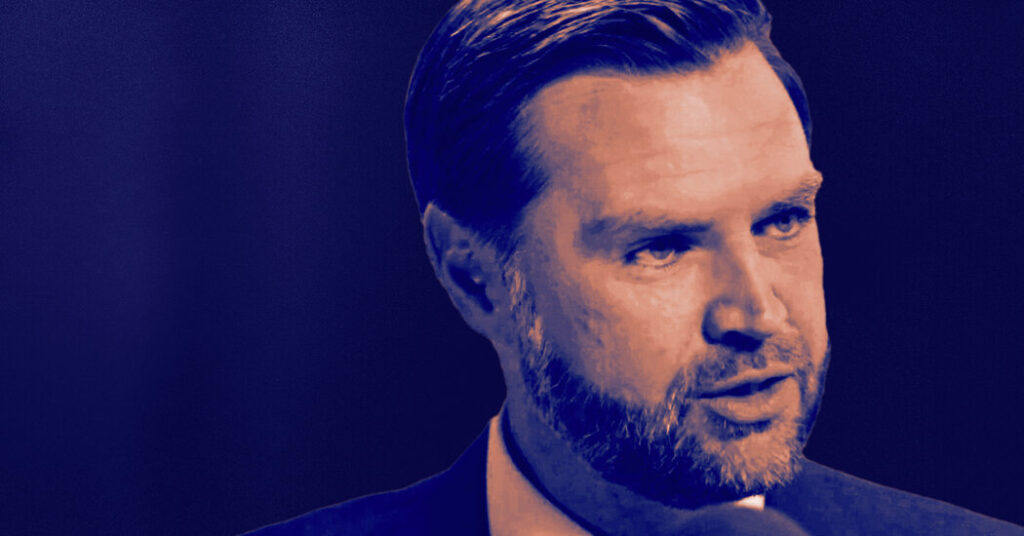
“If you think this is a bad deal, what is your alternative?” Critics of JD Vance think that his key role in the Iran negotiations may end up being an albatross around his neck. (“If it doesn’t work out, I’m blaming JD,” President Trump said in France this week.)
But in our conversation, the vice president seemed buoyant and eager to play the salesman, insisting that the deal is better than the pact President Barack Obama sealed in 2015.
I asked him about his initial opposition to the war, his conflict with the pope and whether his political future is riding on the success of the Iran agreement. We also discussed Vance’s new book, “Communion,” about the vice president’s return to faith, and whether or not the Trump administration’s policies embody Christian values.
Below is an edited transcript of an episode of “Interesting Times.” We recommend listening to it in its original form for the full effect. You can do so using the player above or on the NYTimes app, Apple, Spotify, Amazon Music, YouTube, iHeartRadio or wherever you get your podcasts.
Ross Douthat: Mr. Vice President, welcome back to “Interesting Times.”
JD Vance: Thank you. Thanks for having me.
Douthat: It’s great to have you. So we have a really high bar for repeat guests on this show.
Vance: [Laughs.]
Douthat: I know that you’ve been doing a lot of media, so it probably feels pretty, pretty easy. But here, the standard is, one, the repeat guest has to be second in line, first in line for the presidency.
Vance: First in line.
Douthat: Right, are you first in line? That’s right. You’re first in line, right. They need to have recently published a book on themes important to this show. And they also need to have recently concluded a peace deal with the Islamic Republic of Iran.
So congratulations for clearing the bar.
Vance: Thank you. I’ve checked all three boxes.
Douthat: You’ve hit the trifecta. So we’re going to talk about the book. We’re going to talk about Christianity and your personal journey and how religion and politics fit together in America. Small topics.
But we’re going to start with a few questions about the Iran deal. And just to locate things for viewers, we’re in a moment where we have the deal. The actual thing has not yet been released.
It may appear between the time we have this conversation and the time it’s published. But that doesn’t matter, because I have you here, and you can tell me what’s in it.
Vance: Sure.
Douthat: So let’s start with the most basic question. What is in this deal that is good for America and good for the world that we couldn’t have gotten without three months of military conflict?
Vance: OK. So first of all, we actually really want to get this out because it’s hard to have the conversation without the full text. And I think part of the misalignment here is that in the Pakistani and Qatari systems, they don’t quite have the First Amendment and freedom of the press, and so there isn’t this expectation that the text is going to be out there for the American people to actually interrogate and look at and analyze and understand for themselves.
But it will be out. We’re having this conversation, obviously, on Wednesday morning.
Here’s what the deal does. And the first thing is that it opens the Strait of Hormuz, which obviously has been a major source of global supply shock in both oil and gas, but also oil and gas derivative products like fertilizers and so forth.
So the Strait of Hormuz is open immediately. I will say, break a little bit of news for you this morning, Ross. I don’t think this has been said yet. Last night was the first night in over 100 days of conflict where the Iranians were not shooting at commercial traffic in the Strait of Hormuz. And so we’ve been able to get a fair amount of oil and gas out over the last few weeks, but that has been under the protective blanket of the American military.
The Iranians formally stopped shooting yesterday, and so that’s a major milestone. And that’s one of the reasons oil and gas is so low. That’s No. 1. No. 2 ——
Douthat: Can I pause?
Vance: Please.
Douthat: Were you concerned that — there are a lot of complex elements inside the Iranian regime. Were you concerned about a world where last night the policy of the Iranian government would be no shooting at ships in the Strait of Hormuz, but someone would be shooting anyway?
Vance: Well, one of the confusions here is within the Iranian system, there’s this question of: When does the deal become official? Is it when it’s announced at this formal ceremony on Friday? Is it when it was signed digitally by the president of the United States? There’s been some internal debate there.
There’s also fundamentally a communications problem. So to be clear and to be charitable — there’s a little bit of, like, an Andrew Jackson in New Orleans after the War of 1812 has already had a peace treaty signed, where there are people in their system who are not even aware that the peace deal had been signed, and so a lot of complicated things going on in that system.
What I would say is that while there are fractures — and those fractures were very powerful a couple of months ago — we do see some coalescing with both the hard-liners and the pragmatists behind the idea, not just that they want a peace deal now, but that 47 years of Iran policy toward the United States has been a mistake.
And when you ask: What has changed? I think that has changed. So what the deal does is — in some ways, there are very significant wins in the M.O.U. itself, but the big wins are fundamentally conditional. Conditional on whether the Iranians actually transform the way that they behave vis-à-vis the region.
So what it says: Strait of Hormuz is open, the Iranians will destroy the highly enriched uranium stockpile that they have, which people always ask me: What’s different about this versus the J.C.P.O.A.? And there are all these answers I can give ——
Douthat: Just to clarify, that is the deal that the Obama administration made.
Vance: Correct. That’s the Obama-Iran nuclear deal. And the Obama-Iran deal allowed them to generate a stockpile of enriched uranium. Our deal ensures that stockpile is destroyed and eliminated, so that’s a very, very big difference, a very important difference for the American people. But ——
Douthat: And is that something — the destruction — has it actually been agreed to?
Vance: Correct.
Douthat: That’s not something that will be negotiated over months?
Vance: Yeah, and it sets a minimum methodology for the destruction. But when you say negotiated over a period of months, this is why I always try to be clear about what this is and what this isn’t. This is not a blood oath, right?
People break contracts. And my attitude is, you know, I can be cynical at some times about what people promise.
Douthat: Not in journalism, only in politics.
Vance: Oh yeah, that’s right. [Laughs.] You’re in the one business maybe where people break their word more than in politics.
But regardless, when people say: Is the destruction actually in the memorandum of understanding?The answer is yes. But it’s not like we sign this thing on Friday and through some act of magic it happens.
There has to be a process for doing it. We have to see that it’s actually happening. And so while the memorandum of understanding, while the peace deal, is, I think, fundamentally good for the American people, a big part of this is verifying, ensuring, they honor their end of the commitment.
And then, of course — and this is the final point, and then I’m sure you have some follow-up questions. There’s a lot in the media about all of the things Iran gets, right?
I’ve heard numbers like $300 billion reconstruction fund, $24 billion of unfrozen assets and all this other stuff. And what the deal contemplates is that there will be economic benefits — to be clear, not paid for by American taxpayers. Not a cent of American money goes to Iran.
But there could potentially be economic benefits for Iran paid for by investment from other countries, but only if they fundamentally transform their country. And so when I see people say: Well you shouldn’t give them anything — I say: Well, we’re not giving them anything.
And then they’ll say: Well, you shouldn’t allow anybody to invest in their country. And I say: Well, if the Iranian political system is transformed in how they interact with the United States of America, isn’t investing in their reconstruction and redevelopment a good thing?
Like, if we’ve transformed their country, isn’t that good?
Douthat: Is the Iranian political system going to be transformed by this deal? Like, the internal politics?
Vance: Well, the Iranian political system is not going to be transformed by this deal, but I think the Iranian political system has been transformed by what has happened not just over the last few months but over the last year and a half.
One of the frustrations, Ross, that I had in the lead-up to Operation Epic Fury, which is the operation that has been going on the last few months — I’ve been in this job for a year and a half — I’ve been involved in these negotiations from the very beginning — is how sclerotic and impossible it was to actually talk to the Iranians.
Fundamental questions like: What is it that you want, Iran? What is it that you care about? What is it that you’re willing to give up?
That conversation was quite literally impossible six months or so ago. I would talk to friends of mine who are very dovish, who really didn’t want to do anything militarily in Iran, and I would say to them: I understand your perspective, of course.
I try to understand where everybody’s coming from. As you know, I’m, generally speaking, very skeptical of open-ended military engagements. I think this was different because it actually had a clear goal and a clear endpoint in mind.
But I would say the fundamental problem is Donald Trump could strike a deal with the Iranians, but it would require the Iranians to actually negotiate like a normal country.
The fundamental difference is they are negotiating like a normal country. They’re making demands. Now, of course, sometimes we don’t like these demands. We disagree with those demands, but they’re talking to us in a way that I don’t think has happened diplomatically with the Iranian system in a very long time, maybe ever.
Douthat: So I think the strongest version of the critique that you’re pushing back against here would say something like: Yes, the deal links investment, the unfreezing of assets and everything else, hopefully, to some kind of settlement of the nuclear program.
But the Obama administration also thought that they had made breakthroughs in talking to and negotiating with the Iranian regime. And actually, what the Iranian regime will do in this case is just what it has always done, which is it will find ways to pocket at least some money and then set out to just slow-walk whatever system of inspections, destruction, observation you guys try to set up. Right?
Vance: Yeah, I understand that criticism. But here’s what I’d say about this: There are a few massive differences between the Obama-Iran deal, not just the deal itself, but our posture going into the deal.
So if you compare where we were back when Obama made that deal, No. 1: Iran had an extraordinarily advanced nuclear program, probably the most advanced nuclear program that was not yet a weapons-grade program. No. 2: Their economy was at a position of maximal strength compared to years of dealing with Iran. And No. 3: Their conventional military was at its position of maximal strength relative to the region. So what we were effectively doing with the Obama deal, and I know that people will say I’m being uncharitable to the Obama deal ——
Douthat: People will probably say that.
Vance: Forgive a Republican vice president for being uncharitable to Obama. But we were basically taking the Iranians at a position of maximum strength, and we were bribing them to do a little bit less on the nuclear side.
What we’re doing here is we’re taking the Iranians at a position of maximum weakness and cutting off their ability to rebuild, to get back to the place that they were when Obama cut the J.C.P.O.A.
Their conventional military is largely destroyed. Their nuclear program is destroyed. I mean, they have no capacity right now to enrich uranium, to stockpile uranium. The facilities that they built have now been buried under rubble. It would take them months even to dig that out.
Douthat: Independent of the deal itself, what is your administration’s estimate of how long it would take Iran to reconstitute things based on what has been done to them in the last two years?
Vance: It’s a very hard question to answer, and, obviously, it gets a little bit into classified information, but it’s dependent a little bit also on how much money they have.
To build an underground nuclear facility with all of the centrifuges and all the capacity to enrich uranium and all the ability to turn enriched uranium into a nuclear weapon, it would cost a lot of money. And so without access to money, it would take many, many years — decades possibly.
If they had unlimited access to resources, but they don’t, it would obviously be shorter. But we feel with extraordinary confidence, if they did everything that they could to build a nuclear weapon, they couldn’t do it during this administration. And what this deal does fundamentally is set up a framework whereby we can be confident that they’re not going to build a nuclear weapon far into the future.
But you asked about the Obama nuclear deal, and I want to make two other very important points about this. The other, very significant difference, and I’m going to repeat this, but there was already a stockpile of enriched material.
The Obama deal allowed them to further stockpile enriched material. Our deal takes the existing stockpile and ensures that it’s destroyed. And this is the third — I actually think this is the most important.
I trust the people who know the most and who have the strongest incentives to care. Who are the people who know the most about Iran and care the most about Iran? It’s the Gulf coast coalition. It’s Saudi Arabia, it’s Qatar, it’s the U.A.E., Bahrain, Kuwait and so forth. What did they say about the Obama J.C.P.O.A.?
Like, don’t believe the vice president if you’re not aligned with me politically. What did the Arab regimes, the Arab countries, say about the Obama J.C.P.O.A.? They hated it. They thought that it was effectively bribing Iran to try to be a little bit less malign of an influence.
What are all of them saying about this deal?That it’s amazing, that it’s the first real sense that they’ve seen — and these people have been dealing with Iran in their own backyard. You know, you look at Qatar on a map, and it’s like you could practically swim to Iran from Qatar, right? That’s right in their neighborhood.
All of these countries, the Emiratis, the Saudis, all these countries have been great, by the way. They’re all saying: You know what? This actually is the first time in 47 years that we think something has transformed about Iran.
We’re going to verify that, and, of course, if they don’t transform, they don’t get any of the economic benefits of the bargain. But there’s an optimism in the region about this deal that makes me think people just have to listen to what the experts in the region are saying.
They’re very happy about it.
Douthat: All right. Two follow-ups off that.
Vance: OK.
Douthat: One reason the Gulf states might be enthusiastic about a peace deal right now — relative to the Obama era — is that for all of the weaknesses that you’ve described in the Iranian system, Iran has also in this conflict seemingly discovered the power that comes with being able to close the Strait of Hormuz and disrupt global energy markets.
So someone might say: Well, sure, the Saudis and the Emiratis want to make this deal now because they know that we’re heading over a global energy cliff that will screw them over in various ways. And so they’re willing to talk themselves into a deal that they wouldn’t have liked as much if Iran hadn’t demonstrated that kind of power.
Isn’t Iran, at the very least, walking away from this war, having established a kind of nonnuclear deterrence?
Vance: So that was a better but still wrong argument four weeks ago. I think it’s very hard to sort of make that case today. Let me explain why.
So, No. 1: Everybody knew the Strait of Hormuz — just for pure function of geography and how easy it is to asymmetrically disrupt traffic in the Strait of Hormuz. Everybody, the Gulf coast coalition, the United States, Israel, Iran, everybody has known that Iran has had that as a potential leverage point to use.
Everybody understood that, so the idea that we discovered that or that the Gulf coast coalition discovered that is not accurate.
No. 2: One of the things that we’ve actually been able to do under what was originally called Project Freedom is that we’ve been able to get a lot of oil and gas out of the Gulf in the last few weeks.
And I do think this is one of the things the Iranians learned. The Strait of Hormuz is not a card that you play and then you pick up off the table. You have to play it day after day after day. And I think the fundamental transformation is that the Iranians saw that leverage point — to be clear, it was very powerful three months ago — was weakening more and more over time.
Douthat: So could you have kept going without — because we avoided the scale of global energy shock that a lot of people, myself included, as an amateur reader about oil, expected.
We had higher gas prices, but things were not nearly as bad as they could have been. But my perception was, and a lot of people’s perception was, that you couldn’t keep running that through the fall.
Vance: So, by the way, I have to give credit to Scott Bessent, the Treasury secretary, and Chris Wright, the energy secretary, on this. And to be clear, I know the American people have felt some pain because of this. I don’t want to discount this.
But the very worst predictions never came to fruition because Scott Bessent and Chris Wright did an amazing job at trying to absorb as much of that shock as possible.
So could we have kept going? Sure, we could have kept going, and we would have gotten more and more oil and gas out of the Strait of Hormuz.
But the fundamental thing that the president asks — and he’s just fundamentally pragmatic about foreign policy — is he looks at the situation and says: If we keep going, gas prices stay higher for longer, inevitably, and we also don’t get this opportunity that we have right in front of us to at least take a shot at transforming the Middle East.
And if it doesn’t work, we can always figure out new options a couple of months down the road. We could always just say: By the way, you know what? Their nuclear program is destroyed. They can’t rebuild it without any money. So we’re going to continue to choke their economy and say to the Iranians: Come to us when you want to make a deal.
There’s a lot of optionality here, and I think what the president said is he wanted to get us to a point where we had optionality, we had leverage, and then play this out a little bit further. And that’s what we’re doing.
Douthat: There is another country in the Middle East that thinks of itself as having a very intimate knowledge of the Iranian regime, not just the Gulf states. That’s Israel.
I don’t think this deal is popular in Israel right now. I don’t think you’re an especially popular figure in Israel today. We’ll see where things are in six months.
And one perception that people have after watching this war unfold is that there is a certain misalignment maybe between the pragmatic American interests that you just described the president having and the more existential sense of the stakes that Israel has.
And one key criticism of the Obama deal from people in the Republican Party, people in Israel and elsewhere was always that it was focused on the nuclear program and wasn’t focused on Iranian proxies, their support for terrorism around the Middle East, their support for Hezbollah and Hamas.
So I’m just curious: Do you think there’s a misalignment between the U.S. and Israel?
Do you think Israel has incentives not to want this deal to continue? And is there a vision for how you get to a point where Iranian support for Hezbollah isn’t sending rockets into Israel on the regular?
Vance: What I’d say here is: It’s clear that large segments of the Israeli political system and population are very sensitive about this deal. But I also think they’re picking up on some misinformation about the deal and running with it and sort of panicking about it.
And I fundamentally believe this deal will be good for the entire region and for the world. That includes, of course, the Israelis. Now, I think it’s important to say that, while I do believe that, I do believe this deal will be good for the entire world, fundamentally, we’re worried about what’s in the best interest of the American people.
And the president has shown this. Where he sees misalignment between the goals of the political system in Israel and the goals of the American people, he’s willing to say that we’re going to pursue America’s interests where there are divergences. And so there are certainly going to be disagreements from time to time. I think that’s normal.
I will say, maybe I’ve missed this, but I don’t think Bibi himself has actually criticized the deal. Because I think he’s maybe a little bit more familiar with the details of what’s in it. But you’ve seen people in their system, Itamar Ben-Gvir and Bezalel Smotrich, who’ve attacked the deal.
And I guess my response to them would be: What is your exact proposal? You’re a country of nine million people. You can’t just kill your way out of solving every single national security problem that you have.
Look at what we’ve accomplished. First of all, Americans have protected a lot of Israeli lives through our missile systems and through our missile programs over the last few months.
We have destroyed their nuclear program. We have got the Iranians to a point where they’re offering things — again, whether they’ll actually act on them, we’ll see — that would have been the stuff of dreams even six months ago.
So let us play this negotiation out. Let us see if the Iranian actions actually meet the Iranian words, and give a little bit of credit to the United States of America, which I think has been an incredible partner for the Israeli government for a long time.
Douthat: In the best case, do you think that this deal changes how Hezbollah works?
Vance: Oh, absolutely. I mean, there is this weird panic almost in the Israeli system that I’ve picked up on where they assume that everything that is contemplated that is good for Iran will happen — but that will happen without the Iranians changing any behavior. And I just don’t know why anybody would think that’s true.
That’s not how the deal is written. The United States has all the financial leverage. The president of the United States or the secretary of the Treasury has to release all these sanctions. Do they actually think we’re going to release sanctions on the Iranian system if they’re still funding a terrorist organization?
The answer is: Of course not. So I find this whole freakout in Israel a little bit odd because I think that it comes from a place of mistrust, and I think that America has earned the trust of that region of the world. We’ve done a very good job by that particular country and that particular government, and I think that the idea that we’ve made a terrible deal is not supported by the facts, but just doesn’t make any sense if you consider the broad length of the relationship.
Douthat: OK. We’re going to try and come back to this at the end. But you know who only makes good deals? Jesus. So we’re going to talk ——
Vance: I was going to say, you know who also had strong opinions and came from Israel?
Douthat: Who had strong views from the Middle East ——
Vance: A man named Jesus Christ. [Laughs.]
Douthat: So, in addition to talking about the Iran deal, you’re talking about your new book, which is called “Communion: Finding My Way Back to Faith.”
Vance: Sure.
Douthat: And it’s part religious memoir and then, I would say, partially folding religious memoir into the kind of book that someone contemplating a run for president might write.
Vance: Oh, c’mon! [Shakes head no.]
Douthat: It’s an uneasy hybrid of genres. It’s a rich text, let’s say that.
Vance: Well, the two books that I’ve written are actually fundamentally uneasy fusions of genres. That’s what I like to do.
Douthat: I’ve done uneasy genre fusion myself.
So let’s talk about the personal story in the book for a minute. You grew up bouncing around different forms of Protestant Christianity — evangelical, nondenominational, Pentecostal — all of which, I should note, tend to be massively underrepresented in the American elite.
Could you talk about what that upbringing offered to you? What did you take away from the experience of religion, from growing up in that part of American Christianity?
Vance: So some good and some not so good. I think, in particular, what was not so good about my religious upbringing is it was fundamentally, institutionally unrooted.
We would occasionally go to church. There was a church that my grandma liked a lot, but in a good year, we went there once a month, at most. And so one of the things that is true, I think, of a lot of Christianity in the United States of America is that people believe very deeply.
We certainly believed very deeply, but I didn’t have a proper formation of my faith because I didn’t actually have a community of believers that was surrounding me. When my grandma died, that was my anchor to Christianity. And it’s really no coincidence that my grandma died and, like, two years later, I called myself an atheist because that was the only real hook that I had for my religious faith.
One of the really powerful, good things about American Protestant Christianity, especially in the heartland, but I think probably true anywhere — I think it’s true of the Black church, it’s true of a lot of churches that I have much less exposure to — but there is a generosity of spirit.
I really think that in all of these misunderstandings between coastal elites and the heartland, if the average New York Times reader showed up in a Pentecostal church in Eastern Kentucky, he would find people who barely have enough money to put clothes on the backs of their children who are so welcoming and so generous and would say: Come over to my house and have breakfast, and let’s talk about Jesus and everything else.
So there is in these churches a sense of community that, unfortunately, I just didn’t tap into when I was a kid, but I think is still, still very profound and very important.
The second thing that you see in these churches that I still struggle with — I think I struggled with as a kid — but there’s this idea that you should have a personal relationship with Jesus Christ. The idea that prayer was not just some silent words in your head or out loud, but that you really think about it, and you really feel it, and you have this connection.
Maybe this is wrong — I mean, I’m not a religious scholar. I’m not a theologian. But I actually think that American Catholicism has picked some of that up from American Evangelical Christianity — this idea that your relationship with God should be a little bit more personal.
And yes, it should be institutional. It’s got to be rooted, but it also has to be personal, too. And so I picked up all these things.
The last thing I say is that there is a lot written about this connection between American Protestant Christianity and political conservatism.
And what’s interesting is, I’m 41 years old. I really didn’t see that when I was like 12, but I certainly saw it by the time that I was 18 or 19. And so there was this sense in which you could be a Democrat or a Republican if you were a Pentecostal or a Southern Baptist.
Maybe more people were Republicans than Democrats in the churches, but there was not this sense of political identification between the Republican Party and between conservative Christianity. I think the country was more integrated politically, somehow, when I was a kid versus when I was a teenager. But I think it’s been very bad, actually.
I talk about this in the book. My stepmom — very devout Christian, one of the very first people, by the way, to be truly MAGA, truly on board, with Donald J. Trump.
But I will never forget this conversation I had with her. We’re getting ready for church, and I’m like: Why are you Republican? And she says: Well, Republicans are the party of rich people.
She was raised by a union man. And like a lot of us, we were raised by union men who worked in union, blue-collar jobs.
So she said: Republicans are the party of the rich, but at least they care about family, and at least they’re trying to protect the life of the unborn.
And that was why she was a Republican. There is a rich Christian, pro-family, protect the unborn, social tradition that I think is really important, right?
And I do think that you see it reflected in the Republican Party more than the Democratic Party. But there’s also a Christian economic tradition of trying to uplift the poor and supporting your community and being there for people who are really struggling.
I think a lot of the business side of the Republican Party doesn’t pay attention to that side of the Christian tradition, and I think that’s a mistake. And it’s bad, frankly, for both Christians, but I also think it’s bad for the Republican Party.
Douthat: When you lost your faith in your early 20s, it was around when you were in the Marines. You mentioned that sense of politicization of faith itself as one factor, right?
You had the sense that some of the churches you were connected to were themselves talking about culture-war issues at a moment when your family was suffering, dealing with addiction, dealing with various issues that seem very remote from culture-war debate. So, just picking up off that, talk about how you became a nonbeliever.
Vance: So this is one man’s story, but I suspect in talking to people that it’s more common than I might have realized.
But, if you think about this again, I was unchurched, so when my grandmother died, I had no connection to Christianity. And part of the reason I wrote this book is because as a father, I care a lot about this.
I believe Jesus Christ is the son of God. I take my kids to church every single week, and I have this fear, like a lot of parents, that it just won’t take. For whatever reason, it won’t take.
And so why didn’t it take for me? I think one thing in particular, going back to the politics, is: I’m 21 years old. I’m about to leave for Iraq. The Christianity that I’ve been exposed to is very focused on culture-war topics.
So the Terri Schiavo case, I write about this in the book, was a very big story. And, by the way, I think the Terri Schiavo case does raise some very difficult questions of morality and end-of-life care, and so forth.
Douthat: This is a woman, and there was a big debate about whether essentially to remove her feeding tube ——
Vance: To take her off life support, yes. So again, I’m not even saying that the Christians — I was mad at them — were wrong on the substance, but the fact that this was such a focus of both the Protestants and the Catholics in America at the time.
What was going on for me? I was about to leave for Iraq. My entire family was terrified that something bad was going to happen to me. My mom was struggling with the worst throes of her addiction problem. My grandmother had just died.
Our economic situation in our family had been bad for a long time. Now it seemed to somehow get worse. And I’m sending money back home to my family and thinking to myself: This Christianity has nothing to say about the struggles in my life.
And in some ways I was being uncharitable. But in some ways, I think it’s important for Christian churches to recognize that there are a lot of kids — whether they’re at college, they’re in the work force — they’re living the normal struggles of life. They’re dealing with heartbreak, they’re dealing with addiction in their family, maybe they’re struggling to find a job.
And I do think that as Christians, we have to ask ourselves: Does the Gospel speak to a 21-year-old kid who’s struggling with all the normal things that 21-year-old kids struggle with? At least in my life at the time, I didn’t feel like it was speaking to me.
Douthat: From there, you go into a stage of your life where you leave the Marines, you’re in college, you’re in your 20s.
Vance: Yeah.
Douthat: You’re reading Ayn Rand.
Vance: Indeed.
Douthat: Which is sort of the Gospel of hyper-individualism. I was actually struck by how, in a way, old-fashioned the arc that you follow is.
I feel like it was really commonplace to have a dynamic in American life where people drift away from religion when they’re in the individualist phase of their 20s. When they’re dating, drinking, sinning and so on.
[Vance laughs.]
Douthat: And then to come back as they sort of assume adult responsibilities.
You’re pretty straightforward about this. You have various brushstrokes of providence moments. It seems like really you come back to faith because you want to be a good husband, even though your wife, Usha, is not herself a Christian.
She looms large as a factor.
Vance: Yeah, very much so.
Douthat: Being a father, having kids — these were the building blocks of American religion for a long time. And I’m curious: To what extent do you think that religion serves to connect people to adult roles, and how do you balance that in your own mind, that sort of structural, social role of religion with the question: Do I have a personal relationship with Jesus?
Vance: One of my flaws as a person, and I sort of realized this in myself when I was in my 20s, is, fundamentally, I had become a striver. I was not trying to achieve something like: Oh, I want to build rockets because I think it’s important for mankind to go back to the moon or to go to Mars.
It was just like: I want to win the social competition. I want to be better than other people. And I wanted to go to the best school, so I got into Yale Law School. And I wanted the best jobs, and I wanted to make the most money.
But the thing I realized is that this kind of striving had made me pretty hollow. It had made me less interesting than some of the Christians that I know who seemed to have things figured out much better than the “elites” that I had surrounded myself with.
And I just started searching for something that answered the more important questions, like: How do you be a good father? How do you be a good husband? So one way that I would put this is, and this goes back to the personal relationship thing, is, yes, I do think religion serves a socially useful role.
I think the evidence is quite clear that people and families that are raised with some sort of institutionalized faith are happier and healthier and more well-adjusted. But I also think: Isn’t that evidence that there’s something about Christianity that’s particularly true? That if these people who believe these things and practice the faith in these ways — I come back to this phrase, I think it’s from the Book of Matthew: “By your fruits you shall know them.”
So if the fruits of Christian faith and tradition are happier, healthier, more well-adjusted, more virtuous people, then maybe there’s something true about the faith. And that’s true with all of — the fact that there are exceptions, that there are terrible Christians in the world, and there are very good and virtuous atheists in the world. But as a general matter, I started to believe that Christianity bore the best fruits.
Everybody has their own personal story here. A big part of my personal story is that I was really fascinated by the fact that so many of the people in my life who seemed to have things most figured out were Christians, and a lot of them were Catholics.
So they would take me to a Catholic church, and I’d start to feel a little bit more comfortable there. And I think it is possible to over-intellectualize this stuff. At some basic level, I had some really good friends who were really good people, and they showed me the truth of faith by the way that they conducted themselves in the world.
Douthat: It seems in the book like at times you’re emphasizing religious life and faith as an alternative to meritocratic strivings or empty meritocratic striving.
Vance: One hundred percent.
Douthat: But then there’s also, and I think this is relevant to conservative politics and the right-wing coalition, a sense in which you’re offering it as an alternative to a kind of male nihilism.
Vance: Sure.
Douthat: You talk about when you were in your 20s, that was the culture of pickup artists, and “The Game.” But now I think you could say it’s kind of metastasized into a culture of male influencers who have big doses of misogyny, sometimes racism and antisemitism, a whole spectrum from Andrew Tate to Nick Fuentes.
What is the best response to that culture? Do you want to proselytize to young men in those worlds about the path that you took?
Vance: No. I’ve never thought of myself as proselytizing to really anybody. I just try to live the best life that I can, and if something about it is useful ——
Douthat: OK, but you’ve written a book that’s offering models.
Vance: No, that’s right. But I kind of put it out there in the world, and I do think that there is some great virtue in the life of the family, in the life of actually focusing on things that matter.
I think it creates just much, much better outcomes, but I also think it’s going to be better for your soul.
So I write a lot about Usha, and a lot about, for example, that she is not a Christian, and I felt kind of guilty, actually, about returning to my faith with all the demands that come with me.
I think about this every single Sunday when I take my 36-week-pregnant wife, who is herself not a Christian, and us and our three kids, and they’re late getting their shoes on, and they’re always misbehaved.
And I think to myself: She did not sign up for this. She signed up to sleep in on Sundays and not have to deal with this. But she does it with incredible patience, and her being not just OK with that but supportive of that journey was like almost confirmation or a sign that it was OK for me to go down this pathway.
But the thing about relationships, and I think all millennials experience this, because we all grew up in the same culture, is there was this sense in which there was nothing sacred about romance. Some people were more successful in the dating world, some people were less successful.
Like, fundamentally, there’s nothing sacred or profound about romance. You find somebody, maybe you care enough about them to marry them. Maybe you have a guy who’s just going from girl to girl, week to week.
I had this epiphany — which is overstating it — but I realized that falling in love with Usha made me realize that there was actually something sacramental to love. And that was a very critical observation.
I thought the Christian sacramental view of love was, at best, old-fashioned, at worst, superstitious and kind of stupid when I was 25 years old. But Usha, even though she’s not a Christian, she really changed how I thought about the union of man and woman together, and she changed how I thought about it. Without even realizing it, I thought about it in a very, very Christian way.
Douthat: You’ve just given some very eloquent descriptions of how Christianity works ideally in your own life. How does Christianity work in the Trump administration?
What is Christian about the second Trump administration?
Vance: [Laughs.] Well, I think we have pursued a series of economic policies. I would say certainly the tax policy, if you look at it, the distributional effects are much more focused on the middle than they are on the top compared to previous Republican administrations.
We have been attacked mercilessly for a trade and economic policy that is geared around rebuilding middle-class jobs, whether they’re in the services sector or the manufacturing sector, around rebuilding the middle class in the United States of America. It’s too early to say because we’re only a year and a half into it, but I think the wage growth numbers in the Trump administration suggest that we’re rebuilding the kind of dignity of middle-class work and the wages that come along with it.
Douthat: Wage growth before the Iran war started, right?
Vance: One hundred percent. There has been an increase in inflation over the last few months related to the conflict in Iran.
But fundamentally, if you get the wage growth numbers right, even though you’re going to have shocks that exist in the economy, if the wage growth is strong, eventually that will produce better outcomes for people. I also think we’ve pursued family policy in a way that, for example, The Wall Street Journal editorial page, the old guard of the business elite, has explicitly attacked us for. Why have you increased the child tax credit? What about the Trump accounts, which actually give people money so that their kids and their families can build some wealth over time?
For all of my frustrations with my own party, that it was too focused on the business elites and not focused enough on the actual people who made up the Republican coalition, I think that we’ve done a lot to make economic life better for normal people, and we’ve also pursued, I think, the most pro-family policy in pretty much my entire lifetime.
Douthat: We could have a longer argument about the economics. But let’s stipulate that the Trump administration has, in some way, a kind of vision of rebuilding the working class that’s connected to Christianity.
Vance: Was that hard to say, Ross?
Douthat: I’m stipulating for the sake of argument.
Vance: We’re stipulating![Laughs.]
Douthat: And the fact that you have not given us three hours to have this discussion.
It also seems to me like the administration has distanced itself in different ways from some other obvious expressions of Christian influence on politics, some of them more sort of liberal coded, some of them more conservative coded.
Vance: What do you mean?
Douthat: The administration has been more hostile than any prior Republican administration, to say nothing of Democrats in the last 20 years, to the way we do humanitarian aid. It has kept religious conservatives, pro-life organizations, especially, at arm’s length in a way that has led to a lot of criticism.
And then, let’s be honest, the tone of the administration is not consistently a Christian tone. There is a tone of aggressive uncharity to people who aren’t on board with the administration’s policies.
So I would describe those as three areas where the administration has felt functionally post-Christian to me, and I’m curious what you think.
Vance: Well, on the first point — sorry, the third point, but I want to address first ——
Douthat: You can work backward.
Vance: So on the tone thing, it’s very hard to rebut this, because it’s fundamentally unfalsifiable. For every clip that you could show me of me or the president or some cabinet secretary saying something that in your view is un-Christian, I could show you another few clips of us doing something or saying something that is very Christian.
The nature of political communication in the era of mass media is that sometimes people are going to say jokes that are taken out of context. Sometimes people are going to make mistakes. I make mistakes. I talk about this in the book a little. In my book “Communion,” available where books are sold, I talk about the own mistakes that I’ve made as a Christian leader.
Douthat: Yes. There is an apology to childless cat ladies — we don’t need to get sidetracked by that. Go on.
Vance: My point is I’m not saying we’re perfect, because we’re not. My point is that the tone argument is, in some ways, I think, people see what they want to see. And I also think that tonal arguments are ways of, frankly, policing working-class ways of communication and covering them in elite preferences.
Take a classic example. The Biden administration had a very humane way of talking about immigration, about illegal immigration.
It was very charitable in some of the words that it offered to people who were coming into our country. I would say that it was not particularly charitable to the people who were living with the consequences of mass migration into our country.
So at a certain level, what I think matters much more than perceived tone is actual conduct. And I think on any issue, I would argue — obviously, I’m extremely biased. I’m the vice president in this administration — while I’m not saying we’re perfect, I think that our actual policy has been much better from a perspective of basic moral practice.
And I think that we’ve defied, for example, the business elites of our party in a way that Joe Biden was never willing to offend the cultural elites of the far left in his administration. I would say the same thing about the Obama administration.
But just on the aid thing. OK. So when we got in, one of the things that we realized, and by the way, I think there’s — to put my conspiracy tinfoil hat on: Why is it that conservative or at least centrist parties keep winning landslide elections in Latin America?
It might have something to do with the fact that your tax dollars and my tax dollars went to fund a left-wing NGO complex that actually tilted Latin American elections in favor of the far-left parties.
Now, maybe that was the policy preference of the Biden administration, but those things, those biases in the way that we distributed international aid, were so built into the very bureaucratic structure of those aid programs, that we got in and said: We have to stop all of this and rebuild it from scratch.
So even if you disagree with our policy preferences, I would hope that every American would agree the money that we distribute to foreign countries should be reflective of the political will of the administration that was elected.
So if Joe Biden wants to fund left-wing American parties, fine. I don’t like it, but that’s ultimately up to the decision of the American people. If Barack Obama wants to do that, it’s the American people’s decision. But the fact that Donald Trump became president, and we had this spigot of money that was going to far-left causes, required us to stop.
The second thing, and this is again, because this NGO complex, nongovernmental organization complex, had built up around this money, what you saw in our foreign aid program is remarkable inefficiency.
And so Marco did a very good job of this. He sat down and said: You know what we’re going to do? We’re going to stop this. We’re going to rebuild this from the ground up.
We still distribute a lot of money in foreign aid, but two differences: It goes to the people who actually need it and not to administrators, and No. 2, it goes according to the policy preferences of the elected president.
Douthat: OK. I think that there was a fundamental carelessness in how the transition you’re describing was handled that had real, and probably continues to have real, humanitarian costs.
Vance: You’re talking about PEPFAR there.
Douthat: We’re talking about PEPFAR and other programs associated with it. But we have five minutes left, and I’m going to get us back to Iran by way of ——
Vance: Oh, Lord.
Douthat: The inevitable question about the pope.
Vance: [Laughs.] OK.
Douthat: I mentioned that there were a couple of moments where you talk about brushstrokes of providence. And one of them ——
Vance: Is this the big reveal, Ross?
Douthat: I’m going to read one of them.
You’re talking about — and this is under Pope Francis — you say:
At the hotel bar, I questioned a conservative Catholic writer about his criticism of the pope.
You write:
(My growing view is that too many American Catholics have failed to show proper deference to the papacy, treating the pope as a political figure to be criticized or praised according to their whims.) While he admitted ——
This is the conservative Catholic writer ——
that some Catholics went too far, he defended his more measured approach, when suddenly a wine glass seemed to leap from a stable place behind the bar and crashed on the floor in front of us. We both stared at each other in silence for a bit, a little startled by what we’d just seen, before ending our conversation abruptly and excusing ourselves.
So, yes, I was that conservative Catholic writer.
Vance: Did I report this accurately?
Douthat: You did report it accurately. There was a mysterious leap of a glass.
And so I have to take the opportunity to ask you, after God warned us both against it: How have you ended up as a Catholic convert vice president fighting with the pope about the Iran war?
Vance: Because I’m not fighting with the pope, Ross.
Douthat: OK.
Vance: And if you look at what I said, you know, in public life you say things, and sometimes you make bone-headed comments, and sometimes you say things that are taken totally out of context.
What I said about the pope is, I actually like that he offers his opinions. I actually like that he’s speaking about the issues of the day and that he’s an advocate for peace. But that doesn’t mean that on provincial questions of how to balance these competing principles, you’re always going to have an elected administration that is going to agree.
And I talk about this in the context of immigration policy, and what I write in the book ——
Douthat: Just stick with Iran. In the context of Iran.
Vance: OK. Sure.
But what I try to do, is I try to accept — you know, you hear people say: Well you can just ignore this or that clergyman. Or: You can just ignore the pope.
I’ve never taken that attitude. What I say is the pope is the leader of the church. He is the leader of the institution that preaches the gospel. He’s an important moral voice, but he also does have a different role from the vice president of the United States.
My role is for the American people to try to apply moral principles in ways that get the best outcomes, that lead to the best things, and that balance competing interests.
And his role, I think, is to preach the Gospel and to offer his opinions on how he thinks we’re doing. And, fundamentally, that will inevitably lead to some conflict.
Douthat: It will lead to some conflict.
But here is what I think is the irony: You were arguing to some degree, in a very polite way, however you want to describe it, with the pope about what his critiques were of the Iran war, even if they were couched in general terms.
But based on, one, the excellent reporting of The New York Times, and two, basically everything you’ve said and done in public life, we all know that you thought the Iran war was a bad idea.
So you were out there as the Catholic vice president trying to end a war that you had opposed while also trying to defend the administration against a pope whose critique I think you agreed with.
Is that a fair assessment of what was going on?
Vance: No, I do not think it’s a fair assessment of what’s going on.
Douthat: OK, why not?
Vance: Well, because No. 1, with all due respect to the fine reporting of The New York Times ——
Douthat: Yes. Some of the best.
Vance: Things that are anonymously resourced, or anonymously sourced, are always missing important context.
And my job as vice president of the United States, I have to do sort of actually two things that are pretty simple and straightforward but are complicated in the application.
No. 1 is I have to offer my opinions to the president of the United States. I’m the only person in the cabinet who can’t be fired, so I have to tell the president of the United States what I think.
Douthat: That is actually a really interesting constitutional point that I just want to take note of.
Vance: I have to tell the president of the United States what I think about all matters. I have to provide him the best counsel. I have to make sure that he’s getting the best information. The president is surrounded all the time by a million different things, and part of my job is to make sure that he’s provided good counsel, both by me and others.
The second part of it is to execute when the president makes a decision. And so when the president makes a decision that we are going to use this military campaign to get to a point where we can end the Iranian nuclear program, not just now, but for the long term, I believe my job is to go out there and support that and try to make that policy decision as successful as possible.
I always find it interesting, it’s like even if I granted, for the sake of argument, that I believed this or that thing, it’s like: Do you think that it would be moral or appropriate to go out there and whine publicly about a decision the president of the United States had made?
I’m not a commentator — I’m the vice president. I serve in the administration that the American people elected him to be in charge of.
Douthat: I’m not saying that it’s inappropriate. I’m just commenting on the strangeness of the position that you ended up in.
[Vance laughs.]
Douthat: Because again, whatever you want to say publicly about it, the world thinks, for good reason, that you advised the president against the war.
The pope was against the war, and then you ended up in tension with the pope. Did you talk to the pope in the last few months?
Vance: [Laughs.] Look, I have a lot of admiration and respect for the pope, as you know. I think by the way, Pope Francis ——
Douthat: You’re not answering my question.
Vance: Well, because again, I think that it’s important ——
Douthat: That’s fine.
Vance: Have I spoken to the pope in the last few months? Yes.
Douthat: OK.
Vance: Do I have what I would characterize — I don’t know what he would say — but do I have what I would characterize as a positive relationship with the pope? I think so.
But fundamentally, we just have different jobs.
Douthat: Did he feel like you were secretly on his team?
Vance: I am not ——
Douthat: Were you, like: Don’t worry, I’m secretly on team peace?
Vance: One thing I will not do with anybody, from the president of the United States, the pope or anybody else, is I do not talk about private conversations.
If somebody talks to me, I think they should expect that I shouldn’t go blab it to the media, with all due respect to my good friend and excellent New York Times journalist Ross Douthat.
Douthat: All respect is appreciated.
Let’s end then with the role you’re playing right now. Because whatever your views on the initial wisdom of the war, you have been working on the peace deal from very early on in the conflict.
Vance: Sure.
Douthat: And the president, for reasons that I suspect are related to your initial views on the world, on the war, clearly gave you that job. And I had my crack researchers look up situations where a vice president was this associated with a peace deal.
Vance: Oh, God.
Douthat: And you know, it’s a little unusual. So you have, you have an unusual ownership of the deal, right?
Vance: Is that a question? [Laughs.]
Douthat: It’s a statement. I guess the question is, well, you’ve made jokes yourself, and facts come through jokes, as we know, that the president could host an “Apprentice”-style competition between you and Marco Rubio to be his successor.
Is there a world where this peace deal goes badly, and in a year or so the president of the United States is like: Yeah, we gave JD the chance to make peace, and he didn’t. So I guess Marco’s star is rising.
Is that a scenario that you think about?
Vance: I don’t think about that at all.
Douthat: OK.
Vance: What I think about is: This deal is good for the American people.
You’re right, I have worked very hard on it, but Marco has been incredibly involved. The entire team has been incredibly involved.
One of the weirdest media narratives that has developed is that Marco and I have somehow this, like, intense rivalry behind the scenes. When he’s one of my favorite people that I come to work with every day.
And, you know ——
Douthat: I don’t think you’re in an intense rivalry, but I will note that he is the secretary of state, and he is not running point on this deal, and you are.
Vance: Well, I’m the vice president. And he’s been extremely involved.
Douthat: Yes. As we established at the outset. You are higher in the line of succession. Yes, that’s true.
Vance: So again, the entire team has been involved.
I think the reason that I took a particular interest in this and why the president gave me a particular set of responsibilities is, yeah, I do care a lot about this particular issue.
No. 2: There’s always just an element of — and I don’t know fully the criteria the president uses for these things, but sometimes he says: This person is the right person for this job, this person is the right person for that job.
I will say this thing in particular has been sort of an all-hands-on-deck thing. I’m not trying to deflect responsibility. I absolutely think this is a good deal for the American people, and I have been personally working very hard on it, but the entire administration has been working very hard on it.
Douthat: Last question, then: What is your message to the part of the Republican Party that is really afraid that this deal is a big sellout and seems preemptively eager to blame you for it?
Meaning, imagine anyone from Lindsey Graham to Ted Cruz to Mark Levin and beyond.
Vance: [Laughs.] Well, first of all, what I’d say is, I actually think criticism and dynamism and disagreement within a party is a good thing.
You know, I don’t know exactly how many people voted for Donald Trump for president. I think it’s 75, 80 million. A lot of people who are going to have a difference of opinion on a whole host of issues.
I like the back and forth, so I think it’s a good thing.
No. 2, just to address their substantive concerns: They will see this. I think they should have some faith in the president, who has kept his promises on this particular issue and a lot of others, that we don’t give anything.
Again, it’s a dial. We turn the dial up as they turn the dial up. And what does turning the dial up mean for them? It means transforming their relationship with the United States, with the region, with Israel, with everybody, OK?
That’s the second thing that I’d say. And the third thing that I’d say is, we’re in the business of solving real problems, not solving abstract problems.
And so if your view is that opening the strait, getting them to commit to the destruction of the enriched uranium and any other number of potential benefits that will come along with this deal — it’s not just whether this is good or bad. It’s: What is the alternative? What do you want to do?
If your proposal is to send 200,000 ground troops into Tehran so that you can make Reza Pahlavi the leader of that country, then say that.
But I don’t. I don’t appreciate criticism without alternatives. I’m in the business every single day where I’m trying to solve problems. If you think this is a bad deal: What is your alternative?
We could drop more bombs. We could destroy more of their country. We could kill the current iteration of their leadership. We know where all of them are. All of those things could happen. But does that make the American people safer or more prosperous? The president of the United States and I think: No.
We think that this deal is what makes the American people safer and more prosperous.
Douthat: All right. JD Vance, if you play your cards right, maybe we’ll have you back again in the future.
Vance: OK. Thank you, Ross.
Douthat: But for now, thank you for joining me.
Vance: Appreciate it.
Thoughts? Email us at [email protected].
This episode of “Interesting Times” was produced by Sophia Alvarez Boyd, Victoria Chamberlin and Rochelle Widdowson. It was edited by Jordana Hochman. Mixing and engineering by Pat McCusker and Efim Shapiro. Cinematography by Marina King. Production assistance by Atticus Hohman. Video editing by Jan Kobal and Dani Dillon. The supervising editor is Jan Kobal. The postproduction manager is Mike Puretz. Original music by Isaac Jones and Efim Shapiro. Fact-checking by Kate Sinclair and Mary Marge Locker. Audience strategy by Shannon Busta, Emma Kehlbeck and Andrea Betanzos. The executive producer is Jordana Hochman. The director of Opinion Video is Jonah M. Kessel. The deputy director of Opinion Shows is Alison Bruzek. The director of Opinion Shows is Annie-Rose Strasser. The head of Opinion is Kathleen Kingsbury.
The Times is committed to publishing a diversity of letters to the editor. We’d like to hear what you think about this or any of our articles. Here are some tips. And here’s our email: [email protected].
Follow the New York Times Opinion section on Facebook, Instagram, TikTok, Bluesky, WhatsApp and Threads.
The post JD Vance on the Morality of the Trump Administration appeared first on New York Times.