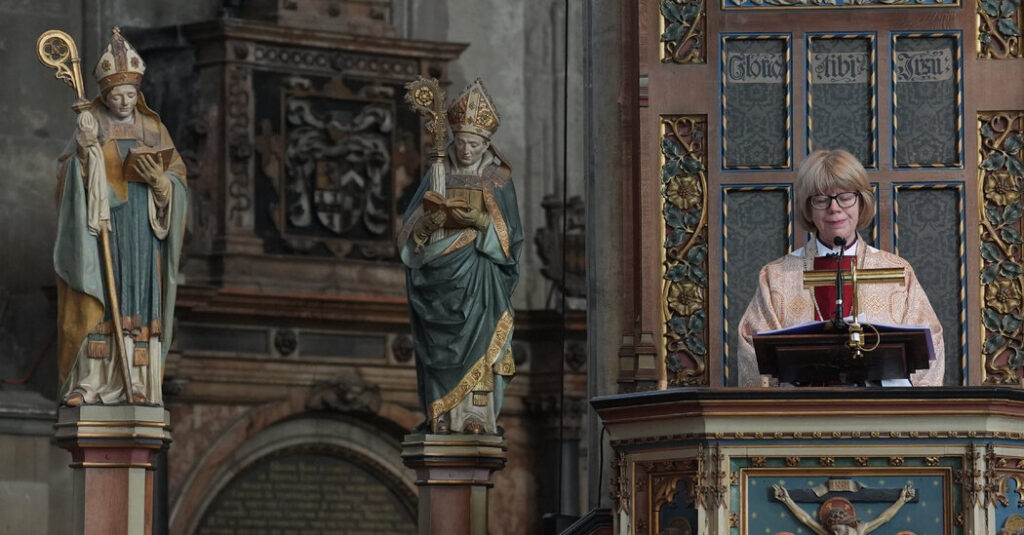
The Church of England apologized Thursday for its role in the decades-long practice of forced adoptions, in which tens of thousands of unmarried pregnant women and girls in England and Wales were sent to institutions where their babies were taken from them.
The archbishop of Canterbury, Sarah Mullally, said in the apology that the church had listened to firsthand accounts of some of the people affected, who she said had described “the pain, shame and indignity experienced both then and now.”
“Today, we say to each of you: The shame you were made to feel was wrong. You have nothing to be ashamed of,” the archbishop said. “Rather, we are deeply ashamed that this happened to people in the care of Christian communities.”
The apology came after years of advocacy by survivors of the institutions run by the church, known as “mother and baby homes,” where unwed mothers were often sent to give birth in secrecy. The women and girls sent to the homes faced stigma and stereotypes about their moral character, shouldering the burden of the shame of unplanned pregnancies while the men involved were typically excused that scrutiny.
Many women described being forced or pressured into handing over their babies for adoption in a system that exploited their shame. The Church of England ran an estimated 200 mother and baby homes in England and Wales from 1949 to 1976.
During that time, an estimated 185,000 babies were taken from unmarried mothers and placed for adoption in England and Wales amid a culture of shame, stigma and hostility surrounding pregnancy outside marriage, new research published on Thursday by the Church of England detailed.
In her statement, Archbishop Mullally said that the forced adoptions had taken place “in a society that often valued secrecy and respectability over compassion and care,” and acknowledged that “The Church of England was part of that society and helped to sustain those attitudes.”
“For many mothers, children, fathers and wider families affected by these practices, the impact has been lifelong,” she said. “These practices are in the past and must never happen again.”
A 2022 report from Britain’s Joint Committee on Human Rights into the forced adoptions from these homes found that the state “bore ultimate responsibility for the pain and suffering caused by public institutions and state employees that railroaded mothers into unwanted adoptions.” It also called for more to be done to support the families living with the lifelong consequences of these adoptions.
The British government has previously said it plans to also make an apology for the adoptions on behalf of the state. The government oversaw and regulated many of the institutions. Bridget Phillipson, the education secretary, told a parliamentary committee on Wednesday that the apology would come “very soon.”
“But here and now, let me say to all of those affected, you will get the apology that you so profoundly deserve,” she said.
The homes were not exclusive to England and Wales or to the Church of England. They were modeled on the Magdalene Hospitals of the mid-1800s set up by the Protestant churches across Britain, Ireland, Australia and Canada. Mother and baby homes continued to function throughout much of the 20th century.
In Ireland, there has been a recent reckoning with the treatment of unwed women sent to mother and baby homes, the majority of which were later run by the Roman Catholic Church. Those institutions were rife with abuse and neglect, and forced adoptions were also common.
The discovery of the remains of hundreds of babies and children interred in an unmarked mass grave at a home run by nuns in the town of Tuam in Galway prompted an investigation by the Irish government and the Catholic Church in 2021. Ireland has also set up a scheme to providing funding to the people impacted by their time in the homes.
The post Archbishop of Canterbury Says Church ‘Deeply Ashamed’ of Role in Forced Adoptions appeared first on New York Times.