For almost a week, people in Kansas City, Mo., watched and waited as every other World Cup host city held its first match. On Tuesday night, they finally got their turn.
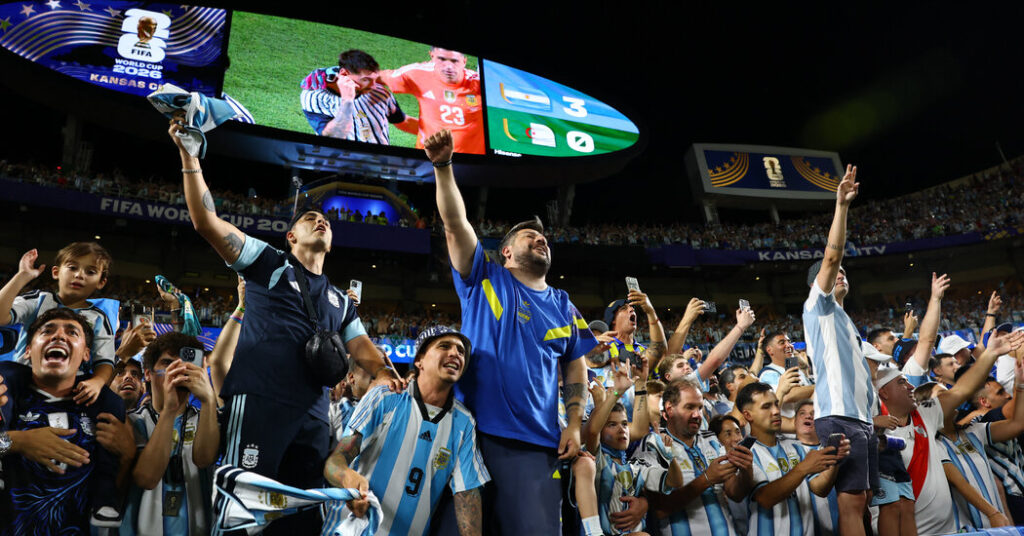
And it was not just any match taking place at Arrowhead Stadium: Lionel Messi’s Argentina, the defending champion, was in town to play Algeria under the lights.
As the smallest U.S. metro area chosen to host World Cup matches, Kansas City faced challenges that other cities did not. With few diplomats based in town, it needed to set up a temporary consular center to serve the influx of foreign visitors. With no experience hosting an international event of this scale, it had to bring in experts from elsewhere. And in a diffuse, car-centric region with limited public transportation, organizers decided to spend millions building a bus system that would end after the tournament.
Sure, there were risks. But for a place without the global cache of New York or Los Angeles, hosting also brought unique upsides. After all, when else would scenes from Kansas City be beamed into living rooms around the world? And when else would some of the most influential public figures from Europe, South America and Africa be showing up in droves at Kansas City’s airport?
The challenge, said Pam Kramer, the chief executive of Kansas City’s host committee, was to capitalize on the opportunity without trying too hard. In other words, she said, “How do we take this moment and turn it into a trade mission at home without making it feel like a timeshare presentation?”
With six matches scheduled at Arrowhead and four teams (Algeria, Argentina, England and the Netherlands) staying and training in the region, organizers planned events like an agriculture round table meant to introduce the city to influential visitors. They also adorned everything from streetcars to the bathroom signs at the airport with World Cup decorations.
Neighboring cities and small businesses got in on the act, too. Riverside, Mo., where the Dutch team is training, dyed its fountains orange. Lawrence, Kan., where the Algerians are staying, delivered a “proclamation of encouragement” for their visitors ahead of Tuesday’s match. And Betty Rae’s Ice Cream, a beloved local spot, created new flavors honoring some of the national teams coming to town. (For Algeria, baklava. For Argentina, dulce de leche.)
But the full payoff for the tournament, organizers knew, would only come if everything went well. Tuesday was the first big test.
At Kansas City International Airport, Argentines, many wearing the team’s blue-and-white-striped jerseys, arrived by the plane-full and chatted with volunteers about where to catch a bus. Downtown, the South Americans filled tables at the Crown Center shopping mall, waved Argentine flags out the windows of rental cars and lined up on Main Street for a quarter-mile to get into a fan festival.
By early evening, many of those fans had made their way across town to the stadium, usually home to the Chiefs of the N.F.L., hoofing it through front yards and across busy intersections to get to their seats.
There were logistical kinks, some of them noticeable.
Some of the buses in the temporary transit system were delayed, organizers acknowledged in a pregame social media post. Some parking passes did not specify an entry gate, leading to circuitous detours. And inside the stadium, a staff member described receiving conflicting directions about who should and should not be allowed to board an elevator.
In a few cases, impatience got the best of people. A group of Argentina fans argued with a parking attendant about whether they could enter, ultimately driving through despite her objection. And as traffic backed up near the stadium, some jersey-wearing motorists drove on the wrong side of the street or made illegal turns.
But by kickoff, that angst seemed to have passed. Few empty red seats were visible. And as Messi, the most famous soccer player in the world, took control of the match, delighted Argentines waved blue-and-white towels and posed for photos.
By night’s end, Argentina had prevailed, 3-0, with each goal scored by Messi. And Kansas City had introduced itself to the world.
The post The World Cup Gives Kansas City a Rare Turn in the Global Spotlight appeared first on New York Times.