The heartbeat of the artificial intelligence economy sounds like a low-frequency thrum of a neighbor’s central air-conditioning unit, an airplane flying overhead at high altitude or a truck engine idling down the road.
But it feels like the vibrating, rhythmic pulse of a subwoofer from a party that will never end.
Yes, the cloud has a sound, and some who live closest to data centers that emit the noise have reached their wit’s end trying to block it out.
Residents in three small cities last month filed lawsuits against data centers specifically about noise.
The United States has more than 3,000 operational data centers, with more than 1,500 in development, according to a Pew Research Center analysis. They have been the backbone of the information economy for decades, operating largely in the background of daily life.
The boxy industrial facilities house thousands of servers and chips to process billions of operations daily and store vast amounts of data.
The memory chips generate heat and they need giant industrial fans to keep them from melting. Many data centers also use diesel-powered generators since the grid often can’t support such heavy power needs.
The demands of artificial intelligence, which require far greater amounts of computing power and cooling infrastructure, have led to a burst of data center construction.
Today, nearly 40 percent of homes are within five miles of at least one operational data center, Pew found, and more of them are creeping closer.
The humming of those cooling systems, the rumbling of the generators and the whirring of fans can be heard, and felt, for hundreds of feet and even up to a mile away.
“The acoustic footprint is just orders of magnitude different,” said Les Blomberg, executive director of the nonprofit Noise Pollution Clearinghouse.
Some of the noise consists of infrasound, ultralow frequency sound waves that fall below the threshold of human hearing.
Instead of audibly hearing these extremely low frequencies, people physically feel them as pressure fluctuations, much like the deep vibration of a bass drum shaking your core at a concert, said Scott Hamilton, a member of the Acoustical Society of America and a consultant on data center projects.
This can leave the traditional gauges of noise, and solutions for dampening it, inadequate to meet modern needs.
Some residents living near infrasound frequently report chronic sleep deprivation and insomnia, headaches, internal ear pressure and anxiety.
Many times the law does not help.
Noise pollution is regulated at the local level through a thicket of zoning ordinances, which were originally written to address loud block parties, barking dogs or construction noise, not the round-the-clock industrial hum of a data center.
There’s no relief at the federal level because the Reagan administration defunded the Environmental Protection Agency’s Office of Noise Abatement and Control in the early 1980s.
While regulations exist, “there’s nobody at home at the E.P.A. to actually enforce them,” said Richard Neitzel, a professor of environmental health sciences at the University of Michigan.
“They held that office up as an example of regulatory overreach, like how dare the government tell me how loud my lawn mower can be,” he said.
Residents are now pushing to fill the regulation gap.
The three lawsuits argue that while the data centers often meet basic zoning codes, the constant humming and vibrations cause significant depreciation of property values and loss of quiet enjoyment for nearby homeowners.
The plaintiffs want compensation for damages and to force companies to improve sound safeguards.
In Vineland, N.J., a group of homeowners filed suit in federal court driven, in part, by the fear of more noise to come.
“There is a constant noise of machinery running that is most noticeable at night when trying to sleep,” Stefanie Bartiromo, a nearby resident, said of the three server rooms already operating, according to the suit. “It sounds like a helicopter that never moves and at times like a heavy duty truck running constantly.”
The suit was filed against DataOne USA, which is adding to its Vineland campus. Upon completion, DataOne will have a 2.6 million-square-foot complex requiring 300 megawatts of power, enough to power a medium-size city.
DataOne said that it already had taken measures to reduce noise and that it would continue to do so as the addition is completed.
“We remain committed to constructive dialogue, and being a valuable and responsible member of the community for the long term,” a spokesman said in a statement.
The company said it wanted to add jobs and spur the local economy. The economic case for data centers was also made by the other companies being sued for noise, years after they repurposed former industrial sites in Dowagiac, Mich., and Lowell, Mass.
Residents in Dowagiac had complained about a 30-megawatt data center in a building that had mostly been used to store boats and R.V.s.
The center’s owner, Alliance Cloud Services, recently bought 50 more acres of forested land, as it plans to expand its power usage capacity to 300 megawatts, from 30 megawatts. Some of that land would act as a natural buffer, the company said.
To combat noise, the industry is moving toward liquid cooling. Instead of using loud fans to push air, servers are submerged in special nonconductive fluids or have liquid-cooled “cold plates” sitting atop heat-generating processors.
This can reduce the noise of a data center by more than 50 percent, but it is much more expensive to install.
Dowagiac, a city of 5,700, had a general noise ordinance, like many communities, but it recently set decibel limits for ambient noise in residential, commercial and industrial zones.
Most communities set their standards using an A-weighted decibel scale, which was designed to mimic human hearing in a quiet environment and significantly discounts, or ignores, low-frequency sounds emitted from data centers, experts said.
In contrast, the C-weighted scale is intended to capture low-frequency noise.
That distinction is especially critical when measuring data center noise, which is dominated by low-frequency hums from massive cooling fans and equipment, Dr. Neitzel said.
Consequently, Mr. Blomberg said, a noise source that clearly dominates a listener’s ear might not register as an issue on a standard decibel meter.
The chief executive of Hyperscale Data, Alliance’s parent company, said that its operations were within the city’s permissible decibel limits, and that it would be using systems that minimize energy usage.
The executive, William B. Horne, said he would attend a City Council meeting to meet with residents and emphasized that he was committed to being a trusted partner.
“We would offer to purchase those properties at market value and provide a subsidy to help cover the cost of moving,” he said of residents who live adjacent to the data center.
The crux of the problem, Dr. Neitzel said, is that with many traditional community noise sources — like airports and freeways — the noise levels tend to die out or decrease at night.
Not so with data centers.
“Now you’ve got the same sound level while you’re trying to sleep, which is a much more sensitive period for recovery for the body,” he said. “Noise is just as serious a hazard as air pollution or water pollution.”
In Lowell, Mass., Diana Streete said the noise “regularly interferes with my family’s ability to sleep, rest, relax and comfortably enjoy our home.”
“My children’s bedrooms face the entrance area where trucks and facility activity occur, which makes the noise especially disruptive,” she said.
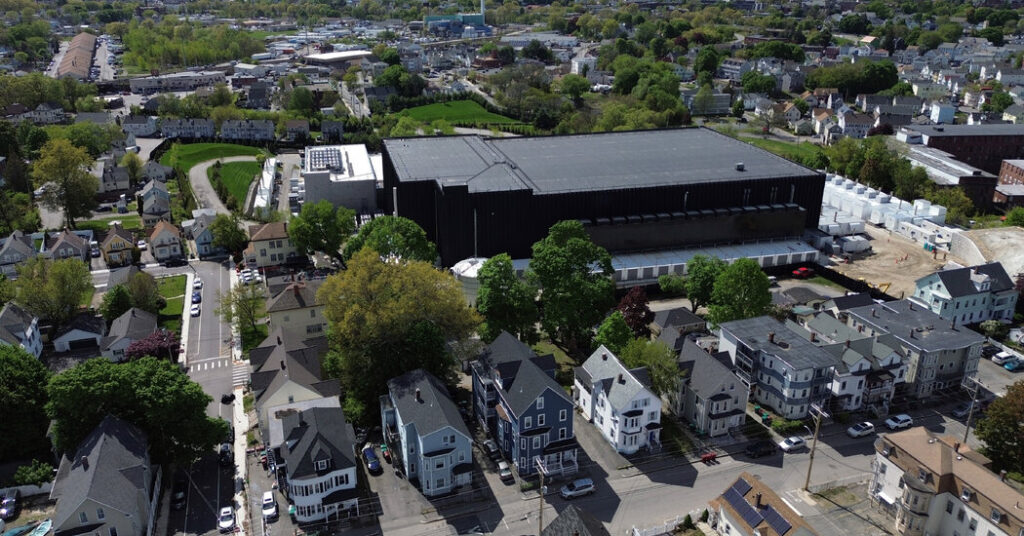
Lowell, a city of 115,000 residents, was founded as a textile town in the 1800s, but its mills closed in the early 20th century. The site of today’s data center was once the Lowell Bleachery and Dye Works, and then for six decades the Prince Spaghetti factory.
The 350,000-square-foot data center is abutted by homes and recreational facilities, including a park and baseball field.
Its owner, Markley, said the complex supported the digital infrastructure of public safety agencies, universities, local hospitals and other regional institutions.
It’s a co-location data center, a shared facility where multiple companies rent space to house their computing equipment. That’s different from the hyperscale data centers that are built to serve the needs of global technology companies.
A Markley spokesman said that the generators were tested weekly, and that the sound was within established limits.
Mr. Hamilton said there was a wide spectrum of sound and, just as wide is the spectrum of how people process that sound. Existing standards are created for the average person, he said.
“But you work in this field long enough and you finally run into, or experience, the ultrasensitive person,” Mr. Hamilton said. “These people legitimately experience sound and vibration and intensity that the average human being goes, ‘This isn’t a problem. I don’t know what you’re talking about,’ and they’re tormented by it.”
What is a good neighbor? Mr. Hamilton said that’s a critical question that he addresses in his work.
“There is no world where any operation doesn’t create any sound,” he said. “We experience sounds all day, every day, but there’s reasonable, there’s acceptable and then there’s unacceptable.”
Kitty Bennett contributed research.
The post The Cloud Has Sound: The Unrelenting and Unseen Cost of the A.I. Boom appeared first on New York Times.