This personal reflection is part of a series called The Big Ideas, in which writers respond to a single question: What drives us? You can read more by visiting The Big Ideas series page.
The rain was hammering relentlessly against the metal roof of the recreational vehicle. It was 4 a.m., just as dark and rainy as when I entered the R.V. to get some sleep and food a couple of hours earlier. In the mountains of Colorado, I was getting ready for the third day of a monthlong odyssey, and my body was screaming to stop.
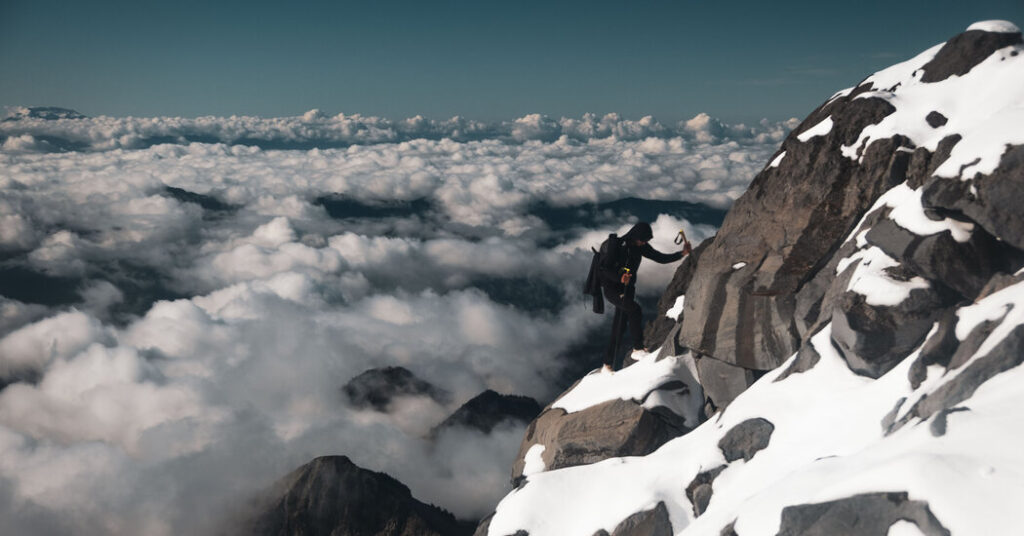
I sat on the edge of the narrow bed, staring at a pair of wet socks. Every fiber of my being seemed to be lobbying for me to go home. I was only 72 hours into an attempt to link the summits above 14,000 feet in the contiguous United States by foot and bicycle. This project, known as “States of Elevation,” spanned from Longs Peak in Colorado to Mount Rainier (also known as Tahoma, its Indigenous name) in Washington.
The scale of the ambition felt laughable in the face of my present reality. I had spent the past three days running for more than 20 hours a day, the high altitude was hitting me hard, and the fatigue was so heavy it was gnawing. As I reached for those wet socks, the question hit me: Why am I doing this?
I have been in uncomfortable situations before. I escaped an avalanche alone at over 25,000 feet, got lost on the North Face of Mount Everest on a stormy night and felt my bones breaking while trying to stop a fall on a steep face. But those moments were governed by a different biological engine: survival. In those instances, the drive to keep moving was primal. Adrenaline is a miraculous architect; it constructs physical and cognitive tools out of thin air, granting you the strength to do the impossible because the alternative is death.
This, however, was different. There was no immediate danger. I was simply a tired man deliberately choosing to put on wet socks and go bike into a freezing deluge. It was a voluntary ascent into suffering.
In endurance sports, we often talk about finish line fever — that psychological pull that occurs when the end is in sight. It is easy to ignore a mounting injury or a staggering heart rate when you are just two hours from the finish of a race you’ve trained years for.
But the opposite is true at the beginning. When you have thousands of miles ahead of you, and you are already broken on day three, the “end” feels no more than a distant idea. The psychological weight of the work ahead is far heavier than the possibility of success. To the brain, starting a massive project under duress feels like an error in judgment. It is the hardest time to keep going, because the investment still feels small.
I am not a masochist. I don’t find pleasure in pain itself. However, over decades of activities in the mountains, I have developed an intimacy with discomfort. I have learned that discomfort is the only currency that can buy passage to certain places — both geographical and emotional — that are otherwise unreachable.
That morning in Colorado, as the rain continued to roar, I realized I couldn’t think about reaching Washington. I couldn’t even think about the next state line. If I looked at the map in its entirety, I would quit before I clicked my cycling shoes into the pedals.
So I focused on the next hour. Then the next summit. Then the next town. I stopped fighting the tiredness and started observing it, as if it were a removed third party traveling alongside me. I stopped obsessing over my slow pace and started looking at the wildlife, at the way the sunsets turned the granite to gold.
A strange thing happened around day seven. My body stopped fighting. Instead, I felt that it started to accept all the effort I was putting in. Human physiology is incredibly malleable if we pursue; the human body is not only resilient, but it adapts. My legs found a rhythm, and I got better day after day, reaching Tahoma with a fresher body, able to continue even further.
I believe that as humans, we carry a biological imperative to explore. You can see this in children. When I watch my own kids running in the forest, they aren’t exercising — they are exploring the world. They climb a tree not to reach the top, but to see what their bodies are capable of. They get tired and sometimes frustrated, yet their eyes ignite with a singular pride when they finally discover something new.
Our history as a species is written in this exploration. Why did we cross the oceans, hike to the frozen poles, climb the highest peaks? Why do we obsess over shaving a millisecond off a sprint? While other species are content with mastering their ecological niches, humans have an insatiable craving for new information.
Sports, at this level, are simply a socially acceptable excuse to conduct an experiment on the self. We explore our inner limits to discover the hidden geography of our own physical and mental capacities.
This pursuit is what kept me moving when the R.V. was warm and the outside world was cold. The project was no longer a list of peaks to check off; it was a question that needed solving. I wanted to see if, by accepting the discomfort rather than fleeing from it, I could become a different version of myself. I wanted to discover the person who existed on the other side of thinking, “I can’t.”
To some, this level of endurance might seem elitist. Not everyone has the opportunity or the desire to spend a life pushing physical boundaries. Yet the core of this drive is universal. I see it in the shining eyes of my children as they explore the world and the limits of their bodies for the first time. I see it in a friend who, at 86, is planning a return to the Himalayas, not trying to outrun his younger self but exploring what it means to be strong in his ninth decade.
This shared human hunger for discovery is what I felt at the foot of Tahoma.
Kílian Jornet is a professional ultramarathoner and mountaineer. In 2025, he spent 31 days linking the 72 peaks above 14,000 feet in the contiguous United States by foot and bicycle.
The post I’m an Ultramarathoner and Mountaineer. Here’s What Keeps Me Going. appeared first on New York Times.