It was early Sunday evening, and a group of artists and journalists was filtering into a dimly lit dance studio with floor-to-ceiling mirrors. Fried vegetarian buns and sandwiches from Vanessa’s Dumpling House were passed around on clear trays while eclectic beats — Caribbean, African, Middle Eastern — vibrated through the space.
Under other circumstances, Imperial Ballroom, a family-run business for over 30 years in Manhattan’s Chinatown, might have been an unexpected venue for a literary magazine party.
For Equator, a new publication about politics, art and culture, it was the perfect choice, said Negar Azimi, the magazine’s art director. The neighborhood “is devoted to the non-Western world,” she said. “One of the main themes of this project is the post-American world.”
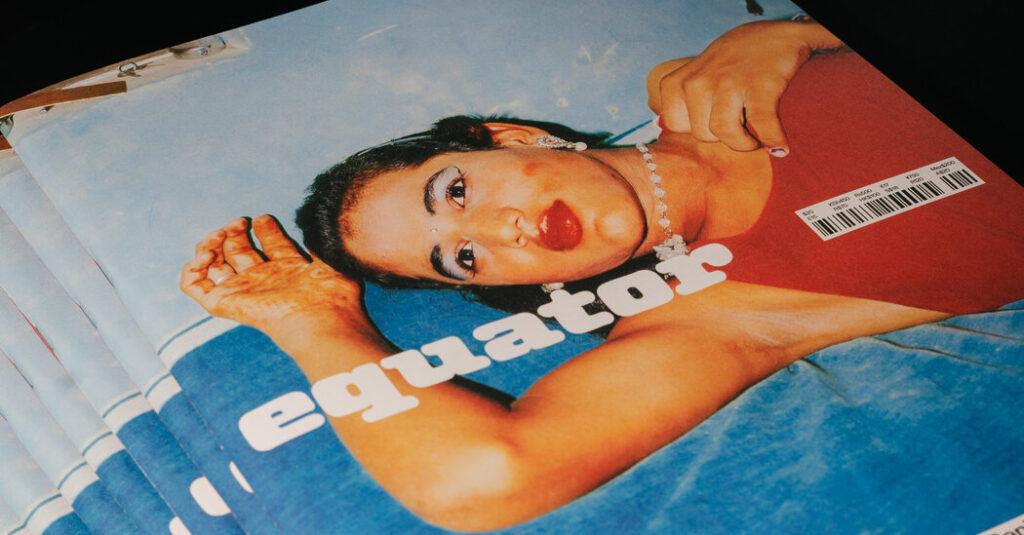
The crowd was there to celebrate the first issue, a hefty — physically and intellectually — periodical with colorful, high-contrast photos, roughly the size of Interview Magazine. On the cover, a boy at the annual trans festival in Villupuram, a small town in Tamil Nadu, in blue eye shadow and bright red lips gazes at readers.
This issue of Equator, a thrice-annual publication, includes an oral history of China’s manufacturing revolution told through the eyes of migrant workers; a memoir by a Mongolian journalist who was re-educated by the Chinese Communist Party; and a first-person account of the rise and fall of Podemos, the Spanish left-wing party, by one of its former ministers.
“But we don’t want it to be all doom and gloom, like eating your vegetables,” said Krithika Varagur, the editor and co-founder of the magazine. “Equator is actually hopeful.”
Varagur, 32, is also an editor at The Drift, the literary magazine that has become the bellwether of young intellectual New York. Varagur, who has a background as a foreign correspondent, was enticed to work on another magazine project last year, when she heard from the writer and novelist Pankaj Mishra, who was bringing together a group of friends and journalists who wanted to take a different approach to covering global affairs.
What would be different about it?
The group wanted to avoid what Azimi, in a speech that evening, called the “boilerplate journalism” they saw from other outlets following the war in Gaza. And they were intent on shedding a presumed American perspective on geopolitics.
Inside the first issue is a yellow foldout poster of the Equator manifesto, which begins with the headline: “The end of the West is not the end of the world.” The 11 editors on the masthead are based in New York and London, as well as Nairobi, Kenya, and Lahore, Pakistan.
Jonathan Shainin, an editor, had just landed in New York from a red-eye from London. Like many of his colleagues, Shainin, 47, had left a post at an established publication to work on the magazine full time. He joined Equator after more than a decade editing The Guardian’s Long Read section.
It’s not the only magazine to arrive on the scene with new ideas about how to cover foreign affairs — and how to get readers interested in them. In March, the journalists Hélène Werner and Nicolas Niarchos feted their new publication, Now Voyager, dedicated to international reportage.
“The project was conceived in the Biden era,” Shainin said of Equator. “With Trump’s return and collapsing of American hegemony, the appetite for this has accelerated.”
At a standing table, Gavin Jacobson, 40, the magazine’s publisher, was leafing through a copy — it was the first time he was seeing the issue in print. He stopped at his favorite piece, about the factory workers of Guangdong. It was by the poet and writer Zheng Xiaoqiong and translated from Chinese.
“We want writers who don’t have writing gigs at The New Yorker,” Jacobson said.
Midway through the evening, Azimi and Varagur corralled the group under a disco ball and multicolored strobe lights, inviting the issue’s contributors to the dance floor to read their work.
Zain Khalid, a novelist and associate editor at The Drift, read part of a short story he had written about a woman who wished her father had been killed in the crush at Mina during the Hajj.
He appreciated that Equator was “uninterested in relatability,” he said later.
As the sun set, guests lined up to refill their drinks at a makeshift bar where wine, Champagne, mezcal and Spindrifts were served out of a large ice bucket.
Emily Greenhouse, editor of The New York Review of Books, sipped from a reusable water bottle with an issue rolled up under her arm. “Equator positions itself straight away as a movement as well as a magazine,” she said. And, she added, it has “real style.”
Nearby, Anthony DiMieri, the Brooklyn filmmaker behind Zohran Mamdani’s mayoral campaign who had helped make videos for Equator’s social media, was listening in on a group talking loudly about the Knicks championship win the night before.
“To meet the horrors of the world right now with community seems important,” he said.
The post A New Magazine With Political Heft, and ‘Real Style’ appeared first on New York Times.