The president of the United States announced last month that, in place of performances by Martina McBride, Young MC, the surviving members of the Commodores, one member of Poison, and other sought-after musicians who had dropped out after being recruited on apparently false pretenses, he would personally provide the entertainment for a 250th-anniversary celebration of American independence.
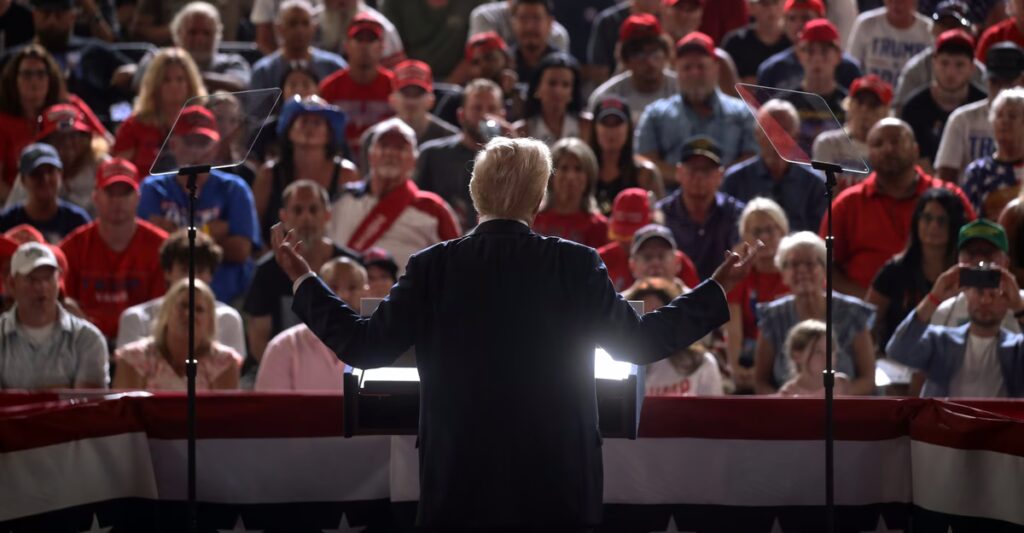
“On Wednesday, June 24th, at 7 P.M., in magnificent Washington, D.C., now totally beautified, and one of the Safest Cities anywhere in the World, and in celebration of our Country’s 250 Year History, we will be bringing you, LIVE, the Greatest Rally, EVER!” Donald Trump wrote on Truth Social. “It will be special at every level—A Rally to end all Rallies!”
This week, he announced another rally, to take place July 4. “We are going to host the most spectacular TRUMP RALLY of them all, a ‘TRIBUTE TO AMERICA.’” The Rally to end all Rallies will apparently end them for a mere week and a half.
The shambolic decision to turn the quarter-millennium anniversary of the Declaration of Independence into yet another rally is, perhaps, an inevitable outgrowth of Trump’s megalomania, which renders him unable to keep separate the functions of party leader and head of state. In merging the two, he has trashed the latter.
Head of state and leader of the governing party are two different roles that, in many countries, are held by different people. In the United Kingdom, the head of state is a monarch. In Israel, it is a president. Both positions differ from the more political role of the prime minister.
The United States gives both roles to the president. Traditionally, presidents have responded to this burden by tailoring the part to the occasion. They would act as a party leader when, say, giving a routine press conference, but as head of state when, for example, meeting foreign leaders or addressing the country during a national disaster or a war. In some cases, the division is marked by rules or norms, which Trump characteristically disregards. There is a law, called the Hatch Act, that limits the use of the presidency for political activities (say, holding a political convention at the White House), which the Trump administration systematically violated during his 2020 reelection campaign.
Read: Inside America’s ugly birthday battle
The wall Trump began dismantling in his first term has been obliterated in the second. Presidents are not supposed to give partisan speeches to active-duty military, but Trump instructed soldiers in February that “you have to vote for us.” Trump has treated the federal government as an extension of his party, which in turn is an extension of himself. He has draped government buildings with his likeness, and he celebrated his birthday with free admission to national parks and an Army parade. The putative excuse for the Army parade, that it was for the branch’s 250th birthday, is rendered dubious in the extreme by the absence of any similar observance for the same birthday of the Navy or Marines.
Trump has commissioned a Trump Gold Card for wealthy immigrants, Trump Accounts for children, TrumpRx for prescription drugs, and a “Trump class” battleship. He renamed the U.S. Institute for Peace and the Kennedy Center after himself, and when a judge ordered him to remove his name from the latter, Trump installed a tarp to cover John F. Kennedy’s, too.
My colleague Michael Scherer reported on the administration’s decision to supersede America250, a nonpartisan organization dedicated to celebrating this year’s Independence Day, with a partisan analogue, Freedom 250. This process accomplished in a more formal and bureaucratized fashion the same objective Trump has carried out informally by treating the presidency as a vehicle for personal glorification and profit. The problem Freedom 250 set out to solve was that Congress had planned a patriotic celebration (one that would cast the president in a head-of-state role) when he preferred an event that would highlight MAGA values (Trump as party leader).
His goal in all of these maneuvers has been to convert a public asset—in this case, the prestige of the presidency—into a private holding. By doing so, however, he has devalued the currency. That is why Freedom 250 was reduced to booking acts one level above the bar-mitzvah tier—many entertainers would be flattered to perform at a ceremony honoring the nation, but far fewer would accept a gig at one designed explicitly to glorify Trump. Vanilla Ice, one of the last remaining musical acts willing to appear at the rally, explained, “You play for your fans. And I’ll go play for Putin, and I’ll play in Iran if you want. It don’t matter.” For the talent to compare the president to, respectively, a notorious dictator and a regime that he has sought to topple with military force was probably not the message Trump had in mind when he planned the event.
[David Frum: Trump’s 250th celebration is a fiasco]
Trump’s predecessors were hardly saints. They understood that performing nonpartisan roles conferred on them a dignity and measure of good feeling that had political side benefits. During his first term, Joe Biden visited Kentucky after a tornado and told the people he met that he was there to support them regardless of whether they voted for him. He surely believed that idealistic message, but he also understood it made him appear presidential. Occasionally being above politics is good politics.
If Trump were smarter, he would understand that husbanding the political capital of the office of the presidency pays off eventually. But this calculation would require him to think long term, rather than to greedily snatch whatever reward presents itself to him in the moment. Sadly, Trump’s inability to forgo immediate fulfillment is as pronounced an aspect of his personality as his megalomania. Well, nobody’s perfect.
The post Why July 4 Turned Into a Trump Rally appeared first on The Atlantic.