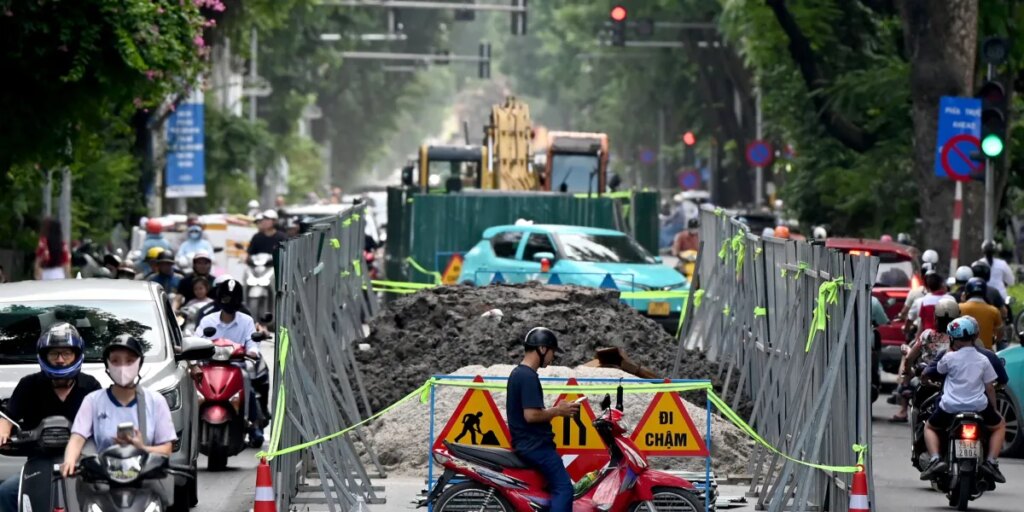
Hail a taxi in Vietnam’s busy Ho Chi Minh City, and you may be surprised to be picked up by a cyan-colored, modern-looking EV. Unlike the motorcycles and scooters that dominated the city’s streets for years, these electric taxis are both comfortable and homegrown; they’re made by VinFast, an ambitious (and expensive) project by Vingroup—one of Vietnam’s largest privately owned companies—that aims to turn the Southeast Asian country into a car manufacturer.
It’s not the only indicator of change on Vietnam’s city streets. Fancy Western-style coffee shops, luxury hotels, and high-end consumer brands dot Ho Chi Minh City, even as many Vietnamese continue to eat their lunch on plastic stools in hole-in-the-wall eateries right next door.
It’s the kind of vibe that’s only found in a country that’s growing—and growing quickly. And it’s not just the consumer economy. Manufacturing, real estate, infrastructure, and tourism are all expanding. “You license a project in six months, you build it in 12,” says Michael Piro, co-CEO of Indochina Capital and an investor in industrial real estate. “It’s so easy. I’ve never seen, in my 20-year career, an opportunity like this.”
Vietnam’s economy grew by 8% last year, almost double the rate recorded across the rest of Southeast Asia. (Malaysia, at 5%, was in second place.) With a GDP of $527 billion, Vietnam’s economy has already overtaken Malaysia and the Philippines, and is quickly catching up to Thailand. The VN-Index, the country’s benchmark stock index, has climbed more than 35% over the past 12 months. And this September, FTSE Russell will upgrade Vietnam to secondary emerging-market status, which could unlock billions of dollars in passive fund flows.
It has also, for now, stabilized its relationship with the U.S., its most important customer. In October, Vietnam secured an agreement from Washington that set U.S. tariffs at 20%, far below the 46% originally threatened on “Liberation Day” in April 2025 and roughly in line with rates imposed on other ASEAN economies. Over $190 billion worth of Vietnamese goods are bound for U.S. customers every year.
“Vietnam has done quite a lot of things right, no matter how you look at it,” says Alberto Vettoretti, a top ASEAN executive for Ascentium, an Asian business services firm that helps companies enter Vietnam.
Yet Hanoi isn’t content to rest on its laurels. The government wants Vietnam to grow by 10% annually by 2030, and reach high-income status by 2045, a feat that would require a near tripling of the country’s per capita gross national income from around $4,500 to $14,000. Only a handful of countries have pulled that off—and just one other country, China, has successfully changed from being a centrally planned economy to a manufacturing and consumption powerhouse.
Can Vietnam copy China’s playbook? It has a stable government that’s laser-focused on economic development; an export-oriented manufacturing sector that’s climbing up the value chain; a diplomatic strategy that’s friendly with Washington, Beijing, and Moscow at the same time; and a fast-growing middle class.
But on the ground, executives and investors who know the country best are asking harder questions about Hanoi’s ambitions. Can Vietnam get enough capital for the economy it wants? Does it have enough workers and human capital? And does it have enough time?
“We want to achieve the government’s target,” says Nguyen Thu Hang, CEO of Vinhomes, Vingroup’s real estate business. “But the most challenging thing isn’t just the short term, but whether we can achieve this high-growth rate and make it more sustainable.”
After reunification in 1976, the Vietnamese Communist Party tried to build a centrally planned economy, with nationalized enterprises, collective agriculture, and fixed prices. A decade later, things were coming undone, with hyperinflation and declining foreign aid from the Soviet Union forcing a change.
In 1986, General Secretary Nguyen Van Linh launched Doi Moi, or “renovation,” which was a sweeping package of reforms that allowed foreign investment, private ownership, and a new stock market. Vietnam also rebuilt ties with former enemies like China and the U.S., the latter of which lifted its trade embargo in 1994.
Still, things were difficult in those early days. “The private sector wasn’t really investable at that point,” remembers Chris Freund, founder of Mekong Capital. “The people you partnered with had no personal stake in the long-term success of the business. They didn’t receive bonuses based on the company’s value, and all they could get is how much they could siphon out.”
The pivot came in the mid-2000s, right as Vietnam joined the World Trade Organization. When Piro arrived in 2006, “there was a pervasive sense of optimism around the WTO and what it was going to mean for Vietnam. Back then, the whole market was in its infancy; people would say, ‘Wow, this restaurant has air conditioning, let’s go there.’ ”
Things are “much more mature” now, Piro adds. “Vietnamese are proud to be Vietnamese. They’re not looking to bring whatever is big in the U.S. or Europe.”
Over the past two decades, millions of Vietnamese have climbed out of poverty, underpinning robust domestic growth in retail, e-commerce, health care, and travel. “For retail—anything selling to Vietnamese consumers—this year is the best in a long time,” says Freund, whose Mekong Capital has made close to 50 investments in Vietnamese consumer businesses. Vietnam’s retail sales grew 12.1% year on year between January and April 2026.
More important, this growth hasn’t generated extreme inequality. Vietnam’s Gini coefficient stands at 0.37, roughly equal to Singapore and Indonesia, and below the Philippines and Malaysia. Nor does Vietnam have the corporate concentration seen in other Southeast Asian countries, in part owing to its much shorter history as a market economy. “In countries like Thailand, Malaysia, and Indonesia, you tend to see large family groups or conglomerates—often over 100 years old—that control a lot more of the economy,” Freund says. “You don’t really have that here.”
Vietnam’s GDP per capita is still below the world average, sitting around the level of other emerging markets like Indonesia, the Philippines, and Morocco.
There’s still a divide between northern and southern Vietnam. Vietnam’s electronics manufacturing is clustered in the north, close to the border with China: Components from Chinese suppliers cross over for final assembly in a Vietnamese factory, then are shipped to markets like the U.S. The south, in contrast, has more light manufacturing and agriculture, as well as the country’s commercial and financial hub, Ho Chi Minh City.
Vietnam is perhaps the biggest beneficiary of the “China plus one” trend, where manufacturers moved parts of their supply chain outside of China, whether to avoid U.S. tariffs or to add some resilience to their operations. Foreign companies like Samsung, Apple, and Nintendo have invested billions of dollars into Vietnamese factories, making laptops, TVs, headphones, and video game consoles for world markets. Vettoretti points out that 80% of Vietnam’s exports come from foreign direct investment.
Still, people on the ground caution against reading too much into Vietnam’s manufacturing boom.
“Much of it isn’t creating wealth for Vietnamese people,” Piro says. “It’s foreign-owned businesses conducting foreign business, so it’s not the core engine of what’s driving wealth for ordinary Vietnamese.”
Also, many of the factories making products for these global brands are backed by Chinese money. “If you look at the numbers and new projects, Chinese investors—including those from Hong Kong, mainland China, and perhaps Taiwan—are number one in terms of project volume,” Vettoretti explains.
Piro estimates that at Indochina Capital’s industrial parks, around 70% of the tenants are mainland Chinese manufacturers and another 20% are Taiwanese.
More recent optimism about Vietnam has focused on a new set of reforms by the country’s government. The most consequential is Resolution 68, which elevates the private sector as “the most important driving force of the national economy” (as opposed to just being merely “important”). The resolution also honors entrepreneurs as “new warriors on the economic front”; sets a target of doubling the number of private enterprises to 2 million by 2030; and calls for the creation of 20 large, globally competitive private companies, similar to the chaebol that drive South Korea’s economy.
The government is also pledging billions of dollars in spending on physical infrastructure. Vietnam has approved a $67 billion high-speed railway linking Hanoi to Ho Chi Minh City, cutting a 30-hour journey down to five. The country is also planning to spend $25 billion on its airports by 2030, including a long-delayed replacement for the wildly overcapacity Tan Son Nhat International Airport in Ho Chi Minh City.
“They’ve developed the north and the south, and now they’re filling out the missing parts,” Vettoretti says, referring to Vietnam’s long, narrow geography, which stretches over 1,500 kilometers, longer than Italy.
Vietnam’s companies are also pushing forward on more advanced manufacturing projects. In addition to VinFast, Vingroup is supporting Vietnam’s high-speed rail lines and its offshore wind projects. Viettel, a telecoms conglomerate owned by the military, broke ground on the country’s first semiconductor fabrication plant in January, with a plan to start making 32-nanometer chips by 2027.
Perhaps the most ambitious proposal is an international financial center (IFC) to be split between Ho Chi Minh City and the coastal city of Da Nang, creating a regulatory island for financial institutions to move money, establish offices, and access global capital markets. Initiatives like Da Nang’s IFC are also part of a needed effort to spread economic development across more of the country. “We need to develop infrastructure in a better way so that economic growth is not concentrated only in Hanoi and Ho Chi Minh City,” Nguyen of Vinhomes says.
These projects are being led by a government that’s unusually unified, even by the standards of a single-party state. General Secretary To Lam, who leads the Vietnamese Communist Party, was chosen as the country’s president in April, putting both of Vietnam’s powerful political positions under one person.
Yap Kwong Weng, the CEO of Vietnam SuperPort, a logistics hub under development in northern Vietnam, sees a real change in Vietnam’s government. “We’re seeing a transition where leaders are being given more permanent positions, which helps make policy formulation and execution more secure,” he says. “For a business like ours, especially from an investor perspective, political stability and consistent policy implementation are extremely important.”
“You have a single party controlling everything, with very clear long-term goals that are very detailed—way beyond what you’d see at the opposite extreme, like in the U.S.,” says Freund, who has been investing in Vietnam for three decades.
Vietnam has also proved adept at managing a complicated geopolitical environment. Hanoi maintains warm relations with Washington, Beijing, and Moscow, a balancing act it has long dubbed “bamboo diplomacy,” a phrase coined by former General Secretary Nguyen Phu Trong, who praised the bamboo plant’s “strong roots, a sturdy trunk, and flexible branches.”
In March, then–Prime Minister Pham Minh Chinh traveled to Moscow to secure support for new nuclear power plants and railway infrastructure. A month later, To Lam made China his first overseas visit after becoming president, with a trip that led to rail and airplane deals.
$178 billion
2025 revenue of the 72 Vietnamese companies on the Fortune Southeast Asia 500
10.5%
Increase in that revenue figure over 2024 Sources: Fortune, company filings
Yet Vietnam still has to avoid some Trump-era pitfalls. The country’s trade agreement with the U.S. imposes a 40% tariff on goods deemed to have been transshipped from China—which could, in more extreme interpretations, threaten goods assembled in Vietnam using Chinese components. The U.S. has also slapped Section 301 probes on Vietnam, accusing it of industrial overproduction and failing to protect intellectual property.
Nor has Vietnam’s ability to play nice with all sides been tested by a genuine decoupling between the U.S. and China, where Washington and Beijing force countries to pick sides. Bamboo, after all, still breaks with enough pressure.
And 10% growth is a high bar for any country. The World Bank expects Vietnam’s growth in 2026 to slow to 6.8%; the OECD is even more bearish, forecasting 6.2% growth. The Asian Development Bank, the International Monetary Fund, and the ASEAN+3 Macroeconomic Research Office are more optimistic, but still predict growth of 7% this year.
HSBC, which forecasts 6.5% growth for Vietnam in 2026, warns that “downside risks to growth are increasing,” particularly if energy prices stay high in the wake of the Iran war. Inflation, at 5.8%, has already broken through the central bank’s inflation ceiling, making interest rate hikes more likely—and, in turn, complicating Vietnam’s path to high growth this year.
In the long term, Vietnam’s growth ambitions have another obstacle: They’ll be very expensive, and it’s not clear that the country can find the money to fund every single project. Most outside analyses suggest Vietnam needs $160 billion in infrastructure investment by 2030.
Jens Lottner, CEO of Techcombank, one of Vietnam’s largest privately owned banks, thinks the amount is even larger: He puts the financing gap at $200 billion, on top of total investment needs of $1.1 trillion. “There’s no way all these infrastructure investments can be financed by the local banking systems,” he says. “Vietnam’s deposit-generating capacity just isn’t big enough.”
The shortfall will need to be filled by foreign investment, but institutional investors may be wary of putting money into a country that still has capital controls. “It’s not difficult to get money into Vietnam,” Piro says. “It’s getting money out.” Even if there aren’t regulatory barriers, Vietnam still doesn’t have the financial infrastructure to allow large foreign investors to both deploy capital and exit investments. (In theory, the new Ho Chi Minh City financial center will address this problem, but the project is still in its very early stages, and few executives Fortune talked to fully understood how it would work.)
But Hanoi also doesn’t have a choice: It needs these infrastructure projects to encourage people to invest. “Logistics is still very expensive in Vietnam,” Yap says. “How are superports going to be linked to cargo terminals, airports, and seaports? We would appreciate more government support.
“If Vietnam cannot scale its ports or complete cross-border rail infrastructure on time, then capital will simply look elsewhere,” he warns.
It’s not just a shortage of funds. The surge in construction and manufacturing is already leading to a shortage of labor, and thus higher costs, across the country. (Nguyen of Vinhomes admits that her company is already having to invest in automation and less-labor-intensive machinery.) Vietnam’s edge against China is narrowing, and low-value manufacturing is already leaving for cheaper economies like Cambodia and Bangladesh.
“Garment factories are saying, ‘I’ll go anywhere—find me a place right near a village in the middle of nowhere where everyone can work,’ ” Piro says.
Vettoretti describes electronics suppliers that want to relocate to Vietnam to be closer to Samsung, only to find they “can’t afford to be nearby due to factors like labor costs and availability.”
“We always thought people were our biggest resource, with a population of over 100 million,” Piro says. “But wages are already going up for skilled and unskilled workers.”
Demographics will make this worse. In 2015 Vietnam became an aging society, where around 7% to 14% of the population is over 65; the United Nations projects that over a quarter of Vietnam’s population will be over 60 by 2050, similar to where graying economies like Germany and Hong Kong are today.
“People are quite a bit more aggressive [in Vietnam]. There’s a real sense of hunger.
Alberto Vettoretti, CEO, ASEAN (Special Markets), Ascentium, comparing Vietnam’s business climate to China’s.
That gives Vietnam a deadline as to how quickly it needs to pull off reforms. “Once your population starts aging, it’s very hard to get higher growth numbers,” Lottner says. “Time really is our scarcest resource.”
Energy is another constraint. Even before hostilities broke out, Vietnam’s power grid was already straining under rolling outages, particularly in the north. Since the U.S.-Israeli strikes on Iran, fuel prices have spiked, with domestic gasoline prices rising nearly 50% in the weeks after the war began.
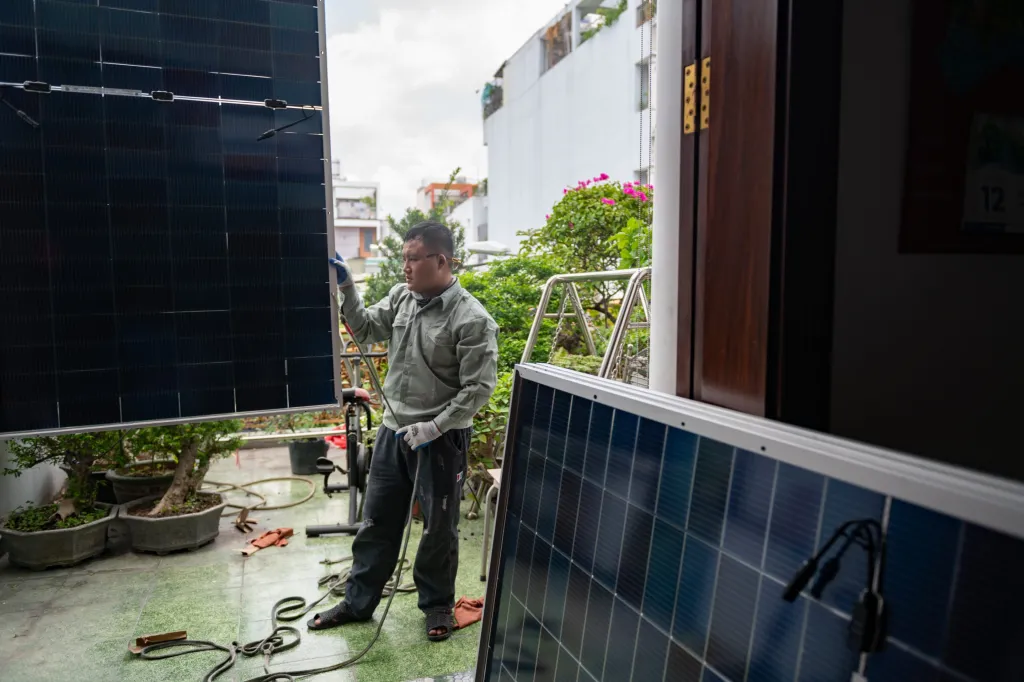
Vietnam has responded with fuel-tax cuts and price stabilization measures, which has helped avoid some of the worst effects of the fuel shortage. But Vietnam still has a long-term energy problem. The country generates most of its electricity from fossil fuels, and its renewable build-out will take years to reach targets. That combination threatens Vietnam’s pitch to high-end manufacturers, chipmakers, and data center operators, all of whom demand reliable, competitively priced electricity before committing billions in investment.
Then there’s the talent gap. In previous booms, Vietnamese companies captured gains quickly by importing Western management practices, but this low-hanging fruit has largely been picked. Now, Vietnamese businesses need an executive class capable of running businesses at a global scale.
“There’s still a shortage of really great management talent; that’s Vietnam’s number one issue,” Freund says. “Good companies that are attractive—Masan, Mobile World, FPT—are able to attract and retain people. But for an average company, it’s a real struggle.”
“When we ask clients what level of efficiency they can get out of Vietnamese factories versus Chinese or Korean factories, Vietnam—with some exceptions—is still lower,” Vettoretti admits. “So the question becomes: How do you drive more efficiency? How do you provide the training needed to reach that level?”
Still, Vietnam’s presence on the Southeast Asia 500, Fortune’s ranking of the largest companies in the region by revenue, continues to expand. Seventy-two Vietnamese companies generated $178 billion in revenue last year, up 10.5% from the year before.
That rise is evidence of Vietnam’s growing heft—and its growing independence.
“There’s this idea of a ‘China century,’ but Vietnam seems to want to carve out its own space within that broader economic development,” Vettoretti says. “I feel a lot more excitement when I walk about Ho Chi Minh City right now than when I go to some industrial zones and startup parks in China.
“People are quite a bit more aggressive. There’s a real sense of hunger.”
This article appears in the June/July 2026: Asia issue of Fortune with the headline “Reality check for the Vietnam boom.”
The post Vietnam’s economy is one of the fastest-growing in the world. Can it make the leap into the ranks of middle-income countries? appeared first on Fortune.