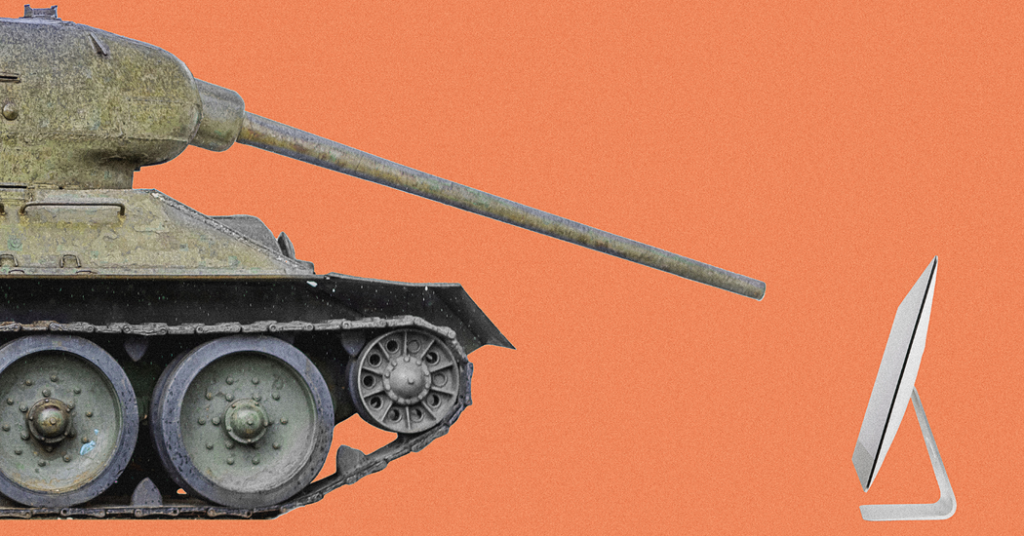
The Trump administration has spent the past week trying to end one war while pushing deeper into another. The first war, the Iran war, feels like the coda to an era; it seems unlikely that the United States will undertake another war for regime change in the Middle East for the foreseeable future. Whereas the second war, the battle over Anthropic’s cutting-edge artificial intelligence models, is the beginning of a new kind of conflict, with private powers and national governments struggling to determine who actually rules an A.I.-dominated world.
The nature of the Anthropic conflict can be swiftly summarized even if the details are in dispute. Two months ago the company declined to publicly release its latest model, Mythos, citing various safety concerns (and hyping the model’s revolutionary power). After previewing Mythos to the U.S. government and certain corporate actors, Anthropic then released Fable, a version of the model with various safety guardrails. Amazon, an Anthropic investor and client, discovered a way to bypass some of those guardrails. This was reported to the White House, Anthropic’s response was deemed unsatisfactory, and the administration used its export-control power to forbid the use of Fable by any foreign national inside the United States and anybody at all outside it — a rule that Anthropic treated as a requirement to shut the new A.I. model down.
That’s where we are now, with the company and the administration negotiating over how to bring back Fable while ongoing leaks to the press paint one or the other side as unreasonable or reckless or ideological and clueless about tech.
It’s a conflict rich in ironies. A White House that sees itself as favoring a free-market approach to A.I. has now twice used heavy-handed regulatory weapons against America’s leading A.I. company. (In the first case, earlier this year, the Pentagon basically tried to cut Anthropic out of all government supply chains because of disputes over the wartime use of its models.) Meanwhile Anthropic sees itself as the A.I. company that’s most attuned to safety issues and eager for democratic oversight, but each move from the Trump administration has prompted the company to shout, “No, not like that!”
Of course this is what wars often look like, with various hypocrisies and culture clashes and misunderstandings driving conflict as much as reasonable assessments of the stakes. But beyond the specifics of why, say, the libertarian tech people in the Trump administration distrust the effective-altruist tech people running Anthropic, the kind of conflict we’re seeing here is overdetermined by the trajectory of the A.I. models: There is too much potential power here not to have ongoing, escalating struggles over who actually gets to rule.
The war over Fable previews the two broad forms that this conflict will take. First there is a private-public struggle, where governments grope for a regulatory sweet spot that allows them to maintain a meaningful veto over the A.I. behemoths without killing off their innovative power, while the A.I. companies try to maintain control over their own models and influence over how governments use their innovations.
There is a path here that leads to nationalization in all but name and a path that leads to a kind of de facto corporate takeover of the government, or at least a too-big-to-fail symbiosis. And along the way there may be not just conflicts between presidents and A.I. executives but also increasingly ruthless corporation-on-corporation action, out of fear that the A.I. landscape is winner-take-all to an extent we’ve never seen in capitalism before. (I’m not saying that’s why Amazon would drop a dime on its dear business partner at Anthropic; I’m just saying that there are potential trajectories for the A.I. companies that could threaten their current partners with thraldom or irrelevance.)
Then alongside the struggle to control A.I. power within American borders, there is the geopolitical struggle to maximize global power (where the only real players are probably the United States and China) and maintain sovereignty (where everyone else is likely to be scrambling to maintain some independence). The use of export controls to shut down Fable presumably reflected U.S. fears of Chinese access to a jailbroken version of the model, but it was also a warning to every other country in the world: If we end up with economy-permeating A.I. models that are made and regulated in America, the American government will control the on-off switch.
One possibility for what that means is spun out in “Europe 2031,” a futurist scenario written by European A.I. researchers and investors in which the European Union ends up choosing political and economic vassalage to either the United States or China, because it lacks sufficiently powerful A.I. models that are under its own control.
That could be too alarmist: The normal rules of trade and comparative advantage may continue to apply, Europe could maintain geopolitical leverage through other forms of technological expertise, open-source models may remain competitive (instead of being left in the dust by proprietary frontier A.I.s that build frontier A.I.s in an accelerating loop).
But at the very least, American and Chinese A.I. dominance is going to create new issues for sovereignty, new forms of dependence and coercion, that will weigh heavily on middle powers as their economies become more and more dependent on specific models and access to computing power.
Finally I should note that from the point of view of many A.I. forecasters, this sketch of future conflict is the optimistic scenario, because it assumes that human actors and human institutions — nation-states, empires, executives, presidents — are still the ones fighting for control. These human wars will be waged in the shadow of the darker scenario — where the war that counts is with our own creation, and the stakes aren’t whether Anthropic or the Pentagon or Beijing has the most power, but whether human beings have any influence at all.
Breviary
Ben Thompson on the Anthropic way of alignment.
Jordan Dworkin on A.I. science bottlenecks.
Kevin Bankston and his brother on A.I. in Hollywood.
Valerie Pavilonis on talking about assisted suicide.
Deena Mousa on how Alberta conquered rats.
Paul Graham on how to become a billionaire.
The post The Battle With Anthropic Is the Start of a New Kind of Conflict appeared first on New York Times.