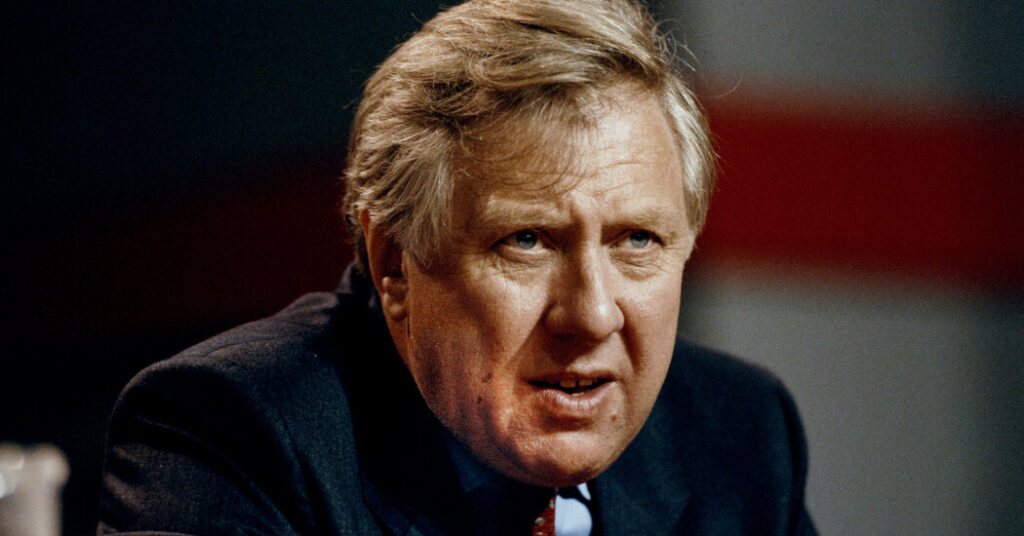
Roy Hattersley, a Labour Party fixture in the British political firmament who spent years in opposition, locked in combat with the ruling Conservatives and a frontline warrior in ideological and personal feuds of his own peers, died on Saturday at his home in Derbyshire, England. He was 93.
The American media executive Norman Pearlstine, his brother-in-law, confirmed the death. Prime Minister Keir Starmer called Mr. Hattersley “a giant of the Labour movement.”
As the party’s deputy leader for nine years from 1983 to 1992 under Neil Kinnock, he was credited with championing a significant move toward the center when enduring tussles between moderates and leftists left its cohesion in tatters.
Supporters said he played a central role in readying Labour for its triumphant return to power in 1997 under Tony Blair after its long sojourn in opposition known as its “wilderness years.”
After Mr. Blair became prime minister, Mr. Hattersley emerged as one of his harshest critics. He assailed him for abandoning Labour’s credentials as the party of blue-collar workers. “Blair’s Labour Party is not the Labour Party I joined,” he said.
Throughout his career, he also argued for a brand of democratic socialism that would eschew the extreme left and draw in moderate voters.
When the leftist Jeremy Corbyn won the party leadership in 2015, Mr. Hattersley was among critics demanding a stronger line against antisemitism inspired by Mr. Corbyn’s support for the Palestinian cause. On other issues, he was a steadfast opponent of leaving the European Union and of the fee-paying schools that have long nurtured a moneyed elite in Britain.
Roy Sydney George Hattersley was born in Sheffield, in the north of England, on Dec. 28, 1932. As a boy, he later said, he had been given no reason to believe that his parents — Frederick Hattersley and Enid (Brackenbury) Hattersley — had anything but a conventional background to their marriage.
After his father’s death in 1973, he discovered from a letter of condolence that his father had been a Roman Catholic priest, and that he had officiated in the late 1920s at Enid’s marriage to another man before running away with the bride two weeks later and leaving the priesthood.
His parents married when the other man — identified in some accounts as a mineworker called O’Hara — died in the early 1950s.
In “The Catholics,” Mr. Hattersley’s 2017 study of the Roman Catholic Church in Britain and Ireland, he said his father had displayed a profound knowledge of Roman Catholic history and the Latin language used in some Roman Catholic liturgy, even though his parents attended Protestant services at the Church of England. But, he wrote, he never wondered why.
“I realized that the only reason the secret had taken so long to come out was my own obtuseness,” he said in 2002.
Frederick Hattersley worked as a “lowly, local-government officer,” his son wrote in “The Catholics.” His mother, steeped in local politics, was a city councilor who went on to become the lord mayor of Sheffield.
By some accounts, she introduced her son to Labour politics at the age of 12 by taking him on the campaign trail for the 1945 elections, which saw Clement Attlee, of the Labour Party, ousting Winston Churchill, the Conservative prime minister who led Britain through World War II.
Mr. Hattersley said he studied economics at the University of Hull because he believed the major offered a better route to high office. At 23, he became the youngest person to win a seat on the Sheffield City Council. He secured his place in Parliament at 31, the youngest of his cohort in 1964.
From his earliest years, he had displayed a purposeful quest for a political career, but he also carved out a parallel life as a journalist and author before and after his decades in Parliament. He published some 20 books and, for many years, wrote a political column titled “Endpiece” that ran successively in newspapers like The Spectator and The Guardian.
Mr. Hattersley married Edith Loughran, an educator known as Molly, in 1956. They divorced in 2013. Later that year, he married Maggie Pearlstine, his literary agent. She is his only immediate survivor.
In a winner-take-all-culture, opponents labeled Mr. Hattersley the party’s “nearly man” because he did not rise to the very top jobs either in Labour’s relatively brief periods in office or within the party itself.
As a government minister, he held relatively junior ranks in governments led by the Labour Party Prime Ministers Harold Wilson and James Callaghan in the 1960s and ’70s. In 1969, as a deputy under Defense Minister Denis Healey, he signed the order that sent British troops into Northern Ireland as the region edged toward the sectarian strife that became known as The Troubles.
At the start of his career, Mr. Hattersley acquired a reputation as an ardent pro-European in the fractious debate over British membership in the European Economic Community, a forerunner to the European Union. The debate flared, sputtered but frequently infused British politics for decades, until it climaxed in a referendum in 2016 that decided narrowly in favor of leaving. The departure — a seismic event in Britain’s modern history — was known as Brexit.
In the early 1970s, the mainstream of the Labour Party opposed the move, and the Conservatives needed a degree of bipartisan support to secure victory. Mr. Hattersley was among 69 Labour lawmakers who voted with the Conservative government of Edward Heath, the prime minister, in favor of entry into the bloc.
But Mr. Hattersley remained a staunch party supporter in 1981 when a so-called “Gang of Four” senior Labour politicians split away from the mainstream party to create the Social Democratic Party. When Labour was defeated in a general election in 1983 for the second term of Margaret Thatcher’s Conservatives, Labour’s disarray deepened, and the party embarked on a leadership contest.
Mr. Hattersley was one of the contenders but lost out to Mr. Kinnock. By tradition, as runner-up, he became deputy leader. The two men devoted their tenure — promoted by the party as “the dream ticket” — to repulse militant leftists and other challengers.
In elections in 1992, their hopes of unseating the Conservatives were dashed, and both men resigned from the party leadership. In 1994, Mr. Hattersley said he would leave the House of Commons when the nation next went to the polls. That was in 1997 when Mr. Blair’s centrist, pro-market “New Labour” secured a landslide victory.
Mr. Hattersley’s career had lifted him to the cusp of the highest echelons of power, and his years as a lawmaker at the heart of major political moments drew official kudos when he was ennobled as a member of the House of Lords with the title Baron Hattersley of Sparkbrook after he stepped down from the House of Commons in 1997. He had represented the same electoral district — Birmingham Sparkbrook — in the English Midlands for 33 years, the bulk of them in opposition.
As a serving politician, Mr. Hattersley had attracted the sometimes cruel attention of television satirists known for their harsh lampoons of public figures. One show, “Spitting Image,” which portrayed its targets as life-size puppets, depicted him as what The Sun, a tabloid, called “a blustering, blubbery, pompous character spraying saliva over everyone he talked.”
He responded by posing for photographs with his likeness.
As a peer and author, Mr. Hattersley revealed the breadth of his interests, writing books on topics like Prime Minister David Lloyd George, the Roman Catholic Church, and the death of his beloved pet dog, Buster.
In 1996, Buster was accused of killing a goose in a royal park in London. A few years later, in “Buster’s Diaries — as Told to Roy Hattersley,” Mr. Hattersley wrote the story from the dog’s point of view as a canine plea of self-defense.
The post Roy Hattersley, Frontline Warrior of British Politics, Dies at 93 appeared first on New York Times.