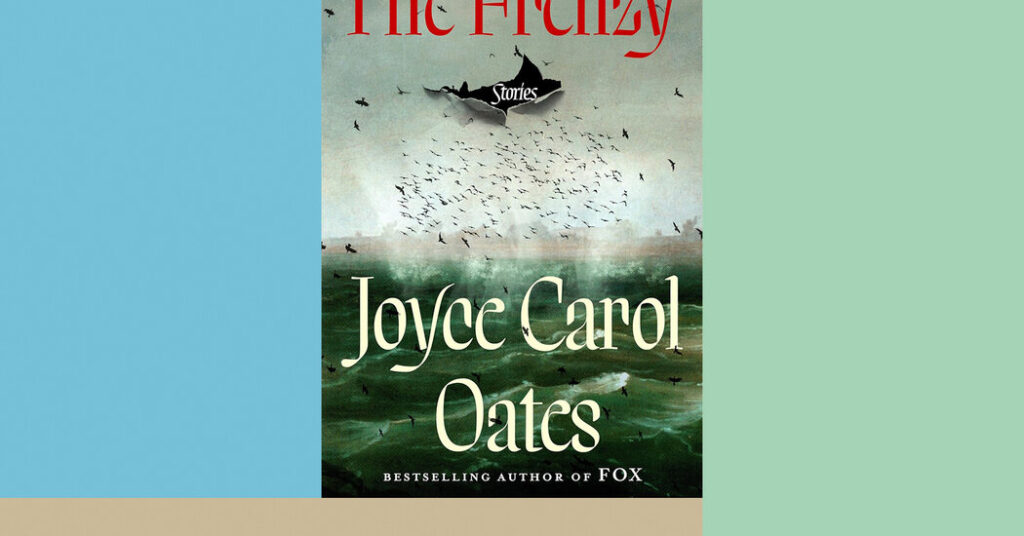
THE FRENZY: Stories, by Joyce Carol Oates
Whether looming in dark gothic tales or permeating what might seem a sunny suburban world, dread stalks the fiction of Joyce Carol Oates — a writer who “can’t ever get enough of fear and loathing in familiar surroundings,” as her fan John Updike once said. So it is with the nine narratives in “The Frenzy,” the 49th story collection (along with more than 60 novels!) published by this freakishly prolific author.
These pieces deal in jagged emergencies and in wounds both physical and psychic. In “Refuge,” a woman’s mercurial husband disappears under mysterious circumstances, setting her off on a rescue attempt that only deepens the mystery. “The Bicycle Accident” follows a 13-year-old girl who is grievously injured while fleeing a family party — and, possibly, the sexual abuse she may have suffered at the hands of a guest.
Oates’s narratives are steeped in transgression and foreboding. “The Redwoods” takes a familiar romantic trope — a chance encounter that lingers over the years as a path not taken — and gives it a sinister twist. Is the protagonist a spiritual seeker … or an obsessed potential stalker?
In the book’s title story, a married man named Cassidy sneaks off to the Jersey Shore with his teenage mistress, the daughter of a couple whom he and his wife socialize with. As they drive, Cassidy ponders dark recognitions about himself (“his life has been an impersonation of someone whom he didn’t know”), even as he excitedly anticipates his lover’s “submissive” acceptance of “whatever Cassidy would do to her.” Our sense of alarm is amplified by vaguely ominous details: “a piece of driftwood resembling a human arm; a child’s sneaker washed clean and pale by the surf.” Like horror movies, these stories are most transfixing when nothing has happened — yet.
Halfway through the collection, I found myself longing for a plot in which violence and harm play no role. But Oates is implacable. One narrative offers an excruciating description of damage done to a girl in a car crash. Another inspects the cruelty that cancer inflicts on the face of a child (“a face that might have been broken into two asymmetrical halves, then forced together again, like broken crockery.”) Oates is a highly cinematic writer, and we navigate these passages feeling the urge to cover our eyes.
And violence isn’t limited to physical harm. Oates finds it everywhere. In “Night Fishing at Antibes,” widowhood is depicted as a “ravaged state,” the protagonist envisioning herself as “an amputee, hobbling around on one leg and a crutch.” The birth of a child triggers in one parent the thought that “no matter how this child matures, he will always be an infant with a soft-boned head, a fontanelle at the crown of his head through which life could stick its cruel thumb at any juncture.” With Oates, even food can be scary; a woman lying awake at night fretting over what to serve at a dinner party experiences a kind of culinary terror: “Like foaming waterfalls entire menus rose and fell in her brain. Appetizers, entrees, desserts were roiling fevers in her blood.”
Oates’s prose comes with certain quirks: abbreviated sentences that lend an odd, breathless quality; parenthetical authorial elaborations; multiple choice options conveyed via “if/when”; liberal sprinklings of exclamation points; and a curious habit of seemingly random italicization (“Juliet knew they were not twins. In fact they were not even sisters but something called cousins”). There are wholly unexpected swerves: A third of the way through one story, the protagonist suddenly dies, only to continue as a ghost. Oates sometimes seems like a writer improvising as she goes, as if she simply gets in the car of her narrative and drives off, with no road map.
Yet these stories are nothing if not engaging. Like the dire predicaments they unfurl, they are spurred by a dark, relentless force. You want to keep reading. Even with eyes half covered.
THE FRENZY: Stories | By Joyce Carol Oates | Hogarth | 318 pp. | $32
The post From Joyce Carol Oates, a ‘Frenzy’ of Fear and Foreboding appeared first on New York Times.