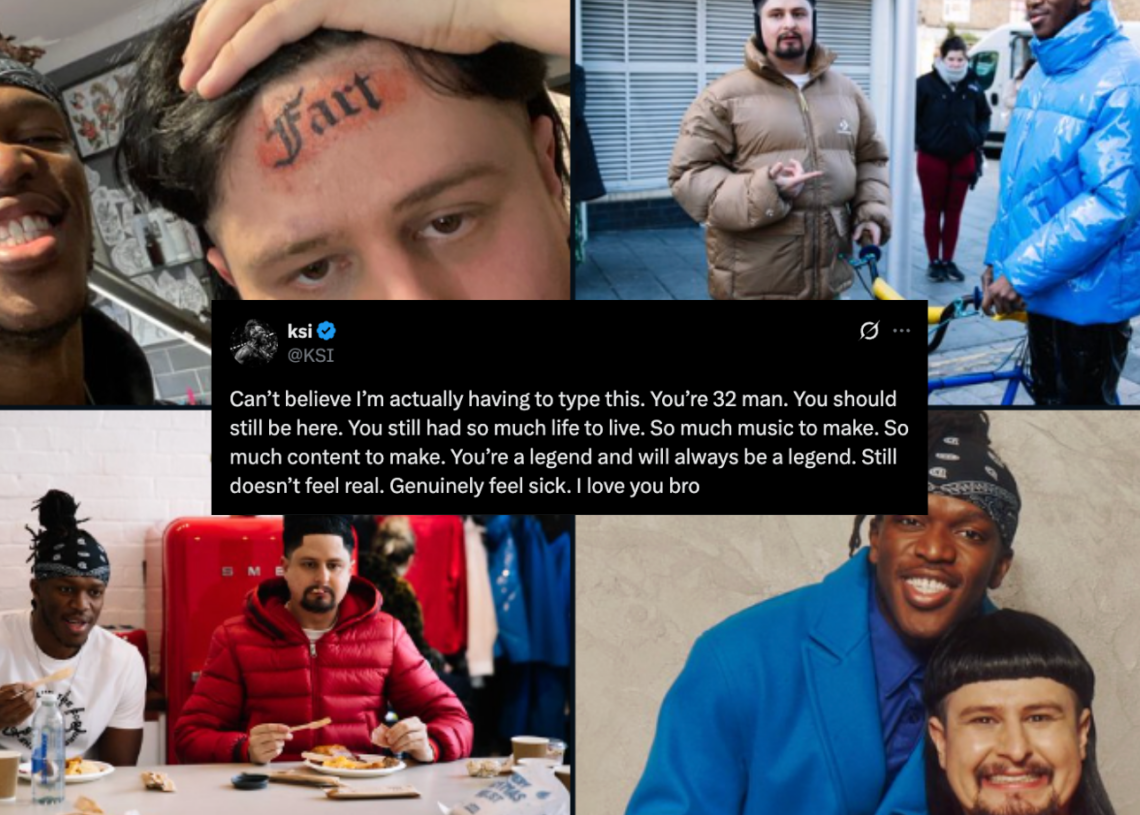
This weekend, the internet personality Oliver Tree died at the age of 32 in a helicopter crash in São Paulo, Brazil. In all the tributes paid to the bowl-haired content creator and recording artist, the one that maybe says the most about Tree and our present online moment came from KSI, who suggested that the real tragedy of his death is that he still had “so much content to make.”
“You’re a legend and will always be a legend,” wrote the British influencer, real name Olajide Olayinka Williams Olatunji, in a farewell message on Sunday, sharing alongside this eulogy a photograph of his late friend after he’d lost a bet and had the word “FART” tattooed on his forehead. (The tattooing was a ruse, unless Tree had it lasered off, or meticulously photoshopped out of every subsequent photo and video he appeared in.)
This is the werst tattoo of all time lol pic.twitter.com/YuIyMVn35g
— Oliver Tree (@Olivertree) January 24, 2023
Despite the 6 million views racked up by this clip, and the hundreds of millions Tree earned elsewhere, there’s an uncomfortable question posed by the sad news of his passing: What will be the lasting legacy for this generation of content creators? Whenever pop stars or Hollywood idols have died, their work has been able to live on via radio, streaming sites, record shops, movie theaters, and television. For those who’ve forged global reputations out of childish antics, attention-grabbing stunts, platform management, and sheer naked ambition, there is not yet any kind of canon for their work to take its place in.
It is difficult to imagine what kind of form such a canon might take. Will we ever have, or ever need, a Criterion Collection for videos of internet comedians dressing up like nu-metal uncs, hitting giant vapes, or pretending they’ve been kidnapped? Boomers and Gen X have the Rock and Roll Hall of Fame, VH1, Magic FM, Planet Hollywood—older millennials will no doubt have logged the appearance, by depressing stealth, of the chart-dance anthems, rap hits, and indie-rock torch songs of their youths on “golden oldie” radio stations like Heart and in heritage act headline festival slots—yet Gen Z equivalents of these feel unlikely and unwieldy. Could you open a restaurant about 6-7? Might Mr. Beast use his wealth to fund some kind of Museum of “Gay or Straight” TikToks? Would anyone visit an art gallery exhibiting the 21st century’s greatest based doomer memes? Solomon R. Guggenheim: Welcome to the wojak penitentiary.
As the frantic, cortisol-spiking dystopia we call life hurtles by at 350,000 tweets per minute (approx), Tree was adept at furnishing his audience with a little fleeting joy, whether it was by refereeing Logan Paul’s wrestling-themed gender reveal party, smoking a zoot so big it needed to be lit with a flamethrower, traveling to Iraq and Afghanistan to make his most recent album, or building the world’s biggest kick scooter. With his zany costumes, taste for facepaint, and endless worship of the scooter, a lot of his content is probably best classified as “slop.” But for as long as there’s been entertainment, there has been slop—I’m not sure “Life Goes On” and “Alien Boy” are really any less sloppy than Bowie’s ”The Laughing Gnome” or Radiohead’s ”Pop Is Dead”.
Who knows. Perhaps Tree was still in his “Laughing Gnome” era, and was simply drumming up attention before unveiling the masterworks that would leave indelible marks upon human culture. (After all, if you’re going to throw anything at the wall to see if it sticks, slop might stick best.) We will never get to find out. What does seem fair to ask is if the culture we’ve created really allows for that kind of progression. The pace is so fast, the need to alchemize attention so unrelenting, that most content creators don’t make it out of those shrill early stages when noise and novelty are what win you the eyeballs you need to make your name.
There are many who seem to have been genuinely moved by his music, and Tree’s thirst for virality was always in service of his musical career. (The story goes that he graduated out of CalArts with a senior thesis titled “How to Turn Yourself Into a Meme”.) There can be no doubt that this strategy helped Tree clamber toward the very highest echelons of the music industry. He released multiple albums on Atlantic Records, and when he died, was in the middle of a world tour. If you’re a regular listener to Spotify’s Ultra Gaming playlist, you’ll no doubt be familiar with his signature blend of nasal rapping, pop-punk melodies, and Eurovision beats.
The many likes and retweets didn’t translate into critical acclaim. Pitchfork dished out a brace of 4.8 reviews, for 2020’s Ugly Is Beautiful: (“For an artist chasing shock and bombast, Oliver Tree’s music is surprisingly tame”) and 2022’s Cowboy Tears (“This is Tree’s schtick: inane gimmicks that overshadow his music and even his blatant pleas for streams.”) This is not to speak ill of the dead, but to recognize that this is where the fate of content creators seems to diverge from artists whose work we’ve long conceptualized as part of an oeuvre. There’s something haunting about poring back through old videos still out there diligently soliciting attention for a life that has just been extinguished, to see Tree living on within a viral purgatory.
Never forget when Oliver Tree broke the World Record for largest scooter pic.twitter.com/qYddb4h0he
— Historic Vids (@historyinmemes) June 14, 2026
Maybe for teenagers this will be one of those “I’ll never forget where I was” moments, like the moon landing, or John Lennon’s shooting. Perhaps there are school children who have had to stay home today because of the grief. When Kurt Cobain died, more than 5,000 distraught fans famously gathered at the Seattle Center fountain to hold a candlelit vigil; when Prince accidentally overdosed in 2016, my friends and I forced the owners of a Berlin bar to hold an impromptu lock-in so we could spend the night dancing on tables to Purple Rain.
For Tree, or for any other content creator, I’m not sure what the equivalent of this would be. Perhaps it is fatally washed and old head of me to even assume that he desired such things as longevity and legacy for his work. Perhaps all he needed was the momentary thrill of creating. Yet in the last 24 hours, a clip has been recirculating of Tree losing his temper during an interview with the online music critic Anthony Fantano, at one point describing himself as a “surrealist pop artist.” His persona, he argued, was a comment on the loud and ephemeral nature of internet culture. The internet is not a place that is built to remember, yet every one of its human users is destined to die. Where does it put the people it can’t bear to forget? Where does the content go when a content creator dies?
OTHER NEWS
- The UK Government is banning social media access for under 16s, presumably to stop those chain messages you have to forward to 15 people unless you want a dead girl to appear on your bedroom ceiling and rip your face off while you sleep.
- A fake list of Morrisey’s enemies (“The Malefactors“), which some people unfortunately mistook as a genuine post from his blog (despite mentions of Prince Diana, Jack Black, and “a very judgemental garden gnome named Clive”) has been removed from Instagram after his management team allegedly contacted the original poster.
- Mark E. Smith was psychic—at least according to the apocryphal tale about his premonition that a woman would be decapitated at Disneyland—so you’d imagine he had the foresight to hold some good tracks back for The Fall’s first album since his death, which has been announced for release in September.
PREDICTION OF THE WEEK
After days of street craziness in New York, U.S. President Donald Trump declares The Knicks a terrorist organization. Timothée Chalamet dons his Lisan al-Gaib outfit to lead protests on the White House lawn.
BRAND NEW SENTENCE
“they were parading elmo’s head around on a pike last night”
Follow Adam on Instagram @yungtolstoi
The post Where Does the Content Go When a Content Creator Dies? appeared first on VICE.