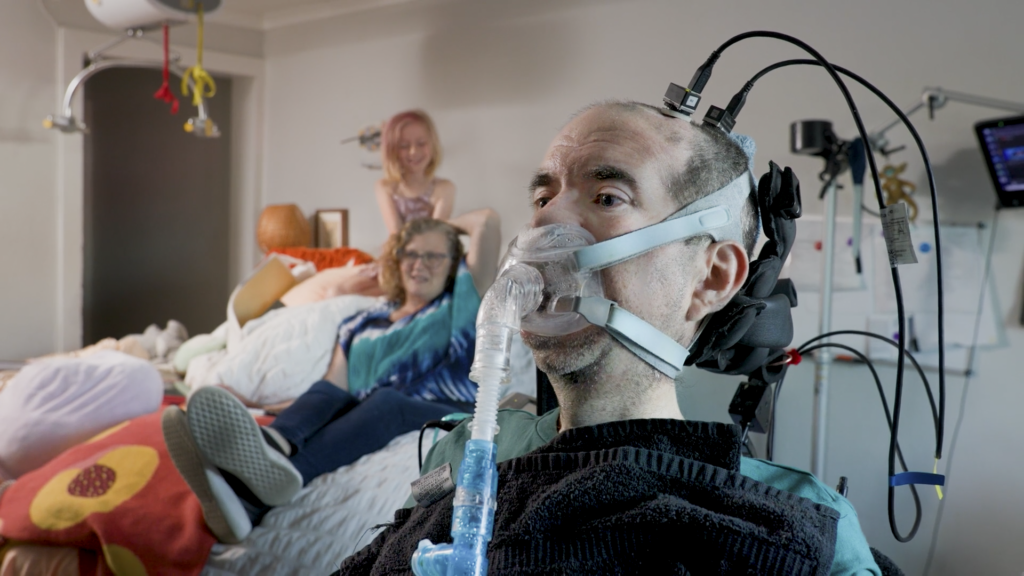
For the past six years, Casey Harrell’s life has felt like a slow-motion car crash. At 42, he began to lose his voice to the neurodegenerative disease ALS, or amyotrophic lateral sclerosis. His world shrank as his ability to sing to his young daughter, give a presentation for work or tell a joke eroded.
Three years later, researchers at the University of California at Davis placed experimental implants in his brain. He gained something incredible: “The ability to talk from my brain,” Harrell wrote in an email.
For several years, Harrell has been known in the scientific literature as “T15,” a study participant in the long-running, federally funded BrainGate2 clinical trial. As a pioneer in the nascent field of brain-computer interfaces, Harrell has spent hours with expert researchers, who carefully chronicle the remarkably fluid speech he can generate with his mind.
In a study published Monday in Nature Medicine, researchers look beyond the structured interactions of research visits to show how the technology has transformed Harrell’s life in the off-hours.
“Obviously, getting more communication ability was pure elation,” Harrell said in an email. He noted that previous technologies that allow people who are paralyzed to communicate are far clumsier, limited to the “functional basics.”
“You do not have enough speed to do anything civilised, like tell a story or a joke. Just the facts, ma’am,” Harrell said. “No longer part of the conversation with other technologies, but with this decoder, I am the conversation!”
It’s his wife, Levana Saxon, who removes the caps from the port mounted to his skull and connects it to a computer system on a cart. The cables aren’t ideal — developers’ goal is a truly wireless system. But they give Harrell freedom to FaceTime with a friend, sign onto a meeting to continue his work as a climate and disability rights activist or chat with his 7-year-old daughter.
Over nearly two years, Harrell used the device at home for more than 3,800 hours, speaking 183,060 sentences, or 1,960,163 words — at a tidy clip of 56 words per minute, the research team reported.
Brain-computer interfaces are still experimental, and some are in commercial development from biotech companies such as Neuralink and Paradromics. The technology has evolved over time, but in Harrell’s brain are four tiny implanted devices that record brain signals and then are analyzed by artificial intelligence to decode those signals into text — and eventually to speech. He can also move a cursor and “click.”
“It’s a significant step — a huge leap, basically,” in demonstrating the functionality of the system during regular home use, said Mariska van Steensel, a brain computer interface researcher at University Medical Center Utrecht in the Netherlands who was not involved in the new work.
Her team previously reported in the New England Journal of Medicine a case study of a woman with ALS who used a brain implant with more limited capabilities for communication for seven years at home. That system used mouse clicks controlled by her brain signals to spell words and call a caregiver.
Studies of brain-computer interfaces are often based on data gathered in the context of focused research sessions. They yield facts and figures on the technical capabilities, the error rate, speed, accuracy and fluency of communication.
The new study shows the power of the technology once unleashed in a person’s life. Harrell can crack jokes, play humorous “sad trombone” sound effects at key moments and stay tethered to his family, work and humanity.
It’s a step toward what the field needs to show to go beyond research demonstrations.
“Our technology has gotten to a point where it truly is actually at an inflection point,” said David Brandman, a neurosurgeon at the University of California at Davis and one of the authors of the paper. “Up until now, we would argue most things in [brain-computer interface] have been one-off scientific demonstrations: We can show up to someone’s house and we can do this. I think the real breakthrough for this technology is you no longer need a group of scientists and engineers to run this technology.”
When Harrell reflects on his life before ALS, he calls it “the before times, a life diverted.” He was a runner and a cyclist and had turned his basement into a personal gym.
Getting his voice back has allowed him to share parenting duties with his wife and show more empathy and emotion. But he hopes to see it keep improving. He said that his wish list would be for a system that was truly portable and wireless instead of requiring him to be plugged into a system that sits on a cart.
The current system converts his brain signals to text, then voice. Going directly from brain-to-voice, he said, would be even more powerful.
“The last one would enable truly instantaneous communication,” Harrell said. “Allowing people who have a medical need, like myself, to rejoin the conversation again.”
The post Two years, 2 million words: How a brain implant transformed an ALS patient’s life appeared first on Washington Post.