JERUSALEM — A “catastrophe.” A “bad deal.” An agreement that “throws a lifeline to the murderous regime in Tehran.”
Among Israeli Prime Minister Benjamin Netanyahu’s supporters and critics alike, in the press and on social media, the mood was clear as Israelis woke up Monday to news of a peace agreement between the United States and Iran: President Donald Trump’s deal is not one that many in Israel like. Iran, they say, will remain a threat.
The question now is whether Trump’s deal is one that Netanyahu will stomach — or one he will seek to derail. Trump in brief expletive-punctuated interviews Sunday already accused the Israeli leader of jeopardizing the accord.
Caught between Trump’s public browbeating and broad discontent at home, Netanyahu faces a challenge like never before over how to navigate the next two months, a delicate period in which Washington and Tehran will negotiate the details of how to reopen the Strait of Hormuz and remove Iran’s nuclear material in exchange for the release of billions in frozen Iranian assets, the lifting of U.S. sanctions and an end to hostilities in Lebanon.
For two weeks in the lead-up to Trump’s accord with Tehran, Netanyahu already showed that he could play the spoiler by bombing Hezbollah, the Iranian-backed Lebanese militant group, in retaliation for what Israeli officials say were Hezbollah attacks on Israel.
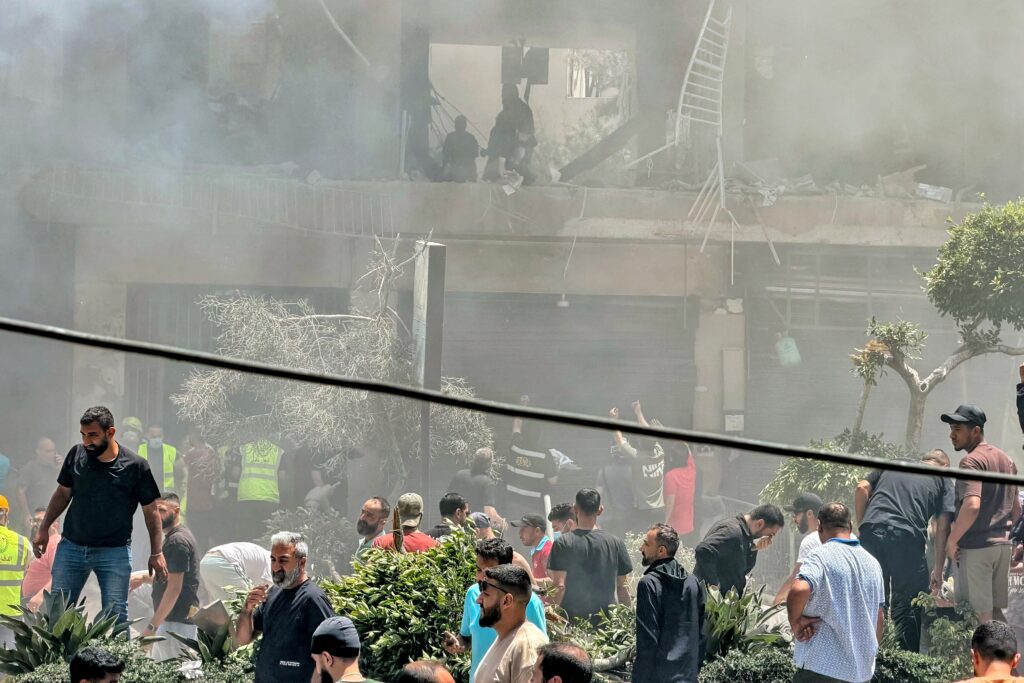
In the chaotic hours before the deal was announced late Sunday Eastern time, Israel again struck the southern suburbs of Beirut, the Lebanese capital, in response to Hezbollah fire, prompting a threat of a ballistic missile barrage from Iran and the expletive-laden rebukes from Trump.
Unlike many other leaders who welcomed the accord to end the war, which has damaged the global economy, Netanyahu did not immediately issue a statement about the deal — a sign he has little good to say about it.
Others were quick to slam it.
“Trump’s agreement does not bind us,” Itamar Ben Gvir, Netanyahu’s minister of national security and an influential far-right leader, posted Monday morning on X. “Israel is not subject to the United States, and we are an independent and sovereign country.”
Israeli officials, including Ben Gvir, have remained consistently defiant in recent days, insisting that they will not refrain from striking Hezbollah, as Iran — and Trump — have demanded, or withdraw Israeli troops from Lebanon.
Netanyahu’s rivals have voiced similar positions, arguing that the prime minister cannot sacrifice Israel’s national security to appease Hezbollah’s patron, Iran, or a U.S. president whose interests are increasingly incompatible with those of Israel.
The mounting pressure on Netanyahu from across the Israeli political spectrum and the Israeli military establishment could place the conflict in Lebanon — and the broader U.S.-Iran peace talks — on a hair trigger and deepen a public split between Israel and the United States that is unlike anything seen in recent years.
After linking arms in late February to undertake the fierce bombing campaign that assassinated Iran’s supreme leader, Ayatollah Ali Khamenei, and other senior political and military leaders, Trump and Netanyahu sharply diverged in their political imperatives.
For Trump, the war proved deeply unpopular at home, where he has faced plummeting poll numbers amid spiking prices, notably for gasoline, and rising opposition in Congress, where House Republicans voted this month to block him from further strikes on Iran.
Netanyahu, facing a national election this fall, has every incentive to continue fighting, especially in Lebanon, where Hezbollah, siding with Iran, has launched unrelenting strikes on northern Israel.
Aside from Ben Gvir, Finance Minister Bezalel Smotrich, another far-right member of Netanyahu’s coalition, has also demanded that Israel “stand firm on our principles and guarantee the IDF full freedom of action to keep pushing Hezbollah back.”
“The agreement with Iran is bad for Israel and the entire free world. Period,” Smotrich said.
Meanwhile, Israeli defense minister Israel Katz stated that Israeli troops will stay “indefinitely” in Lebanon and the Gaza Strip as part of a new military doctrine of maintaining buffer zones following the Oct. 7, 2023, attacks by Hamas.
The IDF’s full withdrawal from Gaza, which is contingent upon Hamas’s disarmament, is a requirement of the peace plan brokered by Trump in October.
Netanyahu would flout Trump’s deals on two fronts if he were to keep IDF soldiers indefinitely in both Lebanon and Gaza.
“We oppose an IDF withdrawal from Lebanon — despite all current and future pressures,” Katz said in a statement. “Prime Minister Netanyahu made this clear to U.S. President Trump and other senior American officials, and I also clarified this yesterday to U.S. Secretary of Defense Pete Hegseth. The IDF validates this position from a professional security standpoint.”
Gayil Talshir, a political scientist at Hebrew University, said Netanyahu struck Beirut on Sunday to demonstrate that he has the ability to say “no” to Trump, seeking to shore up his base at a crucial juncture months before Israeli elections. But now Netanyahu is politically isolated, Talshir said.
“By playing this foolish game for his political base, he provided the final push for a MOU that is among the worst Israel could have imagined,” Talshir said, referring to comments by Trump and Vice President JD Vance that the U.S. administration intervened and pushed to close the deal with Iran after the Beirut airstrike.
“Netanyahu initiated a campaign, and he was also very clear and arrogant about the goals he set for the campaign against Iran: toppling the regime … eliminating the nuclear and enriched uranium industry; eliminating ballistic missiles; and severing the connection between Iran and its proxies,” Talshir added. “Netanyahu’s life project is collapsing before his eyes, while he stands alone in the arena with no one else to blame.”
Trump’s deal, which aims to end a war that he and Netanyahu started, came under fire from the Israeli left as well.
Yair Golan, leader of the Democrats party, stopped short of saying Israel should defy Trump but nonetheless slammed the prime minister for failing to defeat Iran and Hezbollah while losing influence over Trump as he pursued his deal.
“Netanyahu stood on the sidelines: weak, sick, isolated, and lacking any influence,” Golan said. “Netanyahu is good for Iran. Netanyahu is good for Hezbollah. Netanyahu is not good for Israel.”
Sunday’s agreement came after an extraordinary day in which both Trump and Vance sided openly against Netanyahu, a striking reversal from the Biden administration’s policy of supporting the Israeli leader despite international criticism of his actions in Gaza.
After Israel struck Beirut, Trump told Fox News that he had called Netanyahu to ask “what the fuck are you doing” and to demand that Israel stop strikes against Hezbollah.
Vice President JD Vance followed up with an interview with Fox to say that Washington was “very worried” after the Beirut strikes that Iran would launch a retaliatory missile barrage against Israel and said Iran was talked out of it at the last minute.
Iran’s semiofficial Fars News Agency reported Monday that Iran refrained from attacking Israel and signed only after receiving assurances from Trump, via Qatari mediators, that last-minute changes could be made to the deal in light of the Israeli attack.
The Iranians said the U.S. had made last-minute concessions, including speeding up the end of the naval blockade. Under the announced deal, “the naval blockade against Iran will end immediately and completely,” Iran’s Supreme National Security Council said in a statement, according to Fars.
Pakistani Prime Minister Shehbaz Sharif said on social media that both sides “have declared the immediate and permanent termination of military operations on all fronts, including in Lebanon,” and that an official signing ceremony will be on Friday in Switzerland.
Soroka reported from Tel Aviv.
The post Israelis denounce Trump’s deal with Iran appeared first on Washington Post.