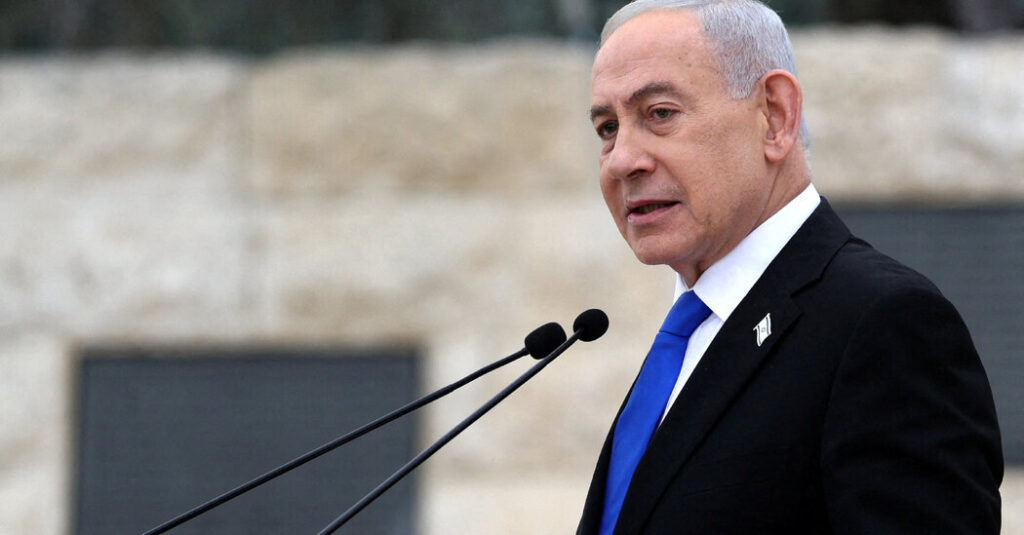
For Prime Minister Benjamin Netanyahu of Israel, the war he had hoped would secure his legacy — Israel and the United States together attacking Iran — may be ending in a way that could sully it.
The framework agreement to end the war in Iran, which was announced on Sunday, omits some of the most important things Israel wanted.
The full text of the deal has not yet been released and Israel was not directly involved in the negotiations. Initial details suggest that the agreement does nothing to curb Iran’s ballistic missile arsenal, or its funding of regional proxies like Hezbollah in Lebanon or the Houthis in Yemen, who have attacked Israel with their own arsenals. It could help Iran bolster those proxies by easing sanctions, which would allow billions of dollars to flow into its bank accounts.
The deal’s terms when it comes to constraining Iran’s nuclear program — of greatest importance to Israel, and the greatest priority of Mr. Netanyahu’s career — remain undisclosed or still to be negotiated during the agreed 60-day cease-fire to allow for further talks. Questions remain over what will become of Iran’s stock of near-bomb-grade uranium and whether the country will be able to keep enriching nuclear fuel.
Worse still for Mr. Netanyahu, who faces re-election in a few months and is behind in the polls, President Trump, the Israeli leader’s most valuable political asset, has publicly rebuked him multiple times in recent weeks.
While Mr. Trump has praised Iran’s new supreme leader, Mojtaba Khamenei, as pragmatic, he has called Mr. Netanyahu “crazy,” ungrateful and lacking in judgment.
On Sunday, Mr. Trump added “difficult” to that litany of insults, after Israel’s military — precisely as the United States was trying to close its deal with Iran — struck what it described as a Hezbollah target on the outskirts of Beirut, the Lebanese capital, in retaliation for a Hezbollah attack that wounded two Israeli soldiers.
Effectively, Mr. Netanyahu appeared to have fallen into a trap.
Had he refrained from hitting back at Hezbollah at that moment, his growing number of critics, including on the Israeli right, surely would have accused him of allowing a new “equation” to take hold.
Striking Beirut could have been seen as off-limits to Israel because of Iran’s alliance with Hezbollah and Mr. Trump’s determination to close a deal with Tehran.
But going ahead with the strike was equally perilous for Mr. Netanyahu because it may have been viewed as an attempt to derail the U.S.-Iran agreement just as it was on the verge of being clinched.
And it put Mr. Netanyahu at odds with Mr. Trump for the third straight week over Israel’s freedom of action to retaliate in Lebanon for Hezbollah attacks.
Notably, Israel did not consult or coordinate the strike with the United States; it only notified the U.S. military moments before it began, according to the two officials, who spoke on condition of anonymity to discuss sensitive security matters.
If Mr. Netanyahu’s goal indeed was to blow up the pending U.S.-Iran deal, he failed to anticipate how forcefully Mr. Trump would push to save it.
Three hours after Israel picked up information that Iran was preparing to attack it with missiles sometime on Sunday night, the two defense officials said, Israel learned that Iran had halted those preparations to give Mr. Trump a chance to calm the situation and close the agreement.
Israel now finds itself counting the ways that Mr. Netanyahu’s grand strategy against Iran has failed.
And Israelis are increasingly convinced that it will make the 2015 Iran nuclear deal look “perfect in comparison,” as the Netanyahu biographer Ben Caspit wrote in the newspaper Maariv on Monday.
The post Israel Counts the Ways That Netanyahu’s Iran Strategy Failed appeared first on New York Times.