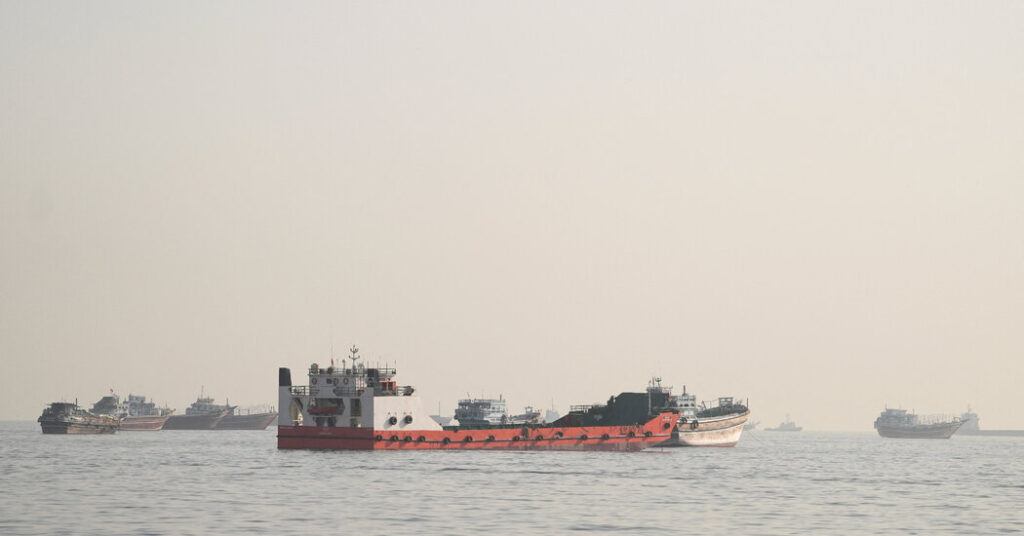
Though President Trump declared on Sunday that the Strait of Hormuz would reopen and be “permanently toll-free,” Iran indicated on Monday that it intended to charge fees for unspecified services in the strait.
The net effect — paying for passage through the vital waterway for global energy supplies, which was not required before the U.S.-Israeli war on Iran — could add expense and complications for commercial shipping in the waterway, and set a dangerous precedent for shipping in international waters worldwide.
Iran’s foreign ministry spokesman, Esmaeil Baghaei, said on Monday that Iran was “not seeking to levy transit tolls; however, fees will be charged in exchange for the services that are provided.” But there was little indication of what services Iran would be providing. Iranian officials have said they might assess environmental charges.
Legally speaking, there is a distinction between a toll — a payment for passage — and fees for actual services rendered, for example providing waste services at a port. Fees can be legal in certain contexts but a toll in the Strait of Hormuz would not be, maritime law experts say, and requiring payment for ships to use a waterway that has long been free would not be rendered legal simply by calling it a fee.
The notion of ships paying to travel through the strait initially came up after the United States and Israel attacked Iran in late February and the Iranians responded with retaliatory strikes on commercial ships in regional waters. In March, Iranian officials said they would start to charge ships traveling in the waterway, and by May, Iran had established the Persian Gulf Strait Authority, which it said would manage “safe passage permits.”
Iran and its neighbor across the strait, Oman, in May discussed a ship payment system which would be based on fees for services rendered.
But experts question whether Iran’s plan would pass legal muster.
“There is no provision in international law for a coastal state charging for passage through a natural waterway, whether you call it a toll or a fee or whatever,” said James R. Holmes, chair of maritime strategy at the Naval War College. “We do not pay to go through the Strait of Malacca or Taiwan Strait, for example.”
But Mr. Holmes noted that in artificial waterways, like the Panama Canal or Suez Canal, coastal states managing the canals do provide services and money does change hands to pay for those services and for the infrastructure.
“Hormuz is a natural waterway and as best I can tell the only service Iran would be charging for is not attacking shipping,” Mr. Holmes said. As services go, simply not striking, while desirable, “doesn’t make the grade,” he said.
The notion of a potential charge has raised concerns among world leaders that the Strait of Hormuz may never return to its prewar status quo. “We defend international law and we will do everything we can so that there isn’t a toll” in the waterway, President Emmanuel Macron of France said in an interview on Monday.
Mr. Trump has in recent months condemned the possibility of Iranian tolls, but he has also introduced the idea that the United States could itself charge money in the strait as the self-declared winner of the war, or suggested that the revenue might be shared.
In May, Mr. Trump dismissed the notion of any payment for passage through the strait. “We want it free,” he said. “We don’t want tolls.”
Secretary of State Marco Rubio also rejected the idea of payment for passage last month. “It can’t happen,” he said. “It would be unacceptable. It would make a diplomatic deal unfeasible if they were to continue to pursue that.”
The post Iran Says Strait of Hormuz Won’t Have ‘Tolls’ but It Will Have ‘Fees’ appeared first on New York Times.