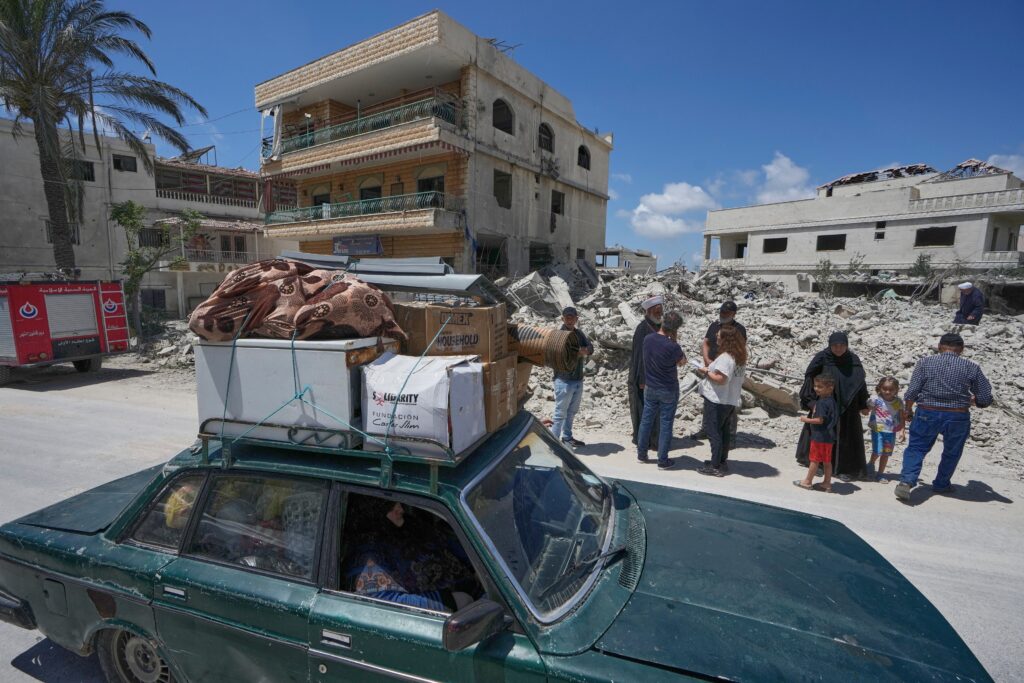
BEIRUT — Hours after President Donald Trump announced a deal to end his war with Iran, displaced families in Lebanon began returning home for the second time since Hezbollah and Israel resumed active fighting in early March — despite Israel vowing to maintain its military buffer zone in south Lebanon and to continue strikes on Hezbollah.
The effort to return home reflected guarded optimism among war-weary Lebanese civilians that the deal Trump reached with Iran not only will get finalized but that Israel will respect terms that call for Lebanon to be included in the truce agreement.
Although there were some reports of drone strikes and artillery fire close to the Israeli border on Monday, for the most part the ceasefire appeared to hold with no strikes reported in major cities.
Mayor Hassan Dbouk of Tyre, the second-largest city in south Lebanon, told The Washington Post that the residents who returned Monday mainly came back “to check if they still have homes or not.” Just last week, the Israel Defense Forces ordered residents to evacuate the city.
Despite the breakthrough in negotiations, the exact terms of the deal between the United States and Iran — and how it would impact Lebanon — remain unclear.
As Israelis broadly denounced the peace agreement on Monday, Israeli Defense Minister Israel Katz insisted the IDF will remain in its buffer zone in south Lebanon “indefinitely.”
Active combat between Israel and Hezbollah restarted in early March after the Iranian-backed militia fired a salvo of rockets and drones at Israeli to avenge the killing of Iran’s supreme leader, Ayatollah Ali Khamenei. In the following weeks, Israel responded with airstrikes and ground operations displacing hundreds of thousands of people, many under direct evacuation orders by the IDF.
Many residents returned a first time in mid-April after the U.S. brokered a ceasefire between Israel and Lebanon, and officials from the two countries met directly for the first time in decades. Despite the negotiations, fighting continued and many residents fled again to safer areas.
Fears persist of another roller-coaster ride, but some said they hope Trump will now insist that Israel respect the terms of the deal. “Residents are now hoping President Trump will intervene to stop Israeli actions,” Dbouk, the mayor, said. “If left to the Israelis, they will finish us all.”
Following the announcement of the latest deal, the Lebanese army urged the displaced to not return to border towns and to report any unexploded ordnances they find.
“Drones are active all the time and raising our anxiety,” said Jalal Naser, a cafe owner who returned to his hometown of Nabatieh on Monday to check on his property. Videos he shared with The Post showed wide destruction in the town.
Hezbollah for its part hailed the agreement between Iran and the United States and called on the Lebanese government to reconsider ongoing talks with Israel, saying, “Reliance on true friends [Iran] are the best means of safeguarding national interests.”
Hezbollah has long opposed the direct talks between Lebanon and Israel, claiming that only Iran is strong enough to negotiate on behalf of Lebanon.
Lebanese Prime Minister Nawaf Salam said talks with Israel in Washington would continue with an aim of securing an Israeli withdrawal.
“Iran has an interest to link Lebanon with the regional war,” said Filippo Dionigi, a professor of international relations at the University of Bristol in Britain and author of a book about Hezbollah. “They would like to appear as the only one capable of representing Lebanon’s interest, better than the government.”
Dionigi said he expected the Israeli-Lebanese talks to continue but also be reshaped by the new deal.
Israeli strikes on Beirut’s suburbs on Sunday nearly derailed the agreement, prompting Trump to lace into Netanyahu using expletives. Iran threatened to attack Israel in retaliation but ultimately stood down in exchange for last-minute concessions, Iranian state media reported.
Years of military strife have left Lebanon reeling with billions of dollars in economic losses and thousands of homes destroyed.
The recent three months of fighting have killed more 3,700, according the Lebanese Health Ministry, which does not distinguish between civilians and combatants. At least 30 Israelis have been killed since March.
Naser, the cafe owner, said the agreement won’t make a difference to him unless attacks fully stop and Israel withdraws. “We cannot live in Nabatieh like this,” he said.
Lior Soroka in Tel Aviv contributed to this report.
The post After news of Iran peace deal, Lebanese return home to assess wreckage appeared first on Washington Post.