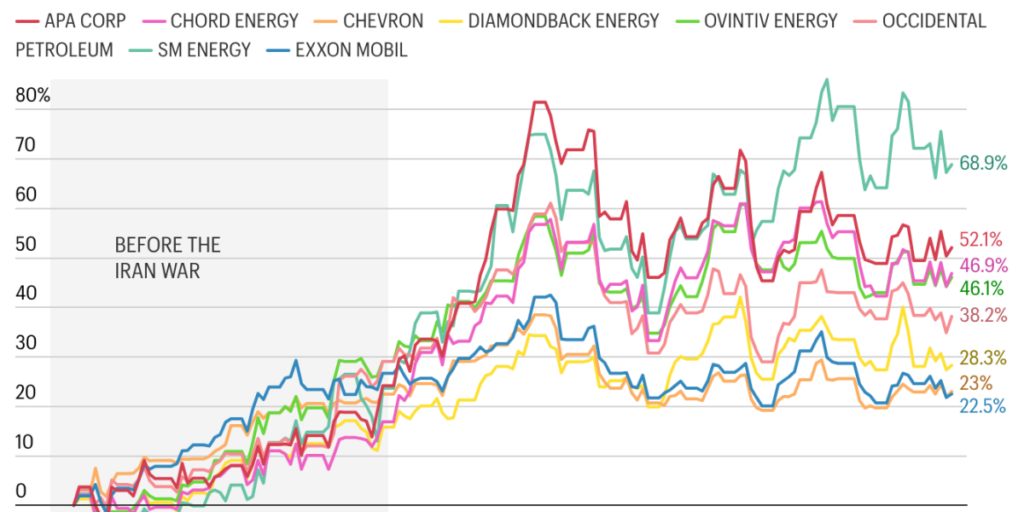
Consumer frustration may be running high as drivers pay well above $4 a gallon at the pump, but the big winners from the Iran war are U.S. oil producers and refiners whose profits and share prices have soared. The stock values of leading U.S. oil players have jumped 20%-70% this year as crude prices and demand spiked—many near all-time highs—and analysts think the rally may not be fleeting.
Beyond the war-driven boom, executives and analysts point to rising global oil demand to replenish or build up strategic reserves as well as greater reliance on Western Hemisphere supplies amid growing geopolitical unrest in the Middle East and other hot spots. Those trends could keep prices higher than expected into 2027 and even 2028, they said.
“I do think you’ll see this country and this hemisphere become a more important part of the global energy system,” Chevron Chairman and CEO Mike Wirth said June 12 in Houston at a Bloomberg energy event. “The U.S. and the Americas are very well set up with strong energy resources and a lot of access to blue-water ports,” he added, noting they avoid risky chokepoints such as the now-infamous Strait of Hormuz.
Chevron and Exxon Mobil shares are both up about 22% this year. And if not for some of their production volumes in the Middle East remaining disrupted, those gains would likely be higher. Both storied Big Oil giants hit all-time stock market highs in late March before the initial ceasefire agreement with Iran knocked some of the war premium out of oil. Exxon’s market cap now sits well above $600 billion, while Chevron tops $370 billion.
U.S. shale producers are riding the wave even more. Shares of Ovintiv, Chord Energy, and APA Corp. have all climbed close to 50% year to date. SM Energy, which recently grew by acquiring Civitas, has surged nearly 70% since Jan. 1. Refiners that churn out gasoline and jet fuel, such as Marathon Petroleum and Valero Energy, are up about 60% amid high profit margins.
Liquefied natural gas (LNG) exporters are booming too. The upstart Venture Global has rallied over 90% this year, while LNG pioneer Cheniere Energy has jumped about 25% near record highs.
Longer-term trends
Even with oil and fuel prices elevated, crude has not spiked to the nearly $200-a-barrel level feared during the greatest energy supply shock in modern history.
Ironically, that resiliency of the energy markets may keep energy prices higher for longer—potentially well into 2028, said Rebecca Babin, senior equity trader for CIBC Private Wealth.
Ever since the first pseudo-ceasefire was announced in early April, energy markets have leaned heavily on emergency reserves while becoming “numb” to chaos and clinging to optimism of a permanent peace deal, she said. Those reserves are still being depleted to dangerously low levels, and refilling them will take even longer on the back end, keeping prices higher for longer.
“We didn’t get the spike to $150, $200 [oil] and, in a way, that’s made this conflict even more bullish for the longer end of the curve,” Babin said.
And she agreed that U.S. barrels will be more highly valued going forward. “There is probably a bigger pull on U.S. barrels because I want to have that secure barrel without a lot of risk premium built in.”
If anything, Wirth said, many countries will want to build their emergency reserves even higher after the war, desiring a larger safety net and greater redundancy, putting even more demand on oil barrels.
Oil prices have remained lower than feared—although still high—because of rising U.S. crude exports from the U.S. Strategic Petroleum Reserve (SPR), much smaller Chinese imports, and conservation efforts in other countries. More volumes sneaking out of the Middle East via pipeline and the Gulf also are contributing.
Relying on emergency reserves means the nation’s SPR is shrinking to its lowest volumes since 1983 this week.
As of June 5, the administration has drained 66 million barrels and counting from the SPR since the war in Iran began, according to the Department of Energy. Trump has authorized the overall release of 172 million barrels over several months. The companies buying the barrels are pledging to replenish them.
There is now a greater belief that the world may require more oil in the years ahead before oil demand eventually peaks amid rising electric vehicles and electrification. Many of the top oil producers are realizing they need to invest more—not less—in global exploration, said James West, Melius Research energy analyst.
“We’ve underexplored for a decade, and now we’re finally seeing exploration budgets get bumped up,” West said. “Some of the big explorers out there like Chevron, Exxon, and BP are now looking for the next big play.”
The post Pump pain, Wall Street gain: Iran war sends U.S. oil profits, stocks soaring as the big winners appeared first on Fortune.