More than three decades after a diagnosis of Type 2 diabetes, Michelle Caldwell says her disease is better controlled than ever.
She keeps regular appointments with her endocrinologist, primary care provider, dietician and pharmacist at MLK Community Medical Group, the outpatient arm of MLK Community Healthcare.
She picks up weekly produce deliveries in the South Los Angeles hospital’s cafeteria and attends its occasional cooking classes. She has learned to decode nutrition labels and developed a taste for salads and nuts.
Just one hurdle remains: the shoes.
Diabetes can damage foot nerves, making it easier for patients to miss small scratches and wounds that could lead to serious infections. Her care team was gently urging her to switch to supportive, closed-toe footwear.
But Caldwell loves a sandal, and the podiatrist-approved options were crimping her style.
“It doesn’t have to be, like, fashion fashion,” she said with a laugh during a recent visit with primary care provider Dr. Edward Cardenas at his East Compton office. But were there any options that didn’t look like “Frankenstein feet”?
That down-to-the-toes level of care is a feature of a program that has transformed the way MLK Community Healthcare treats diabetes, a chronic condition that affects one in every six South Los Angeles residents and nearly a quarter of MLK’s outpatients.
Four years after MLK launched an intensive management program for the most at-risk patients, more than 80% of enrollees have seen blood sugar levels decline. More than 70% have brought their blood pressure under control.
And diabetic-related amputations — which are painful and life-altering procedure that were the hospital’s most common surgeryfor years — have plummeted to zero for program patients.
No novel medications or treatments are behind these results, said Dr. Jorge Reyno, MLK’s senior vice president for population health.
Rather, a relatively modest one-time grant has allowed the hospital system — whose service area includes some of L.A.’s poorest and most disadvantaged neighborhoods — to provide the same level of care for its diabetic patients that people in wealthier areas would expect as standard.
“What we’ve demonstrated here is that we can get best-in-class care — we can even beat national benchmarks for care — if there’s the appropriate commitment and investment. And that people’s health doesn’t have to be determined just by their zip code,” Reyno said. “Because what we’ve created here is not necessarily incredibly innovative. It’s just what needs to be available — and is available in other locations.”
Some 1.3 million people live in MLK’s South Los Angeles service area. More than 90% are Black or Latino, and nearly 70% are either uninsured or have health coverage through Medi-Cal, Medicare or both.
Medi-Cal’s low provider payment rates is one reason South L.A. has only one-third of the full-time physicians necessary to treat a population of its size — a 1,500-doctor shortage, according to MLK’s research.
For many locals, MLK’s emergency department is about the only place they can see a doctor, given the challenge they face securing a timely appointment with a physician who accepts their health coverage.
Roughly 123,000 patients arrived last year at the hospital’s emergency department, which was designed to treat 40,000 people annually. About 40% were seeking primary care.
Emergency room physicians were diagnosing diabetes in severely ill people who did not know they had the disease and treating life-threatening complications for those whose disease had long gone unmanaged.
Patients arrived with gangrenous foot wounds that harried providers elsewhere brushed off as athlete’s foot. Rates of diabetic ketoacidosis, a life-threatening complication that occurs when insulin levels are so low that cells can no longer convert glucose into energy, were three times that of the rest of Los Angeles County.
For many, care arrived too late to prevent one of the disease’s most serious complications: amputation.
Nerve damage means a blister or pebble in the shoe can go unnoticed until it creates a serious wound. High blood sugar impairs immune function and narrows vessels that carry oxygen-rich blood, making it harder for skin to heal. Once serious infection sets in, amputating a foot or limb may be the only option to save a patient’s life. Across the U.S., diabetes complications are responsible for roughly 80% of all non-trauma related amputations, according to the Centers for Disease Control and Prevention.
Broaching amputation with a patient “is really tough,” Cardenas said. “You’re taking such a big part of them away. It’s identity, it’s confidence, it’s [the] ability to walk and do things for themselves. It’s a huge, huge thing.”
It’s also costly. Diabetes cost $306.6 billion in U.S. direct medical spending in 2022, the most recent year for which numbers are available, and foot ulcer-related issues were responsible for about one-third of that, said Dr. David G. Armstrong, director of USC’s limb preservation program and the Southwestern Academic Limb Salvage Alliance.
Indirect costs are also steep. One study of post-surgery outcomes found that only about one-third of patients were able to return to work after the amputation surgery, despite an average age of 54.
“The economic ramifications aren’t just the fact that you’re not working. It’s also that people in your family are taking off of work to be able to help accommodate this, or having to provide extra resources that they previously weren’t having to, so it has sort of a multi-generational effect,” said Dr. Caitlin Hicks, a vascular surgeon and director of research at Johns Hopkins University’s Multidisciplinary Diabetic Foot and Wound Clinic.
In California, the households most likely to bear that cost are those that can least afford it.
Diabetic residents in MLK’s service area and other economically impoverished parts of California were more than 10 times more likely to have a toe, foot or leg amputated than diabetic people in more affluent areas, according to one 2014 UCLA study.
“The finding that residents living in lower income areas bear a disproportionate share of disability and disfigurement from amputations is deeply disturbing in a society that espouses equality and outspends all other nations on health care for its more affluent citizens,” the paper’s authors wrote.
It was a problem MLK decided to do something about.
The hospital secured a $2 million grant from the Good Hope Medical Foundation, a private foundation based in Pasadena, with additional funding from the Rose Hills Foundation and L.A. Care Health Plan.
In October 2021, it began officially enrolling patients in its Diabetes Management Center of Excellence. Within this was an intensive-management program for a subset of high-risk patients, including those with Type 1 diabetes, gestational diabetes or hemoglobin A1C levels — an indicator of blood sugar — at 9.0% or more. (For people without diabetes, a level below 5.7% is considered normal.)
For the most part, the system already had the endocrinologists, nephrologists and primary care physicians it needed. The money let MLK build a network of dedicated support staff who could take care of diabetic patients outside the exam room.
Between visits, patients in the intensive-management program had access to a clinical care pharmacist who reviewed and coordinated medications; a diabetes educator who walked them through blood sugar monitoring, meal planning and other daily concerns; community health workers who could make home visits; and a nurse care manager who served as their primary advocate and point of contact.
Through the hospital’s Recipes for Health program, they could pick up weekly bundles of fresh produce and take bimonthly classes on diabetic-friendly recipes.
They were more likely to stick to their treatment plan, and had more time at doctor visits to discuss medical issues.
“We have multiple people reaching out and interacting with the patients in between physician visits,” said MLK endocrinologist Dr. Megan Jacobs. “They have someone reaching out to them [and] talking to them about the social aspects of things — how they have to take into account their diabetes when they go out to dinner and when they’re at a party.”
By year three, 66% of patients in the intensive-management program had lower blood sugar levels than they did at enrollment; by the fourth year, 81% did. In the third year 63% of patients had brought their blood pressure under control, rising to 71% the following year.
Four years after the program started, appointment compliance hit 84%, up from 50% at baseline. The hospital’s most severely diabetic patients were hospitalized for diabetes at less than half the rate of the area’s general population.
Most significantly, amputations among the intensive-management group dropped to virtually zero.
Over the course of four years, only one of the 1,165 patients in the high-risk group required an amputation. The surgery took place less than a month after their enrollment, indicating they likely entered the program with a wound at critical levels.
Diabetic-related amputations and wound care are now MLK’s third-most common type of surgical procedures, after holding the top spot since the hospital’s 2015 opening.
“This is absolutely, positively spectacular,” USC’s Armstrong said of MLK’s results. “This is life affirming stuff.”
The primary grant ends next year. After that, the program’s future is uncertain.
MLK is eligible to reapply to the Good Hope Medical Foundation, which has been “very happy” with the program’s outcomes, said Howard A. Kahn, the foundation’s chair.
The hospital is also talking to L.A. Care, the largest publicly operated health plan in the U.S., about a potential partnership, Reyno said. It could be a win for both sides.
“The benefit of cost savings usually goes to the state Medicaid plan or to the insurance carrier, who doesn’t have as high a cost to pay,” Reyno said. “If a program like this could be replicated in other safety net communities and have a wider impact, then certainly the return on investment would be even greater.”
Care providers also said they see improvements the data doesn’t capture.
“I hear [patients] say, ‘Oh, I walked to the park with my grandchildren,’ or ‘I was able to move around because I’ve lost the weight’ … maybe they had a sore on their foot that was kind of questionable, [and] ‘Now it’s healed because my sugars are under control,” said nurse care manager Monica Garcia. “Just seeing the benefits when they are compliant is the satisfaction.”
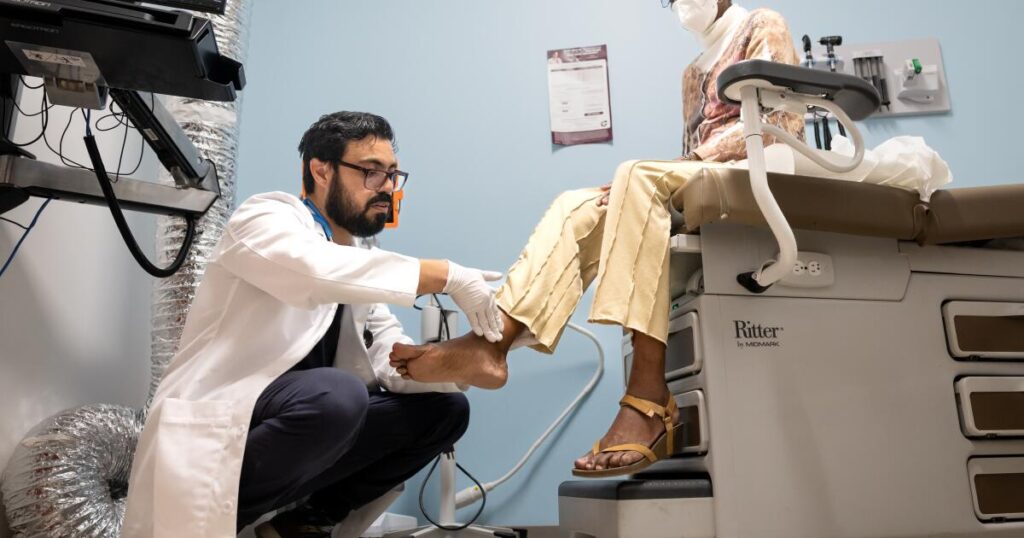
Back at the clinic office in East Compton — the shoe issue set aside for now — Cardenas examined Caldwell’s feet and lower limbs.
The doctor was optimistic that Caldwell’s recent discomfort came from tight muscles, rather than nerve damage, and recommended a stretching and strengthening regimen.
“It shouldn’t be painful, just like a tug,” he said, demonstrating a standing calf stretch. “If you like, I can refer you to physical therapy as well.”
Having providers take the time to explain her disease, rather than just scribbling out prescriptions, has made a world of difference for Caldwell, she said.
“It’s an awesome experience. I’ve changed my eating habits, I’m learning to read labels more clearly,” she said. “Even at my age, you think you know, but you don’t know.”
The post New MLK hospital program brings amputations to zero for at-risk diabetic patients appeared first on Los Angeles Times.