So this is how it feels.
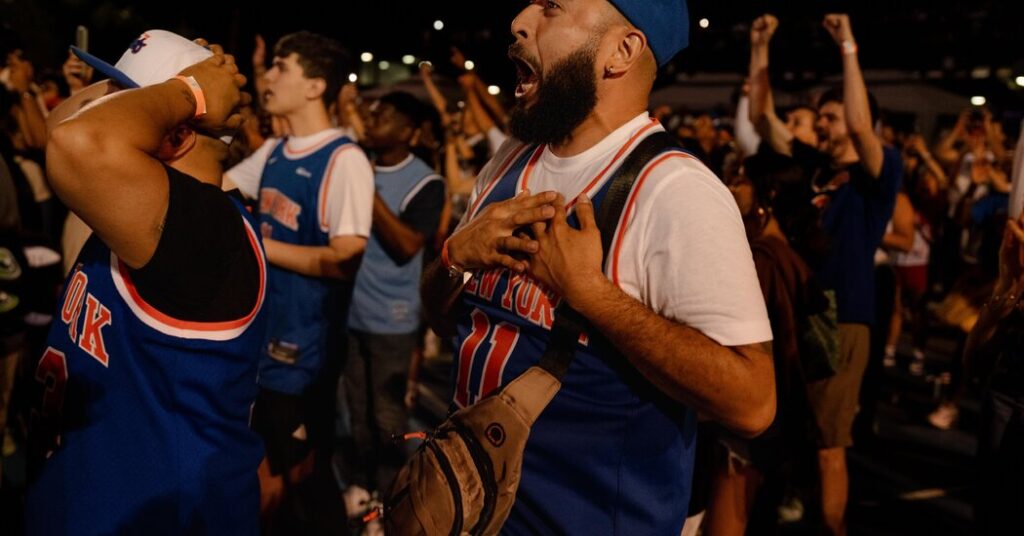
It is giggling, weeping, spinning, convulsing, mosh-pitting, truck-honking, law-skirting, trumpet-playing, cowbell-ringing, off-key-singing, cigar-lighting, all-night-ing — remembering to remember it all, as if Knicks fans would ever forget.
It is hugging strangers so hard they go airborne, fist-bumping cabbies as they crawl through concrete delirium, high-fiving kids on shoulders (and adults on shoulders), climbing stoplights and trees and scaffolding to wave the team flag higher, swiping utility cones and wearing them as hats because they are orange.
It is tears blotting the pavement outside Madison Square Garden, where New Yorkers had for generations walked off disappointment after debacle after heartbreak after OK-that’s-just-cruel.
It is kick-lining together to Sinatra in a Broadway bike lane (“Start spreading the newwwwws …”) as a man nearby stands on a bus-stop bench to make an announcement to no one and everyone in particular (“Ladies and gentlemen! We have just witnessed historyyyyyyy!”) — and it is the whole block calling back with the primal, guttural screams that stir dogs and babies and civilizations and memories of relatives who would have loved this team.
“NEW YORK KNICKS! NEW YORK KNICKSSSSSSSSSSSSS!”
This is how it feels.
Across the mostly miserable, often shambolic, occasionally thrilling, perpetually faith-testing 53 years between Knicks championships, fans had naturally wondered what it might be like to celebrate the team the city cared about most, just once, as other places with beloved teams had done many times over.
This was always the wrong question, its premise rejected ecstatically early Sunday morning amid the car-roof-surfing and the firecrackers and the prepubescent children cursing vanquished Knicks opponents and the empty champagne bottles discarded on sidewalks still vibrating when the sun came up.
It would always be different here because New York is its own thing — for its size, its breadth, its indomitable self-regard — a city experienced maximally, in close quarters, for those fortunate and masochistic enough to try.
It is different because basketball is the city’s game, the province of jangling metal backboards and Rucker Park and game-to-11-ones-and-twos and “Bacon Egg & Threes” T-shirts and a man with an orange-and-blue mohawk skipping like a boy at recess on Sunday morning as a woman with an orange-and-blue handkerchief twerked with scores of new friends atop a flatbed truck.
It is different because, for all its mashed-together brilliance, so little about this city is felt universally: It is rich and broke and Mets and Yankees and pitiless and bighearted and enormous and never smaller than it has seemed lately, when it thought that it might get to see something that so many Knicks fans believed they would never see before they died.
It is different because New York’s mass unifying events tend to imply unbearable tragedy: 9/11, Sandy, Covid.
Maybe the disorientation of this championship run was that shared experiences in the city were allowed to be good, gleeful, uncomplicated.
“History,” a police officer at a Sixth Avenue barricade said quietly, allowing that he had been sneaking midgame peeks at his phone when his bosses weren’t looking. “You’re here. Enjoy it.”
“It’s pure — there it is!” Bill Bradley, the Hall of Famer from the last title team, had said from his watch-party chair after the Knicks won Game 1. “The ball either goes in or it doesn’t. There is no ambiguity and no doubt about what has just happened.”
By Sunday morning, there remained, in these hallucinatory streets, at least some doubt about what had just happened, even if fan overconfidence has been a hallmark of this year’s playoffs.
“Knicks in four!” they shouted all month, until they lost Game 3.
“Knicks in five!” they echoed on their way out of Madison Square Garden that night — and finally, with accuracy and not aspiration, across the boroughs early Sunday morning, clanging the walls and the garbage trucks and the ceilings of subway cars.
Yet this moment would never belong chiefly to the loudest content creators filming themselves on Seventh Avenue, the rowdiest revelers mounting taxis and police vans just because.
This was a night for the quieter obsessives who could only watch games alone (for everyone’s sake) and who never doubted even when they absolutely doubted; the lifers who will tear up one day thinking about this team (and tear up today thinking about tearing up one day); the new locals enshrined now as proper New Yorkers; the pre-kindergarteners nibbling the orange and blue bagels packed into their lunchboxes recently.
“Very happy,” a bleary-eyed 5-year-old named Albie, roused by his parents to join the postgame party in Brooklyn, said from his father’s arms, with a finger raised skyward.
It has helped that the players seemed to understand the city as well as the city sought to understand them.
Their best player, Jalen Brunson, was small (for basketball), underestimated (by his last team), conditioned (by his father, a former Knick) to know that winning here would mean more than winning anywhere else.
Their best play — a sideways-flying, logic-defying, game-winning tip-in by OG Anunoby in Game 4 — seemed to bronze itself, midair, into a future statue whose plaque would say something authentically moving about New York relentlessness.
“We reflect all our fans and their lifestyles,” Karl-Anthony Towns, the center who grew up across the river in New Jersey and came to be known as “Bodega KAT,” had said earlier in the series, “and what it takes to make it in New York City.”
New Yorkers do accept a certain baked-in misery in the name of all that make-it-here-make-it-anywhere business: The rent is too high, the train too creaky, the rat population too resilient.
For most of the city’s modern history, the Knicks were part of that bargain, a dismal constant amid constant change.
There is the tedious trope about the New York minute. What of the New York 53 years?
This place has cheated bankruptcy, built (and rebuilt) towers, raised Jay-Z and J. Lo and J-Seinfeld. It has been told to drop dead and refused. It has elected a billionaire and a socialist and a Bill de Blasio. It has processed Donald Trump as a 20-something curiosity, a chattering pooh-bah, a steak salesman, a defendant and a president whose attendance in Game 3 had Knicks maniacs of all political persuasions wondering about an executive curse.
But then, this jinx-defying, life-giving, preposterous Knicks season has had a way of bending space, time, memory.
Did they really not lose for a month and a half there?
Could they actually rattle the Spurs’ French giant, Victor Wembanyama, who sketched calmly in Gramercy Park between games?
Why were reasonable people, levelheaded people — people with families and careers and pensions and perspective — declaring these the greatest nights of their lives?
Maybe the sexagenarians felt like kids again because that is what they were when the team last won a title.
Maybe the millennials felt like kids again because they were teleported to the 1990s, when the team last made the finals and the weathered faces now dotting the Garden crowd — Ewing, Starks, Houston, Sprewell — were pasted onto their walls.
Or did everyone feel like a kid, at least a little, because this whole thing started to feel something like magic — the divine bounces, the miracle comebacks, the unstoppable joy?
And who but a kid could think like that?
“Remember!” a T-shirt vendor hollered outside a Sixth Avenue halal cart early Sunday morning, flapping his wares at the believers. “Remember today!”
Bernard Mokam contributed reporting.
The post Knicks Give Their City Something New: Impossible Joy appeared first on New York Times.